
One Data Indonesia: Minister Urges Easier Data Sharing Between Agencies
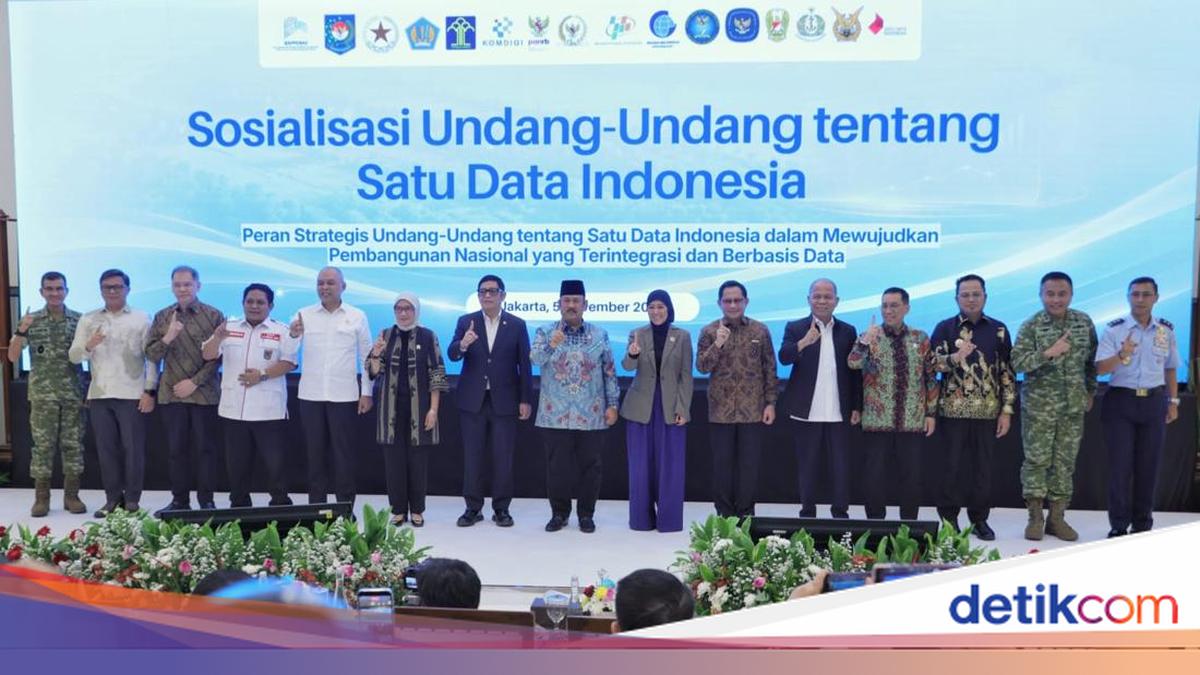
Data is not merely a set of figures; it provides the basis for policymaking and requires good governance. One Data Indonesia therefore plays an important role by promoting data with clear sources that meets common standards and can be accessed and shared.
Minister for Administrative and Bureaucratic Reform Rini Widyantini said One Data Indonesia and Digital Government were not separate agendas, but complemented each other in delivering better public services.
“Digital Government, meanwhile, uses that data to provide services that are increasingly integrated, faster and more proactive in responding to people’s needs,” Rini said in a statement on Thursday (5 November 2026).
She made the remarks at a briefing on the One Data Indonesia Law at the Ministry of National Development Planning (Bappenas) building in Jakarta on Thursday (5 November).
Rini likened data to oil: it must be discovered, processed and checked for quality before it can be used. Data also requires good governance to deliver its full benefits.
“If data is the oil, Digital Government is the network that channels its benefits to the public,” she said.
The foundations for this network have been built gradually and consistently through Presidential Regulation No. 95 of 2018, Presidential Regulation No. 132 of 2022, Presidential Regulation No. 82 of 2023, and the One Data Indonesia Law.
As the ministry coordinating national policy on Electronic-Based Government Systems (SPBE), the Ministry of Administrative and Bureaucratic Reform is committed to ensuring that One Data Indonesia and Digital Government progress in tandem, so high-quality data can be turned into increasingly integrated services for the public.
Rini said One Data Indonesia aims to establish data governance that is standardised, connected and sovereign. An important improvement under the framework is to make data sharing between agencies easier, without requiring a separate memorandum of understanding or cooperation agreement, provided it takes place within the One Data Indonesia framework and complies with data-security standards and classifications.
“Making things easier for agencies must ultimately benefit the public as well. We want to move towards the once-only principle, so people do not have to submit the same data repeatedly when accessing government services,” she said.
The success of the One Data Indonesia Law, she added, would depend on a shared commitment to translate it into the way government operates. Rini urged stakeholders to ensure that stronger data governance went beyond regulation and produced changes that people could actually feel.
“Good data ultimately leads not only to more accurate policies, but also to better services for the people,” she said.
National Development Planning Minister and Bappenas head Rachmat Pambudy said that accurate data obtained quickly was the starting point for the best possible national development. He also thanked the House of Representatives (DPR) and the partners involved in drafting the One Data Indonesia Law.
“Let me express my deepest gratitude, particularly to the DPR and its partners who drafted and designed the law, the Ministry of Home Affairs, the Ministry of Communication and Information, the Ministry of Administrative and Bureaucratic Reform, and everyone involved in its preparation,” he said.
Data, he added, was not merely government property but a strategic national asset and a resource for the future.
Communications and Digital Minister Meutya Hafid said public-sector electronic-system operators had an important role in implementing the One Data Indonesia Law and translating policy into reliable, secure and sustainable digital services.
Each agency must appoint a person responsible for data, adopt interoperability standards and clarify whether it acts as a controller or processor of personal data. Authorities and responsibilities must also be clearly defined to ensure the government retains control over the data.
The Ministry of Home Affairs, meanwhile, is responsible for strengthening governance so that integrated, secure and high-quality data is used for policy, development planning, budgeting and well-targeted public services.
The ministry’s support for One Data Indonesia includes data interoperability; data security and protection; use of population and civil-registration data; stronger regional financial data; integration of Regional Government Information Systems (SIPD); and implementation at regional level and in development planning.
“The Ministry of Home Affairs fully supports One Data Indonesia,” Home Affairs Minister Muhammad Tito Karnavian said.
DPR Legislative Body chairman Bob Hasan said the One Data Indonesia Law established five pillars: data sovereignty, integration without centralisation, a single reference point (the National Basic Data), data security and accountability. He said the law was not merely about technology and bureaucracy, but also about citizens’ rights, and that at least five public rights and interests must be safeguarded.
“Let us work together with the government to implement this law calmly and faithfully, and ensure that we comply with it, so that the message of ‘One Land, One Nation, One Language’ is joined by One Data Indonesia,” he said.
Source: jawawa.id (https://jawawa.id/newsitem/one-data-indonesia-minister-urges-easier-data-sharing-between-agencies-1793872388)
Originally published by detikcom (https://news.detik.com/berita/d-8739824/satu-data-indonesia-menpan-rb-dorong-kemudahan-berbagi-data-antarinstansi), translated from Indonesian