
Once They Crossed the Sea to Buy Sandals; Now They Can Order from Their Pillows
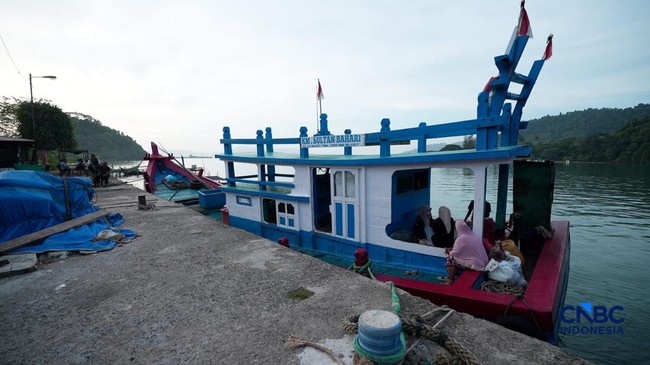
At the Gampong Lampuyang pier on Pulau Breueh, Aceh, dozens of residents wait under the midday sun, with temperatures reaching 30 degrees Celsius, at around 2pm local time.
Their eyes occasionally turn towards arriving boats. For some, a boat’s arrival may be an ordinary sight. But for residents waiting for their orders, it brings the small pleasure of something they have been looking forward to from across the sea.
Boats sailing from Ulee Lheue port in Banda Aceh now carry more than passengers and daily necessities. They also bring sacks of eagerly awaited online shopping parcels. Inside are clothes, hijabs, sandals, jars, food, cosmetics, motorbike spare parts and household goods ordered by phone.
On Pulau Breueh, the parcels carry more than goods. They bring smiles, happiness, hope and a sense of care, as well as gradual changes to daily life on an island a two-to-two-and-a-half-hour boat journey from Banda Aceh.
Lampuyang pier is one of three major piers on Pulau Breueh. The other two are Gugop and Seurapong.
Breueh residents smile as they await their parcels
Salwa could not hide her excitement when she learnt that her order had arrived.
When CNBC Indonesia met her at Lampuyang pier last September, she hurried to look through the pile of parcels at the end of the boat.
The high-school student had ordered clothes and a hijab from an online shop. Shopping online is much easier for her, she said, because there is a wider range of goods and prices can be lower.
“Because it’s cheaper and there’s more choice,” she said briefly.
Salwa only started shopping online this year, but she is already used to browsing products on her phone. Instead of crossing to Banda Aceh, she can choose what she likes and wait for it to arrive by boat.
For many Indonesians living in large cities, the convenience of online shopping may seem unremarkable.
But on an island such as Pulau Breueh, where shopping options are limited, being able to choose goods independently at a price that fits one’s budget represents a meaningful change.
Marmub, a 13th-grade high-school student, has found similar benefits. He often orders motorbike spare parts and items related to his hobbies. Online shopping is his preferred option because it offers plenty of choice.
For young people on Pulau Breueh, the internet is opening up access to things that were previously difficult to reach. The world of shopping no longer ends at the shops across the sea.
No longer spending a whole day shopping
Rahmi, a mother of two who now regularly shops online, has also felt the change. The greatest benefit, she said, is not only the wider choice of goods, but also the time and money saved.
Rahmi remembers how difficult it was to shop in Banda Aceh. She had to leave home and her work in the fields, cross the sea, then continue by rickshaw to find what she needed.
“In the past, if we wanted to buy something, we had to go to Banda [Aceh]. We had to spend the whole day. The boat alone cost Rp60,000, and then we still had to take a rickshaw to the shops and pay for food,” she said.
The boat fare was Rp60,000, food cost about Rp40,000 and transport in Banda Aceh around Rp150,000. The total came to approximately Rp250,000, not including the cost of the goods themselves.
For a family, that is no small expense. The trip also took up valuable time and meant leaving work in the fields undone.
Now, those habits have changed.
“Now I just open my phone and buy things. I can go to the fields or play with the children at home. I just pick the goods up from the boat,” Rahmi said.
Her simple words describe a major change in residents’ everyday lives. Shopping that once required a long journey can now be done from home, even while lying back on a pillow. Time previously spent travelling can be used for work and family.
Sacks of parcels and trust at sea
Behind this convenience is a simple system that gets parcels into their owners’ hands.
Deliveries are usually put into sacks and placed at the end of the boat. There is no elaborate security system or lengthy handover process. The parcels wait there until their owners collect them.
Muyasir, a 43-year-old crew member, is among those who help ensure the deliveries arrive safely. He said parcels may be left on the boat until the following day, or until it is about to depart at around 8am.
Another crew member, Syahrir, said online shopping had become popular over the past three years.
“There were a few orders five years ago, but it has only really become busy in the last three years. On this boat, we can carry three sacks a day—probably hundreds of parcels. At Lebaran, it can reach 10 sacks,” he said.
If owners have not arrived to collect their goods, crew members leave the parcels at a nearby stall. If they are still uncollected, the parcels are taken back to Banda Aceh and left at a stall in the Ulee Lheue area.
The system works primarily through trust and goodwill.
The parcels are not just piles of goods in sacks. They contain items that have been paid for, family necessities and orders someone at home is eagerly awaiting. Although crew members do not always meet the owners in person, they do their best to ensure nothing goes missing.
More unusually, the boat parcel-delivery service is free.
“Sometimes someone gives us Rp5,000, but many don’t. We do it willingly,” Muyasir said.
His boat typically carries around three sacks of parcels a day. The number rises ahead of Lebaran, when residents begin ordering more goods for the holiday.
Amid the changes brought by technology, the tradition of helping one another remains. Online shopping depends on internet access and digital platforms, but parcels still make their final journey to residents through people who trust one another and act with goodwill.
Unlike in many other areas, couriers do not deliver directly to buyers’ homes on Pulau Breueh.
Salwa told CNBC that online sellers or couriers notify her by phone when an item is due to be sent, along with a photograph.
“Usually it takes two or three days. They’ll photograph the item and tell us which boat it’s being sent on. We go to that boat when it arrives,” she said.
Online shopping creates business opportunities
The growth in online shopping has also created new business opportunities on Pulau Breueh. Limited access to financial services means some residents need help paying for their orders.
Muslih saw an opportunity in this demand. He offers mobile top-ups and data packages, money transfers, and assistance with online shopping payments. Similar services are becoming more common on Pulau Aceh, which has a population of about 3,100 according to the data used in this report.
“Someone comes in every day. Sometimes there are five people. The extra charge depends on the [value of the] goods,” he said.
Residents most often order clothes, shoes, sports equipment and household necessities. Orders become more varied ahead of Lebaran, ranging from jars to other items needed for the holiday.
Muslih said he charges Rp3,000 for parcels worth Rp50,000–100,000, Rp5,000 for those worth more than Rp100,000, and generally Rp15,000 for orders above Rp150,000.
The parcel-payment service is not his main business, but it is popular.
He said improved mobile and internet connections had made the service easier to provide.
“Before 2019, the signal was poor. Now it’s much stronger,” he said.
For Muslih, the service does more than help residents shop. It also provides additional income. The digital economy therefore brings not only greater convenience in buying goods, but also new businesses within the island community.
The service has become a source of livelihood for Husnaeni, too. The 36-year-old runs the business to supplement her income after becoming a single parent to two children.
“It’s fairly worthwhile. There’s someone every day. Before Lebaran, it can be 10 people in a day. Some order plates or jars,” she said.
Husnaeni said she had been running the business since 2023, after internet connectivity improved.
Statistics Indonesia (BPS) data show that every village in Pulo Aceh sub-district, including those on Pulau Breueh, can access an internet signal, although speeds vary.
Pulau Breueh, in Pulo Aceh sub-district, Aceh Besar regency, was among the areas worst devastated by the tsunami on 26 December 2004.
Nearly 3,000 people, or 70 per cent of the island’s population, were killed or went missing in the disaster.
The tsunami also destroyed all homes and public facilities, including electricity and communications networks.
Although communications infrastructure has since been built, mobile coverage remains weak. Private operators entered the area in 2012 and the signal began to improve, although many parts of Pulo Aceh remain mobile blackspots.
In 2019, the local government pushed for a major expansion of coverage. The Telecommunications and Information Accessibility Agency (BAKTI) under the Communications and Digital Affairs Ministry built a base transceiver station (BTS) in Alue Raya village.
There are now four BTS towers on the island. In 2022, BAKTI opened 24 internet access points in Pulo Aceh, located at schools and government offices.
According to BPS data, every village in Pulo Aceh sub-district now has an internet signal, although speeds differ.
The sea still separates them, but the internet brings them closer
For residents of Pulau Breueh, shopping no longer necessarily means paying for a boat, leaving work and spending a whole day in Banda Aceh. Mobile phones open access to a wider market, while boats provide the final link, carrying orders to the island.
Compas.co.id data for August 2026 show that 49 online sellers in Aceh Besar regency, including on Pulau Breueh, recorded total sales of 2,179 items, generating revenue of Rp206.6 million. The figures point to substantial online trading activity in the area.
Compas.co.id is an e-commerce data provider that collects sales data from Indonesia’s four largest marketplaces.
The change brought by online shopping may seem small in a big city: a parcel arrives, its owner collects it and life goes on as usual. But for residents who once had to travel a long way across the sea to obtain goods, the convenience means time regained, lower costs and more choice.
At Lampuyang pier, sacks of parcels continue to arrive by boat from across the water. There are clothes awaited by a schoolgirl, motorbike parts for a student and sandals ordered by a mother.
The goods cross the sea to reach their owners. They also carry the changes brought by the internet—and the goodwill of the people who ensure every parcel arrives, even when its owner has not yet come to collect it.
Source: jawawa.id (https://jawawa.id/newsitem/once-they-crossed-the-sea-to-buy-sandals-now-they-can-order-from-their-pillows-1792590713)
Originally published by CNBC Indonesia (https://www.cnbcindonesia.com/research/20261018103955-128-777182/dulu-menyebrang-laut-demi-beli-sandal-kini-tinggal-klik-dari-bantal), translated from Indonesian