
Once Submerged, Three Villages Reappear Amid Extreme Drought
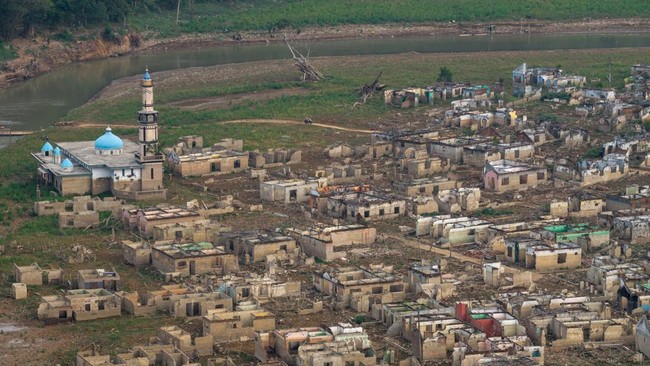
Jakarta, CNBC Indonesia – A prolonged drought affecting several parts of Indonesia in 2026 has led to an unusual phenomenon. Villages and settlements that had been submerged at the bottom of reservoirs for years are once again visible as water levels fall.
The situation comes amid an extreme dry season driven by El Niño. Reduced rainfall has lowered water levels in several reservoirs, exposing the remains of buildings, roads and even graves that were previously underwater.
The re-emergence of these areas has also revealed traces of the lives of communities that had to leave their homes and villages to make way for dam construction.
According to CNN Indonesia, these are three areas in Indonesia that have reappeared amid the prolonged drought in 2026.
1. Somang Village, Banten
Somang Village in Lebak Regency, Banten, is one of the settlements to have re-emerged after the water level at Karian Dam fell sharply. Once a densely populated area, the village began to be vacated in 2023 to allow the reservoir to be filled.
Although residents had left, some buildings in the area were not completely demolished. As a result, when the flow at Karian Dam fell during the 2026 dry season, the remains of the buildings became visible again.
2. Former settlements at Jatigede Reservoir, Sumedang
A similar phenomenon has occurred at Jatigede Reservoir in Sumedang Regency, West Java. Falling water levels have exposed former residential areas that had been submerged for more than a decade.
Jatigede Reservoir began filling on 31 August 2015. Its construction and subsequent filling required people in several villages to leave their homes and land.
On 5 September 2026, the falling reservoir level caused the shoreline to recede by around 300 metres. This exposed paved roads, land and building ruins that had previously been underwater.
3. Old graves at Gajah Mungkur Reservoir, Wonogiri
In Wonogiri Regency, Central Java, receding water at Gajah Mungkur Reservoir has also revealed traces of an area that had long been submerged. Before the reservoir was built, the area was home to settlements spanning 51 villages in seven subdistricts.
The construction of Gajah Mungkur Reservoir between 1976 and 1980 forced thousands of residents to leave their homes. Some took part in the transmigration programme or the bedol desa village relocation programme.
On 9 September 2026, dozens of old graves in Wuryantoro subdistrict, Wuryantoro District, reappeared as the reservoir’s water level fell.
The reappearance of the graves is not a new phenomenon. They usually become visible when reservoir levels fall during the dry season, then are submerged again when the rainy season arrives. In 2026, however, they did not emerge until September, later than in previous years.
Source: jawawa.id (https://jawawa.id/newsitem/once-submerged-three-villages-reappear-amid-extreme-drought-1793595104)
Originally published by CNBC Indonesia (https://www.cnbcindonesia.com/lifestyle/20261102051516-33-781325/dulu-tenggelam-3-kampung-ini-muncul-lagi-imbas-kekeringan-ekstrem), translated from Indonesian