
Once Embargoed by the US, Turkey Is Now an Arms Giant: How It Got There
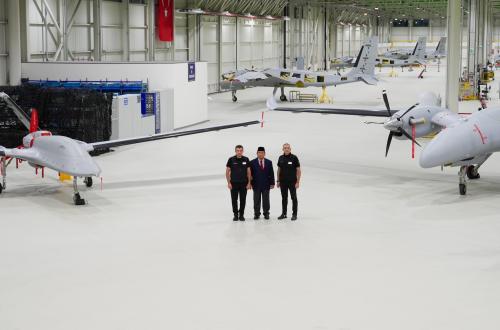
JAKARTA — Turkey’s defence industry has continued to expand, with military electronics company ASELSAN signing a €523 million contract with the Turkish Presidency of Defence Industries (SSB) on Monday (26 October 2026). The agreement is intended to develop next-generation air-defence and missile systems, highlighting Ankara’s sustained investment in building national arms capabilities.
ASELSAN announced the contract through the Public Disclosure Platform (KAP), the system for disclosures by Turkish publicly listed companies. The company has not revealed the name of the system to be developed, its technical specifications or the completion schedule. The contract therefore represents a commitment to technology development, rather than an announcement that new weapons are ready for use.
The latest agreement follows an export contract worth US$442.5 million announced by ASELSAN on Friday (23 October 2026). The deal with an unnamed international buyer covers the sale of radar, counter-drone systems, and command-and-control equipment.
The two contracts, announced within days of each other, illustrate the two strands of growth in Turkey’s defence industry: government investment in domestic technology development and expanding sales to international markets. They also draw attention to how a country that once relied heavily on foreign arms has become capable of producing a range of military systems that are increasingly sought after worldwide.
This resurgence is linked to Turkey’s position as one of NATO’s major military powers. During a visit to Ankara in November 2024, NATO Secretary-General Mark Rutte said Turkey had the alliance’s second-largest army after the United States. NATO reiterated the point ahead of the Ankara summit in July 2026.
That status does not mean Turkey is the world’s second-largest military power or ranks second in NATO across every measure of combat strength. Personnel numbers must be distinguished from technological capability, weapons quality, defence spending, air and naval power, and the capacity to conduct long-range military operations.
The US embargo changed the course of the defence industry
Turkey’s defence industry resurgence cannot be separated from the difficulties it faced over arms supplies in the 1970s. When Turkey intervened militarily in Cyprus in 1974, it encountered serious problems because of its reliance on military equipment supplied by Western countries.
The United States subsequently imposed an arms embargo on Turkey from 1975 to 1978, restricting Ankara’s access to certain equipment and military support. The measure prompted the Turkish government and military to recognise that NATO membership did not automatically guarantee continued arms supplies when the political interests of allies diverged.
According to research by the German think tank Stiftung Wissenschaft und Politik (SWP), the embargo was a significant catalyst for the transformation of Turkey’s defence industry. Efforts to build domestic production capabilities began well before President Recep Tayyip Erdoğan’s government and have progressed through successive policy phases under different administrations.
One of the most important steps was the establishment of ASELSAN on 14 November 1975 to meet national military communications and electronics needs. A study by the Turkish Academy of Sciences says the company began operations with four engineers and one licensed product, before growing into a defence company with much broader research, engineering and production capabilities.
The Turkish government subsequently strengthened the institutional foundations of the defence industry by establishing a defence-industry development agency in 1985, which later evolved into the current SSB structure. The agency coordinates military requirements, project financing, arms procurement and the development of domestic industry.
In the early stages, industrialisation relied on licence purchases, joint production and the gradual acquisition of technology. This strategy gave Turkish companies manufacturing experience before they went on to develop products whose designs and systems were increasingly produced in-house.
Source: jawawa.id (https://jawawa.id/newsitem/once-embargoed-by-the-us-turkey-is-now-an-arms-giant-how-it-got-there-1793062267)
Originally published by Republika (https://news.republika.co.id/berita/tnje8o451/dulu-diembargo-as-kini-turki-jadi-raksasa-senjata-begini-perjalanannya), translated from Indonesian