
Once Dismissed by the Dutch, This Indonesian Engineer’s Work Is Now Recognised Worldwide
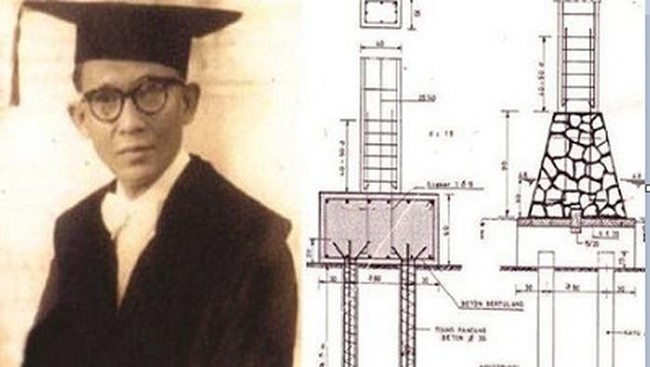
Jakarta, CNBC Indonesia — On this day 117 years ago, Sedyatmo was born. The Indonesian engineer would later become known around the world for inventing the ‘cakar ayam’ (chicken-claw) foundation system. Before gaining widespread recognition, however, Dutch engineers dismissed him, judging his design to depart from the engineering standards of the time.
The story began in 1936, two years after Sedyatmo earned his engineering degree. Mangkunegoro VII entrusted him with building a water bridge in Wiroko village, Wonogiri. The bridge was intended to channel water from the Wiroko River for use by farmers in the surrounding area.
The project was no easy task. The construction site was remote, road access was inadequate, and the surrounding area was filled with venomous snakes. Even so, Sedyatmo pressed on, prioritising efficiency in materials, costs and time without compromising the structure’s strength.
During construction, Sedyatmo also faced disagreement over the bridge’s design. Dutch engineers considered it unconventional because it used thinner concrete than the engineering standards of the time prescribed.
Sedyatmo remained confident in his calculations. He believed the Dutch engineers were too fixated on textbook theory.
‘The strength of the bridge was no less than that of bridges built using conventional formulae,’ said the man born in 1909, according to his biography, Prof. Dr. Ir. Sedyatmo: Intuisi Mencetus Daya Cipta (2019).
During the construction process, Sedyatmo also observed a local tradition. Before work began, he slaughtered a buffalo and buried its head near the project site.
In the beliefs of the local Javanese community at the time, the buried buffalo head was an offering to the spirits believed to guard the place, intended to ensure the construction went smoothly and protect the workers.
In his autobiography, however, Sedyatmo stressed that he did not observe the tradition because he believed in its mystical elements. He did so out of respect for the people involved in the project.
‘Sedyatmo carried out the custom, but not because he shared that belief. He did so solely to reassure the local community and the people helping him,’ the biography quotes him as saying.
Sedyatmo recalled that after the slaughter, residents and workers shared the buffalo meat as a gesture of togetherness. The head was buried because it consisted mostly of bone and was difficult to make use of.
The water-bridge project was completed in 1937. The Wiroko Water Bridge stood firm, demonstrating that Sedyatmo’s calculations were sound despite the earlier objections from Dutch engineers.
The success marked a turning point in his career. Sedyatmo’s abilities caught the attention of Prof. Ir. Bijlaard, a senior official in the Public Works Department of the Netherlands East Indies. Bijlaard asked the bridge engineer to join the department, making Sedyatmo the first Javanese person to work there.
Sedyatmo’s achievements continued. In 1953, according to the newspaper De Locomotief (11 August 1953), he was appointed professor of hydropower at ITB. His most notable milestone came in 1961, when he developed the ‘cakar ayam’ foundation system.
According to the newspaper Berita Yudha (7 February 1985), cakar ayam is a reinforced-concrete slab foundation used on unstable ground. Sedyatmo’s invention later received international patents in more than a dozen countries. He is consequently regarded as one of the most influential engineers in Indonesian history.
Source: jawawa.id (https://jawawa.id/newsitem/once-dismissed-by-the-dutch-this-indonesian-engineers-work-is-now-recognised-worldwide-1792835478)
Originally published by CNBC Indonesia (https://www.cnbcindonesia.com/entrepreneur/20261024122941-25-779128/orang-ri-ini-dulu-diremehkan-belanda-kini-karyanya-diakui-dunia), translated from Indonesian