
Once Discarded, Where Is Sukarno's Handwritten Proclamation Manuscript Now?
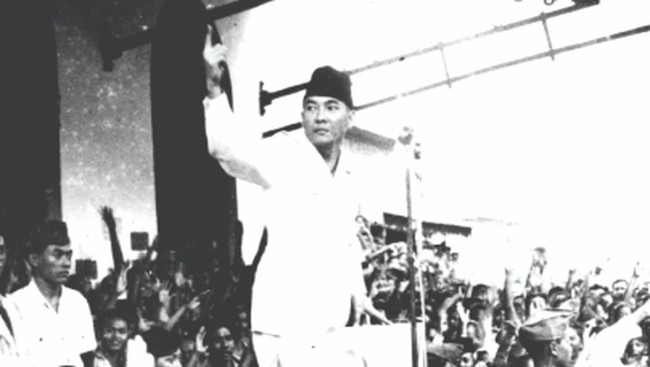
The handwritten draft of Indonesia’s Proclamation of Independence by Sukarno was once on the brink of destruction. After the proclamation text had been typed, the draft paper bearing Sukarno’s handwriting was discarded. Fortunately, journalist B.M. Diah noticed it and decided to save it.
The episode took place in the early hours of 17 August 1945 at the residence of Admiral Tadashi Maeda in Jakarta. Several hours earlier, Sukarno and Mohammad Hatta had returned from Rengasdengklok. Together with Achmad Soebardjo, the two leaders then drafted the proclamation text at Maeda’s house.
A number of young activists were also present at the residence to oversee the drafting process. One of them was B.M. Diah, a journalist who at the time worked for the Domei news agency.
After the wording was completed, Sukarno wrote it out by hand. The draft was then read before the assembled figures and agreed upon. However, the manuscript was not yet the document that would be read out that morning.
Sayuti Melik was then tasked with retyping the text. Once completed, the typed version underwent several changes and was eventually signed by Sukarno and Hatta on behalf of the Indonesian nation.
After the typed text was regarded as the final version, Sukarno’s handwritten draft no longer received attention. The paper was even thrown away. B.M. Diah, who was at the scene, realised that the paper was not merely an ordinary draft. He picked it up and kept it.
“My instinct as a journalist was to take it so that it could be published through the newspaper,” Diah said.
That decision proved to be highly significant. Diah kept the manuscript for decades until he finally handed it over to the government in 1992.
Diah’s role on the night and morning of the Proclamation, however, was not limited to saving the document. Before everyone left Maeda’s house, Mohammad Hatta also tasked him with spreading the news of independence through the Domei news agency network.
“Those of you who work at the Domei office, wire the news of the Proclamation as far as possible to the entire world that can be reached,” Hatta wrote in his memoir Untuk Negeriku: Sebuah Otobiografi (2011).
Diah then sought to relay the news through press and radio networks. He even drafted a news report about the Proclamation and took it to the Siliwangi printing house to be reproduced.
Meanwhile, Sukarno’s handwritten manuscript remained in Diah’s keeping. Only on 19 May 1992 did he hand it over to President Soeharto. The document was subsequently transferred to the National Archives of the Republic of Indonesia (ANRI).
Today, the manuscript is one of the key archives recording the process that gave birth to the Proclamation. There is the typed text that was read out on 17 August 1945, but there is also the handwritten draft that shows how the text was first formulated.
Ironically, the document that now holds immense historical value was once considered unnecessary and thrown away. Had B.M. Diah not picked it up at the time, Indonesia might no longer possess Sukarno’s handwritten draft.