
Once Depressed at Start of Incarceration, Ex-Convict Now Builds Home Convection Business
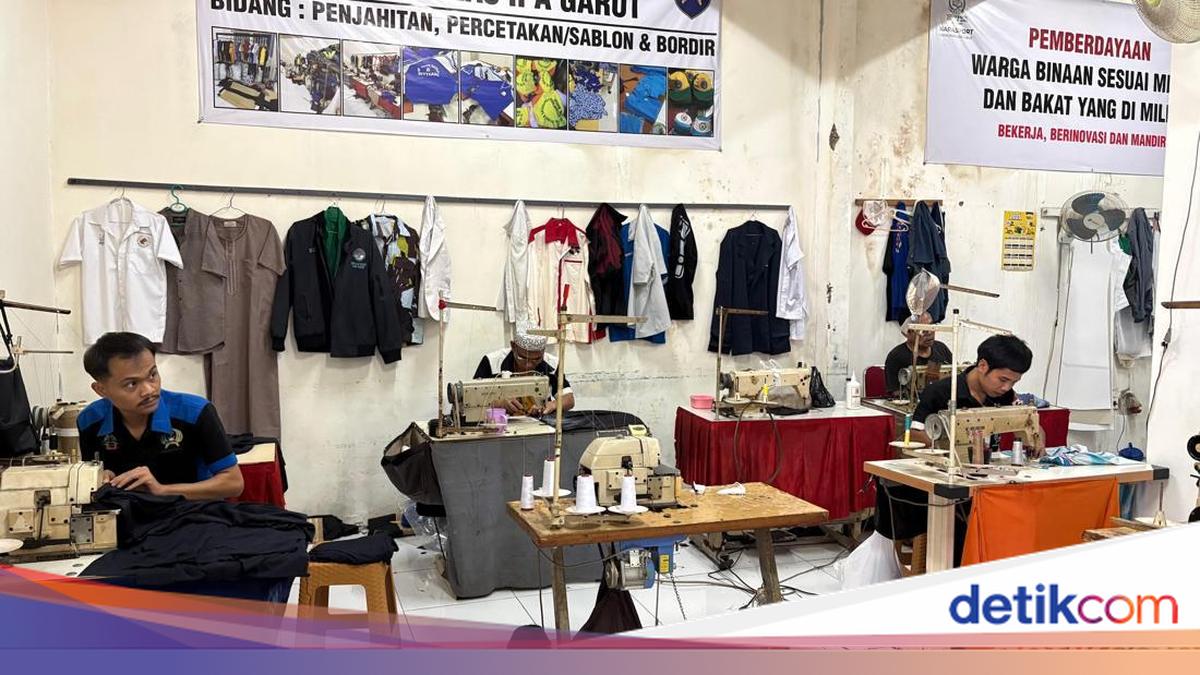
A second-hand sewing machine costing Rp 1.5 million became Fajar’s companion in pursuing his dream of owning a convection business. Two months after his conditional release from the Class II Garut Prison in West Java, he restarted his life equipped with garment production skills acquired behind prison walls.
The machine was bought by his in-laws. From morning until afternoon, he works at a convection business owned by someone else, and only after Maghrib until around 10 p.m. Western Indonesia Time does the sewing machine at home go back to work to complete small orders he receives personally.
“For now I work daily at a convection business, so sewing orders and alterations at home I do after I finish my work at the convection business, for example after Maghrib until 10 p.m. WIB,” Fajar said when met by detikcom in the front yard of the Class II Garut Prison after reporting for his conditional release, Wednesday (19/8/2026).
Fajar recounted that his debut came when a relative asked him to make a full alma mater outfit, complete with a vest and trousers. Fajar only asked for Rp 150,000.
“When it comes to pricing for a relative, I was confused because I am just starting out. I didn’t set a fixed price; the important thing is that people know the quality of my stitching,” he said.
Gradually, Fajar continued, other orders came in. Some asked for clothes to be cut, others needed alterations. Although the value was only Rp 15,000 to Rp 20,000 per piece, for Fajar every garment that came to his home was an opportunity to build a customer base.
From his work at someone else’s convection business and the home convection business he is building, Fajar said he earned nearly Rp 4 million in his first month after release. Entering the second month, in one week he once pocketed more than Rp 1 million, then around Rp 900,000 the following week.
“As for my income from working at the convection business plus taking sewing and alteration orders at home, I probably got nearly Rp 4 million in the first month. In this second month, there was a week when I got more than a million, the next week Rp 900,000,” Fajar said.
He has not used much of the profit for other things. Fajar chose to save it little by little to buy sewing equipment, such as pattern rulers and thread.
“My short-term plan is to attract customers first, to brand the quality of my stitching first. I am still saving the profit for capital, to buy pattern rulers and threads,” he said.
Unable to Sleep Soundly, Haunted by Fear
Fajar entered Garut Prison in October 2021, after previously being detained at the Garut Detention Centre. He was caught up in a case related to the Child Protection Law and received a 10-year prison sentence, plus a fine of Rp 50 million with a six-month subsidiary sentence.
Fajar admitted he was depressed at first because of grim images of life inside prison. His impressions were largely shaped by what he saw on television and in films, plus other people’s stories about prison life.
“Honestly, my first impression of entering prison was bleak. Like what you see on TV and in films — images of violence, of being bullied by fellow inmates. At first, during the two-week orientation period, I slept at most only an hour at a time, woke up, slept another hour, woke up again, full of anxiety. Because previously there were ex-recidivists who scared us, saying prison is like this and that,” Fajar explained.
That anxiety gradually subsided when he began participating in various activities. He spent his first two years taking part in religious activities as a santri inside the prison.
“But it turned out that what I experienced was not like that. After entering, this is my personal experience, what I went through and experienced was beyond my expectations. It turned out to be very humane,” Fajar recounted.
Fajar said at that time he had not thought about joining the work training programme directly. “Maybe because I wanted to repent first,” he added.
After two years, an order came in for the Garut Prison convection workshop, which brought him back to honing his sewing skills. Before his criminal case, the man from Pameungpeuk had worked at his brother’s sewing house in Cikajang.
That ability was known to Sopian. Sopian is a fellow former inmate. Now Sopian is a contract worker at the Garut Prison convection workshop, while also building a home convection business like Fajar.
“Eventually I went to the convection work training because someone invited me, because at that time there was an order for campaign T-shirts. I was invited by Mang Sopian, also a former inmate here, who now has a convection business outside. I joined from there. I continued in the work training. Mang Sopian knew my background in sewing because we often shared about our activities before entering prison, what our jobs were, where we worked,” Fajar explained.
Not Just Learning to Sew
Fajar initially only worked in the sewing division of the Garut Prison convection workshop. However, production needs and regeneration ‘forced’ him to learn more to improve his skills. When the inmate who previously led the convection team was released, Fajar was encouraged to master pattern making, measuring and fabric cutting.
“Here I didn’t just sew. Because I was ‘forced’ to sharpen my skills, I was ‘forced’ to be able to cut fabric, to make patterns for various kinds of clothing. It has been passed down from generation to generation with a leader. When I first entered the convection work training, the leader was a foreign national from China, Mr Si Chan. Because he went home, I was forced to be able to make clothing patterns, to cut, to measure,” he explained.
The word ‘forced’, Fajar continued, does not refer to punishment or intimidation from the prison authorities. It describes the strong encouragement for him not to stop at just sewing fabric.
He said learning to make patterns took about six months. According to Fajar, pattern-making ability is actually an important part of the garment production process.
His responsibilities then grew. Fajar was entrusted with leading eight inmates at the convection workshop. It was at this stage that he felt he learned something new beyond sewing: leadership.
“The inmates I led in the convection work training numbered eight people. Previously at my brother’s sewing house there were three to four workers. So here, besides honing convection skills, leadership and coordination skills were also sharpened,” Fajar said.
He had to understand each member’s abilities, decide who would do patterns, sewing or measuring, while ensuring production targets and quality were met. One test came when they had to complete an order for 1,500 drawstring bags within three weeks.
“The challenge was being trusted to chase targets, first of all. Plus having to maintain quality. I also had to set an example for my friends. I had to know how far each of my friends’ skills had developed. So who handles patterns, who handles sewing, who handles measuring, who handles this and that,” Fajar explained.
To meet the target, Fajar conveyed his colleagues’ suggestion to the prison authorities that the team be allowed to work overtime and sleep in the workshop. Permission was granted. Food was delivered to the workplace so they did not need to return to their cell block during the work. The order was eventually completed.
“Alhamdulillah, thanks to cooperation with my friends and Mr Asep, I also asked permission from the prison governor to be able to sleep in the convection workshop. Alhamdulillah, the order was completed. So we had to be tactical. My friends also suggested asking for overtime to reach the target, and I brought their aspirations to the prison governor. So we didn’t return to the block while chasing that order. At meal times, food was delivered to the convection workshop,” Fajar recounted.
Managing eight people also taught Fajar that chasing targets does not always mean asking everyone to keep working. If an inmate was bored or looked fed up, Fajar let that inmate rest or try learning something new in the prison convection workshop.
“If someone on the team was bored or stressed, my strategy was to tell them to rest first. Or switch processes, for example from sewing to pattern making so they don’t get bored. Switching processes brings a new challenge,” he said.
Confused in the Face of Freedom
Approaching his conditional release, Fajar admitted a new problem arose. He repeatedly thought about what he should do when returning to society.
“Breathing free air, honestly I still felt confused because I had to adapt again to the outside world. For a week I probably did nothing,” he said.
He then remembered Mubarok, an SME actor who cooperates with Garut Prison. Mubarok initially came as a maggot cultivation consultant, but was also interested in the Garut Prison convection SME.
The Head of the Work Training Section at Garut Prison, Asep, said Mubarok later became familiar with Fajar’s abilities. He, Fajar and Mubarok discussed several times the possibility of developing a convection business.
“Fajar was not merely employed at the Garut Prison convection workshop; we invited him to discuss projections for developing a convection business,” Asep said.
Mubarok has a plan to build a convection business with its own production and brand. If it grows, the business is expected to open job opportunities for former inmates, especially those with convection skills.
“Mubarok’s intention is good because he wants his business to become a job platform for ex-inmates, especially those from convection,” said the man who has been an officer at Garut Prison for 21 years.
Returning to Fajar, closing his conversation with detikcom, he mentioned Asep, who in his eyes is not merely a prison officer. To Fajar, Asep is a ‘father’ to the inmates at the convection workshop.
“The prison officer closest to me here is Mr Asep, because he often shares with the inmates about activities inside. If we need anything, for example materials and tools, we talk to Mr Asep. My hope going forward is that the convection work training facility at Garut Prison can have more equipment, more modern equipment,” Fajar concluded.
Source: jawawa.id (https://jawawa.id/newsitem/once-depressed-at-start-of-incarceration-ex-convict-now-builds-home-convection-business-1787194331)
Originally published by detikcom (https://news.detik.com/berita/d-8626495/sempat-depresi-saat-awal-dibui-kini-eks-napi-ini-rintis-usaha-konveksi-rumahan), translated from Indonesian