
Once Criticised, Now Beloved: The Long Drama Behind the Birth of TransJakarta
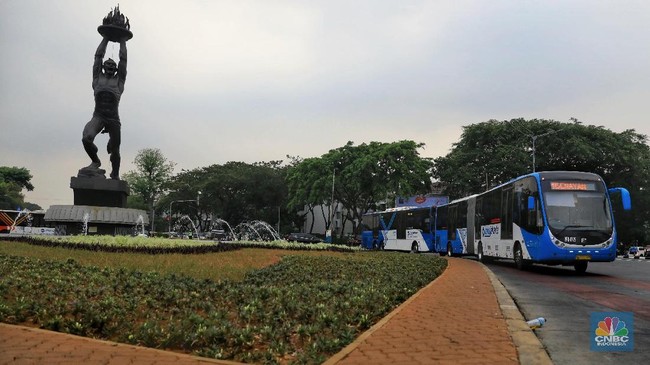
TransJakarta has become one of the primary modes of transport for residents of the capital and its surrounding areas. Millions of journeys are made using this service every day. However, the long journey of TransJakarta did not happen by chance. It all began with the idea of Jakarta Governor Sutiyoso to introduce a bus-based mass transit system amidst Jakarta’s congestion issues.
In 2003, Sutiyoso began pushing for the development of a Bus Rapid Transit (BRT) system, or ‘busway’, in Jakarta. In reality, Sutiyoso was merely continuing an old, failed idea for Jakarta’s transportation. Long before Sutiyoso, the Jakarta Provincial Government had prepared proposals for mass transit during R. Suprapto’s term as governor (1987-1997).
At that time, the local government had conducted 11 transportation research projects and comparative studies in the UK, Canada, and Japan. The proposal was drafted by three officials: the Vice Governor for Economic and Development Affairs, Bun Yamin Ramto; the Director General of Land Transportation, Giri Suseno; and the Director General of Highway Development, Suryatin Sastromijoyo. They designed a light rail system that would circulate around Jakarta, with a route stretching from Cinere, passing through the Sudirman and Thamrin areas, then heading to Ancol and Gunung Sahari before returning to Cinere.
However, the light rail plan never materialised. An alternative option was presented by the Minister of Research and Technology, B.J. Habibie, involving a bus-based mass transit system. Unfortunately, this option also failed to progress, particularly following the 1997-1arr 1998 economic crisis. It was only years later that the bus-based mass transit idea was realised under Sutiyoso.
According to news reports from Suara Karya in 2003, the former military-background governor grew concerned that Jakarta’s congestion would worsen, necessitating immediate mass transit policies. He aimed to achieve this by utilising regional budgets without needing to involve the central government. Sutiyoso looked to the bus system in Bogotá, Colombia, as a model that could be applied in Jakarta. In May 2003, he visited Bogotá to observe the TransMilenio system firsthand.
Upon his return, the Jakarta government formed a cross-departmental team to develop a similar concept. In the vision of Sutiyoso and his team, there would be a bus system with dedicated lanes separated from other vehicles. However, the plan was not immediately accepted. Dedicated bus lanes meant that part of the road space had to be diverted from other vehicles. Concerns arose that the busway would actually reduce space for private vehicles and exacerbate congestion.
Because of this, the development of TransJakarta was not smooth. The operational plan, originally targeted for October 2002, was delayed several times until the first corridor officially began operating on 15 January 2004. The route connected Blok M in South Jakarta to Kota in West Jakarta, spanning approximately 13 kilometres.
In news reports from August 2004, the presence of TransJakarta faced numerous complaints. Some parties argued that the bus lanes actually made road space more limited and triggered congestion, especially since the bus lanes were not yet fully segregated. This aligns with a 2017 research study titled “Improving Mobility in Developing Country Cities: Evaluating Bus Rapid Transit and Other Policies in Jakarta”. The research team revealed that an analysis of travel time changes around BRT corridors found that the system, rather than reducing congestion in busy corridors, actually increased travel times for users of other transport modes passing through the same routes.
This finding applied to most studied transport modes, including public buses, cars, and motorcycles. Meanwhile, train travel times showed no significant change because the BRT system does not share the same space as trains. Despite this, Sutiyoso continued the development of TransJakarta. Corridors were built one after another, and the network was expanded to reach more areas of Jakarta. Today, there are 14 corridors serving TransJakarta.
The journey shows that the idea for mass transit in Jakarta emerged long before TransJakarta was established. The difference is that the light rail plan during the R. Suprapto era never came to fruition, whereas the bus-based concept was finally realised through TransJakarta during the Sutiyoso era. After long controversy and evolving since January 2004, TransJakarta has become a preferred and reliable choice, with passenger numbers continuing to surge.
Source: jawawa.id (https://jawawa.id/newsitem/once-criticised-now-beloved-the-long-drama-behind-the-birth-of-transjakarta-1790920303)
Originally published by CNBC Indonesia (https://www.cnbcindonesia.com/research/20261001105644-128-772428/dulu-dicaci-kini-buat-happy-ini-drama-panjang-lahirnya-transjakarta), translated from Indonesian