
Once Burned, Maize Waste in Selaparang Transmigration Area Now Helps Enrich the Soil
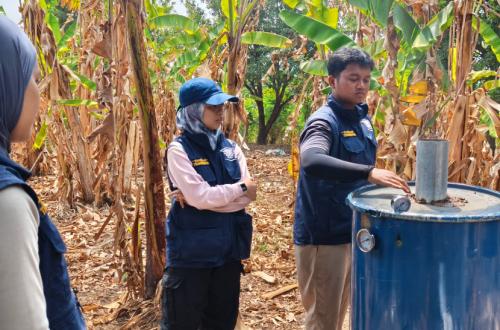
EAST LOMBOK – Agricultural waste, including maize cobs and rice husks, which was previously burned or left to pile up, is now being put to use as a soil conditioner in the Selaparang Transmigration Area in East Lombok, West Nusa Tenggara (NTB). By processing it into biochar, farmers have an alternative way to use crop residues while helping to maintain soil moisture and fertility.
The initiative was introduced through training delivered by the Patriot Expedition Team (TEP) 21 of Sepuluh Nopember Institute of Technology (ITS). The programme gives farming groups the skills to turn agricultural waste into biochar that can be reused on their land.
Supriadi, head of the Cempaka Putih Farmers’ Group in Seruni Mumbul village, said farmers had made little use of maize cobs after harvest. Some of the waste was burned directly in fields, while the rest was left to accumulate.
“Until now, we have simply burned maize cobs in the fields or left them piled up until they became an environmental problem. Through the training and introduction to biochar technology by the ITS Patriot Expedition Team, we have come to understand that this waste can be processed into a soil conditioner that is very useful for maintaining the moisture and fertility of our farmland,” Supriadi said in a statement on Friday (23 October 2026).
Processing waste into biochar gives farmers an alternative to burning crop residues. The material can be used as a soil conditioner, giving previously unused waste a purpose in cultivation.
To support adoption of the technology, TEP 21 ITS distributed eight biochar-making tools to eight villages in the Selaparang Transmigration Area. Each village was represented by a member of a farmers’ group, who received guidance on operating the equipment.
Beneficiaries were selected following field surveys and coordination with agricultural extension officers. The approach is intended to ensure the technology can be used by farming groups in line with local needs.
TEP 21 ITS head Grasianto said he hoped farmers would continue using the biochar technology independently after the support programme ends, so that agricultural waste processing does not stop when the training concludes.
“We hope that this initiative will enable people in the area to apply and develop biochar independently and sustainably, even after the ITS Patriot Expedition Team is no longer there,” Grasianto said.
The programme aligns with government efforts to connect academic innovation with the needs of communities in transmigration areas. The involvement of universities is expected to produce technologies that are easy to apply and beneficial to local economic activity.
Coordinating Minister for Infrastructure and Regional Development Agus Harimurti Yudhoyono previously stressed the importance of cooperation between academics and government in formulating policies based on conditions on the ground. He said academic input and empirical data were needed to ensure policies could be implemented effectively.
“Hopefully, when academic input meets strategic policy at the central level, it will produce policies that are genuinely effective and can be implemented well. Empirical data from the field will be an important foundation for developing well-targeted policies,” Agus said in Jakarta on 30 July 2026.
Transmigration Minister M Iftitah Sulaiman Suryanagara also emphasised the importance of tangible results from the Patriot Expedition in transmigration areas. He urged participants to use their time in the assignment to deliver activities that benefit local communities.
“I want to encourage all Patriot Expedition Team participants: keep moving every day. Our time is limited, just four months. Give your all and do your best while you are in the transmigration area. Something must be done, it must have an impact and it must bring benefits,” Iftitah said in Jakarta some time ago.
The use of biochar in the Selaparang Transmigration Area creates opportunities for more productive management of agricultural waste. Its continued adoption will depend on farming groups’ ability to operate the equipment and use the processed material independently.
Source: jawawa.id (https://jawawa.id/newsitem/once-burned-maize-waste-in-selaparang-transmigration-area-now-helps-enrich-the-soil-1792806652)
Originally published by Republika (https://esgnow.republika.co.id/berita/tncujj416/dulu-dibakar-limbah-jagung-di-kawasan-transmigrasi-selaparang-kini-jadi-penyubur-tanah), translated from Indonesian