
On the Way of Seeing
Jakarta (ANTARA) - There was a time when riding a train in Indonesia felt like a survival exercise that happened to use rails. Passengers were crowded, doors became places to hang onto, roofs turned into travel spaces, while broken toilets and dull carriages were slowly accepted as part of one’s fate.
Everyone knew something was wrong. However, when something wrong happens every day, humans possess a strange ability to stop perceiving it as a problem.
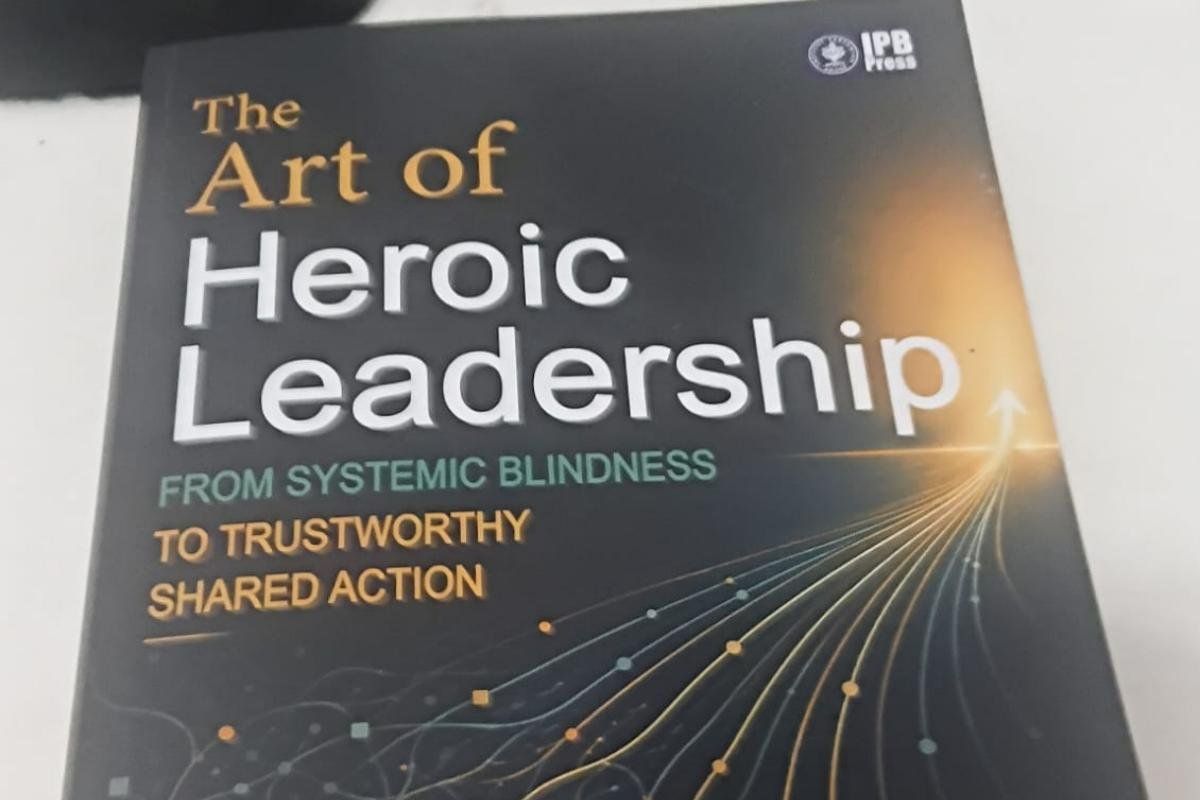
It is at this juncture that ‘The Art of Heroic Leadership: From Systemic Blindness to Trustworthy Shared Action’ by Zulfikar M. Rachman and Ahmad Mukhlis Yusuf becomes compelling. Not because the book offers a new recipe for becoming a great leader, but because it poses a more unsettling question: “From what kind of awareness is an action born?”
That is the heart of the idea. We live in an era where organisations are increasingly proficient at execution. Dashboards increase, meetings become faster, KPIs become more detailed, and technology becomes more sophisticated, but moving faster does not automatically mean moving in the right direction.
Organisations can even become highly efficient at doing something wrong.
This is where what is called a ‘crisis of source’ emerges: a crisis in the inner source and the awareness from which decisions are born. The issue is not merely whether a leader is capable of making decisions, but from what place they see, hear, weigh, and then act.
The story of the transformation of PT Kereta Api Indonesia serves as one of the most powerful examples. The poor conditions that persisted for years gave rise to what is known as ‘toilet syndrome’: something that was initially shocking eventually felt normal because it was seen too often.
The greatest problem in a broken system is not when people are still angry about the damage. The greatest problem arises when people are no longer angry.
The phrase “it has always been this way” then transforms into a sort of unwritten SOP. And that may be the cheapest, yet most expensive, SOP in organisational history.
From this, two forms of blindness are introduced: system blindspot and self blindspot. The first blindness is the inability to see the incentives, history, power structures, and patterns of relationships that shape systemic behaviour. The second blindness is more personal: the inability to see how ego, fear, past experiences, the need for recognition, or self-fragmentation contribute to shaping decisions.
The parable of the six blind men and an elephant explains this issue simply. One holds the leg and is convinced the elephant is a tree. Others hold the tail and swear the elephant is a rope. The person touching the tusk considers it a spear.
No one is entirely lying. They are merely seeing the truth partially and then treating it as the whole.
This is how organisational conflict often works. Finance sees costs. Operations sees capacity. Marketing sees customers. Regulators see compliance. The public feels the consequences.
The higher a leader’s position, the greater the paradox: the more likely they are to be distanced from reality. Information arrives in the form of presentations, summaries, figures, and reports that have been cleansed of field complexities.
Therefore, this reading is most relevant for directors, commissioners, leaders of State-Owned Enterprises (BUMN), regional heads, public officials, transformation consultants, management academics, and senior professionals who are beginning to move from merely managing tasks towards shaping systems.
Source: jawawa.id (https://jawawa.id/newsitem/on-the-way-of-seeing-1789103589)
Originally published by Antara (Indonesian) (https://www.antaranews.com/berita/5736093/tentang-cara-melihat), translated from Indonesian