
On the Brink of Crisis: Investors Party While Nigerians Struggle
The sweeping economic reforms implemented by Nigerian President Bola Tinubu over the past three years have begun to yield results for financial markets and investors. Yet at the same time, millions of Nigerians are grappling with soaring living costs, widening the gulf between investor optimism and the daily hardships faced by ordinary citizens.
Grace Adama, a health NGO worker living in Abuja, experiences this reality first-hand. Each morning she prepares for work from her two-bedroom flat. Despite earning a monthly salary of 135,000 naira, roughly US$99 and nearly double the national minimum wage, she says it is increasingly difficult to make ends meet.
“If I receive my salary today, it only lasts for one week,” Adama told Reuters. “When you look at the cost of living, housing, electricity, everything has gone up.”
The decline in living standards for millions of Nigerians coincides with the economic reforms pursued by the Tinubu administration. These policies include the removal of fuel subsidies, the devaluation of the naira, and cuts to electricity subsidies.
The Nigerian government and investors argue these measures are essential to save the country from a looming fiscal crisis and will deliver long-term benefits. However, the immediate impact has been severe for the public. According to an index compiled by Lagos-based SBM Intelligence, the cost of making jollof rice, a staple dish hugely popular in Nigeria, has more than doubled since Tinubu took office.
Fuel prices have also surged sixfold after subsidies were scrapped, exacerbated by the weakening naira and rising global oil prices.
The World Bank estimates that more than half of Nigeria’s population lived in poverty last year, up from around 42% in 2022. The economic hardship has led some citizens to nickname Tinubu “T-Pain”, a reference to the suffering caused by rising living costs.
Investors, by contrast, view the reforms as the right course of action. “This is probably the most positive period for investors towards Nigeria in the last two decades,” said Thys Louw, portfolio manager at investment firm Ninety One. “They are swallowing the bitter pill now.”
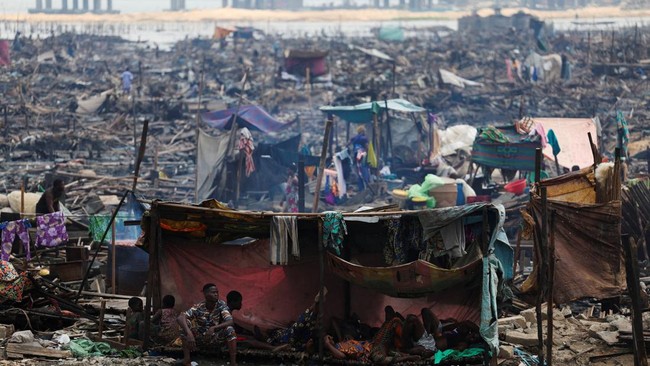
The stark contrast between citizens like Adama, squeezed by living costs, and a booming financial market underscores Nigeria’s widening inequality. The country has long been known for glaring disparities, from cosmopolitan Lagos to Maiduguri in the north-east, plagued by militant threats, and from affluent districts with grand mansions to modest zinc-roofed settlements.
This situation poses a political challenge for Tinubu ahead of elections scheduled for January. He must convince voters that the benefits of economic reform will eventually be felt by the wider population.
“I can’t even send money to my elderly mother in my home town in Benue. I can’t do many of the things I used to be able to do,” Adama said. She has cut back on meat consumption, moved to a smaller flat, and still relies on short-term loans to pay her bills.
Tinubu’s tenure follows eight years of unorthodox economic policies under President Muhammadu Buhari, when the government imposed import bans to boost domestic industry, maintained tight controls on the exchange rate, and provided large fuel subsidies. Those policies led to shortages of imported goods, restricted access to foreign currency, and drained the state budget. In 2022 alone, fuel subsidies reportedly cost the government around US$10 billion.
“We were living in a fiscal illusion,” Finance Minister Taiwo Oyedele said at an event in Abuja. “We have to stop deceiving ourselves for this country to move forward.”
The Tinubu government argues the reforms are beginning to show positive results. Nigeria’s stock market has risen nearly 60% this year. The government also points to the transfer of oil assets to local companies and the operation of the 650,000-barrel-per-day Dangote refinery outside Lagos since 2024. In addition, capital inflows into Nigeria reached US$23 billion last year, the highest in six years, according to the National Bureau of Statistics.
Yet the benefits of this growth have not been felt by most citizens. Nigeria’s stock exchange records that fewer than 5% of adults in the country invest in the capital market. Moreover, much of the incoming capital is short-term money that can quickly exit if economic conditions deteriorate.
Businesses and households also continue to struggle to access cheap credit. The central bank’s benchmark interest rate currently stands at 26.5% amid efforts to curb inflation, which remains near 16%.
The national average petrol price is now around 1,600 naira per litre. While cheaper than in Ghana and Côte d’Ivoire, many Nigerians still consider it too high after years of enjoying cheap fuel as one of the main benefits from the government.
“The solution for me is that the government must reduce the price of fuel,” said Eji Uchenna, a food vendor in Lagos. According to her, customers can no longer afford to buy in large quantities as they once did.
Public dissatisfaction with the economic situation continues to grow. In June, federal workers rejected a proposed minimum wage of 100,000 naira and threatened an indefinite nationwide strike. A voter sentiment survey conducted by SBM Intelligence in June also showed around 80% of Nigerians believe their country is heading in the wrong direction.
Beyond the economy, security remains a major concern. Kidnappings are still rampant in various parts of the country.
Nevertheless, SBM Intelligence chief executive Cheta Nwanze believes public anger may not be enough to unseat Tinubu because the opposition remains fragmented. “The opposition is not united, and the only way the opposition can defeat Tinubu is if they unite,” Nwanze said.
Meanwhile, Louw believes the public will eventually begin to feel the benefits of reform if the government remains consistent in implementing its policies. He argues that falling inflation will open room for interest rate cuts, which could help businesses and households.
The government also acknowledges that much work remains to ensure the fruits of reform are truly felt by all Nigerians. Oyedele stressed that the government must ensure prosperity is enjoyed by every segment of society. “We have to create prosperity for all Nigerians,” he said.
He warned that widening inequality could pose a serious threat to the country’s stability. “When inequality persists, it becomes dangerous. It feels like sitting on a powder keg; one day it will explode,” Oyedele said.
Source: jawawa.id (https://jawawa.id/newsitem/on-the-brink-of-crisis-investors-party-while-nigerians-struggle-1786438335)
Originally published by CNBC Indonesia (https://www.cnbcindonesia.com/news/20260811142514-4-758292/negara-di-tepi-jurang-krisis-investor-berpesta-rakyat-masih-merana), translated from Indonesian