
On Senen Sidewalk, Black Stone and Acid Become the "Judges" of Gold Value
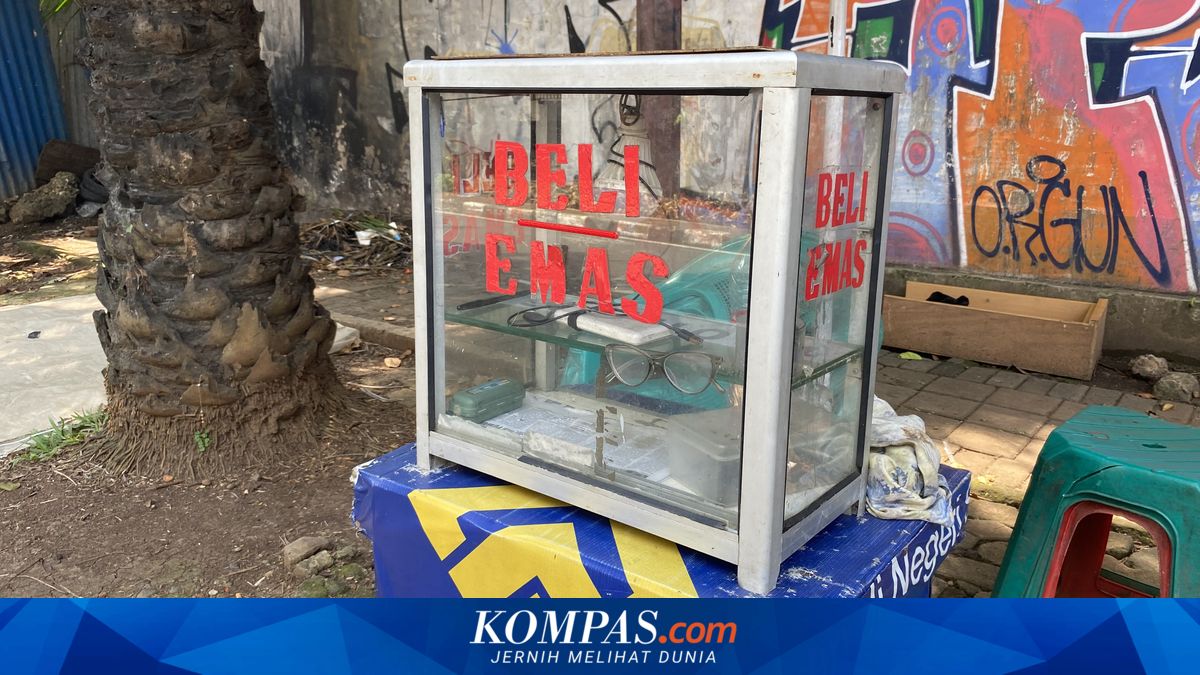
In the shaded sidewalk of Jalan Senen III, Central Jakarta, simple gold buying and selling stalls stand without large signs or luxurious display cases. Though appearing modest, the activities there proceed quickly and precisely. A black testing stone, acid solution, and digital scale serve as the primary tools determining the value of someone’s jewellery—reflecting the pulse of the informal gold market that remains alive amid the proliferation of modern shops and digital investments. The gold trading stall stands simply in the tree-shaded sidewalk area. There are no large signs or luxurious display cases like typical jewellery stores. On the glass display of the cart, an orange sticker reads “BUY GOLD.” Around it, rows of parked motorbikes, online ojek drivers waiting for passengers, and vehicles speeding by on the main road are visible. Poman wears a light brown long-sleeved T-shirt and blue jeans. He sits on a small stool, with a calm face but alert eyes. In front of him, a small digital scale is placed on a faded pink mat. When a buyer asks Poman to check a silver chain, the man immediately begins the procedure he knows by heart. The silver chain is placed on the digital scale. The screen shows 3.8 grams. Poman nods slowly, then slides the scale to the side. With age-wrinkled hands, Poman picks up a rectangular testing stone about 10 cm long, dark grey to black in colour. Its surface appears dull, full of thin line marks from metal scratches. He holds the silver chain with two fingers, then rubs it slowly against the stone’s surface. His movements are unhurried. He applies a certain pressure to leave a metal mark on the stone. After rubbing the silver, Poman reaches for a small clear bottle shaped like a pipette, stored in a plastic container filled with cream-coloured sand. He mentions that the liquid used is nitric acid solution, with two types they commonly call Acid 1 and Acid 2. He presses the pipette tip gently, dripping the liquid precisely on the silver scratch line. Within seconds, a milky white colour appears. “When tested with the liquid, see this milky white colour emerging. That’s a sign of silver,” says Poman, pointing to the colour change on the testing stone to Kompas.com at his stall on Tuesday (14/4/2026). He then explains that if old gold or high-purity gold is tested, the colour will differ. “If it’s old gold, it remains eternally yellow even when doused with the testing solution. That’s the special quality of gold,” he says. At the Senen stalls, this method acts as a kind of judge determining the value of one’s goods. Only through the black stone and acid solution can traders decide if the jewellery is genuine, fake, or just gold-plated. “We test first, we check the purity level. Rubbed on the stone, using the testing solution. There’s a solution to test if it’s gold or not, and a solution to test the gold purity,” says Limbong. The item for sale is scratched on the black testing stone until it leaves a trace. Then acid is dripped on. From the colour reaction and changes on the scratch mark, traders can read if the gold is 18 karat, 22 karat, or 24 karat. After the purity is known, the next step is to weigh the gold’s weight. “After knowing the purity, we then offer the price based on the gram weight,” says Limbong. On his stall table, Limbong also shows unprocessed rough silver granules that have not yet been made into jewellery or bars. He says the sample he holds weighs 31 grams. “The price is around Rp 30,000 per gram. If up to 1 kilogram, the value can be Rp 30 million,” he says. At this point, the roadside gold stall looks like a fast-moving knot of the informal economy—goods come in, are tested, weighed, bargained, then change hands. Limbong says he always updates gold price information every day. “Referring to the general market price. We check from news, newspapers, or media. Every day we must update the price,” he says.