
On its 81st Anniversary, KAI Adopts 'Increasing Service' Theme Towards World-Class Operator Status
Continuing the 159-year journey of Indonesian railways, KAI is driving services that are increasingly safe, efficient, integrated, and sustainable.
Jakarta (ANTARA) - PT Kereta Api Indonesia (Pers cáo) commemorated its 81st anniversary with a ceremony at the KAI Head Office in Bandung on Monday (28/9). Carrying the theme “Increasing Service” (Semakin Melayani), this year’s commemoration serves as a momentum for KAI to continue its corporate transformation through improvements in service quality, safety, efficiency, innovation, and sustainability.
KAI President Director Bobby Rasyint stated that KAI’s 81-year journey is part of the long history of Indonesian railways, which has spanned 159 years. The construction of the first railway line, Semarang–Tanggung, began on 17 June 1864 and has continued to develop into a vital component of public mobility, goods distribution, and inter-regional economic activity.
This journey entered a crucial phase on 28 September 1945, when Indonesian railway workers took control of the railways from colonial hands. This event marked the establishment of the Djawatan Kereta Api Republik Indonesia and is subsequently commemorated as Railway Day.
“Eighty-one years after that momentum, KAI continues its role in serving the community and supporting Indonesia’s connectivity. The theme ‘Increasing Service’ is a commitment that every growth and corporate transformation is accompanied by an increase in service quality and benefits for the public,” said Bobby.
Entering its 81st year, KAI is operating at an increasingly large scale of service and performance. Throughout the first semester of 2024, the KAI Group served 258,993,359 customers, an increase of 7.55 per cent compared to 240,805,920 customers during the same period the previous year. During the same period, KAI’s consolidated revenue reached approximately Rp18 trillion.
Bobby stated that this growth serves as capital for KAI to enhance service quality while maintaining corporate growth. As the transport business expands, KAI also continues to develop non-transportation revenue through asset optimisation, area development, and the creation of new revenue streams.
Corporate transformation is being implemented through the improvement of train services, station revitalisation, the development of tourism services through The Nusantara Explorer, and the utilisation of assets to support residential areas integrated with public transport. These developments are aimed at addressing changing public mobility needs while opening up future growth opportunities for the company.
“Growth brings increasing responsibility. The growing need for mobility must be addressed through increased capacity and service reliability, strengthening infrastructure, and ensuring safety and intermodal integration. Moving forward, every investment and transformation must further strengthen KAI while providing broader benefits to the community. This is the meaning of ‘Increasing Service’ that we realise together,” said Bobby.
In line with corporate transformation, KAI carries the vision: “Driving the Creation of an Efficient and Sustainable Railway Service Ecosystem Towards a World-Class Operator.”
This vision guides KAI in developing a railway service ecosystem that is efficient, integrated, adaptive to technological developments, and capable of meeting national passenger and logistics mobility needs.
To achieve this vision, KAI carries out three missions. First, providing passenger mobility services based on railways that prioritise safety, punctuality, comfort, efficiency, and sustainability.
Second, providing efficient, reliable, and integrated railway-based transport and logistics solutions to support the reduction of national logistics costs.
Third, driving innovation through digitalisation and technological advancement, developing non-farebox businesses, increasing organisational capability, and strengthening the governance of the railway sector.
“This vision and mission serve as a direction for KAI to continue growing with service as the primary orientation. Safety is the priority in every journey, accompanied by increased service reliability, the use of technology, business development, and organisational capabilities that can keep up with changing community needs,” said Bobby.
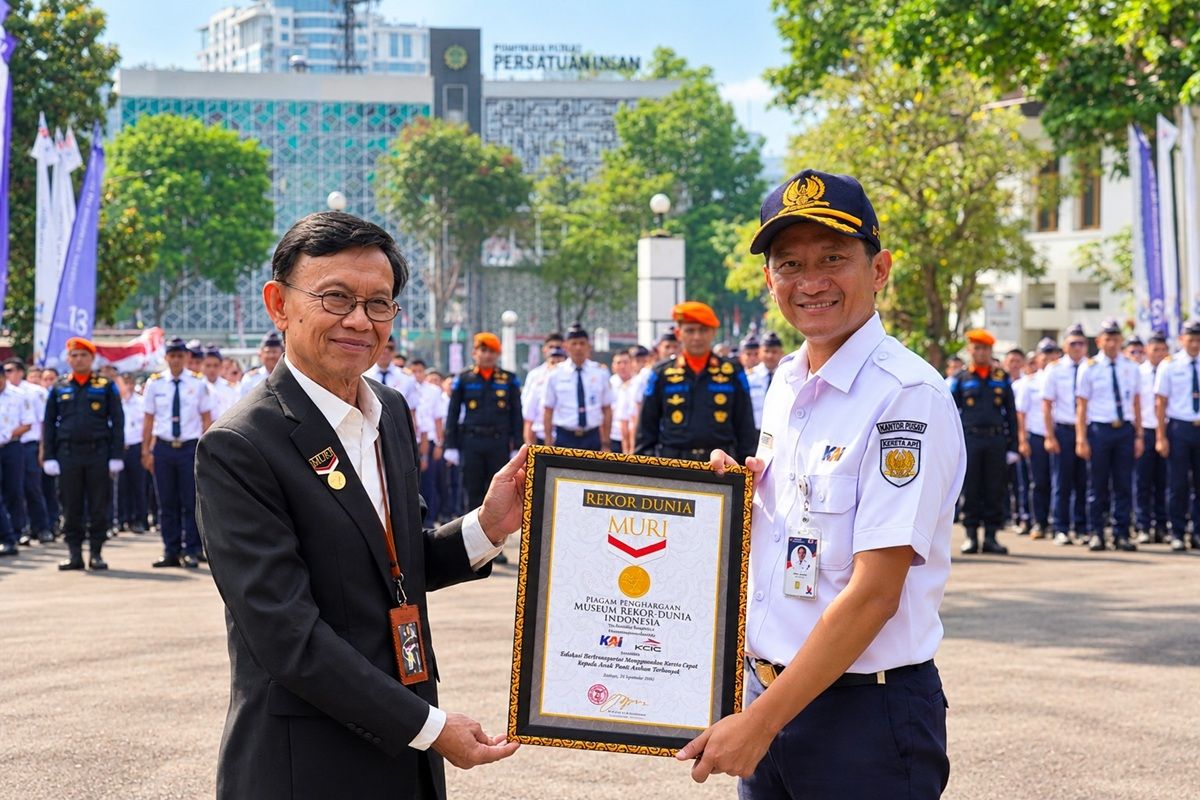
The 81st anniversary commemoration at the KAI Head Office was also marked by the presentation of a MURI (Indonesian World Records Museum) award to the EduTrain programme for having the largest number of participants using Whoosh.
EduTrain is an educational travel programme that introduces modern transportation to orphans through the experience of using the Whoosh High-Speed Railway. The programme, a collaboration between KAI and KCIC, was conducted in two batches, during the 81st Indonesian Independence Day celebrations and the 81st KAI Anniversary.
Through EduTrain, participants gain experience using Whoosh while getting to know the world of Indonesian railways more closely. The programme is also aimed at fostering motivation, a passion for learning, and courage in children to achieve their dreams.
The EduTrain series includes educational journeys, interactive sessions regarding KAI and public transport, inspirational classes, introduction to Whoosh technology and services, educational games, and appreciation for participants.
“We hope this travel experience broadens children’s horizons regarding the development of Indonesian transportation while fostering the spirit to continue learning and the courage to pursue their dreams. The younger generation will be an important part of continuing Indonesia’s journey in the future,” said Bobby.
Bobby stated that KAI’s journey and achievements to this day are the result of the hard work of all KAI personnel, accompanied by the support of their families. This togetherness must be maintained so that KAI becomes a place for company employees to grow, create, and provide the best service to the community.