
On Energy Subsidies, DEN Says DME Can Boost Domestic Value Addition
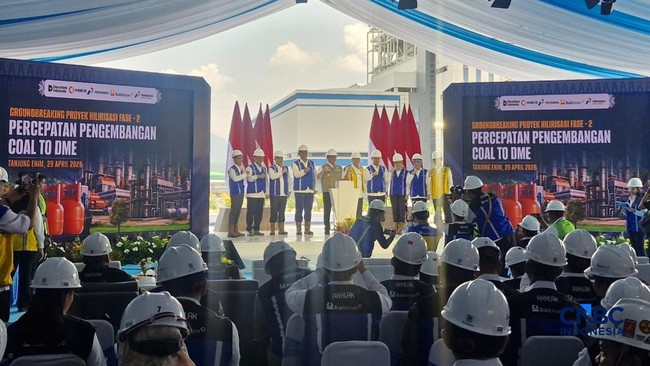
Jakarta, CNBC Indonesia - A member of the National Energy Council (DEN), Kholid Syeirazi, has outlined a new paradigm for viewing the national energy subsidy scheme, amid the government’s push to accelerate the downstreaming of coal into Dimethyl Ether (DME).
He stated that subsidies for the DME project should not be seen merely as a fiscal burden. Instead, they are considered an investment in creating domestic value addition while strengthening national energy resilience.
“If there are still subsidies (for DME), they would be subsidies from our own production. With LPG, the subsidies come from imports, so there is no domestic value addition,” Kholid said in his statement, as written on Wednesday (13/5/2026).
He explained that Indonesia still heavily relies on LPG imports. Of the total national LPG needs, around 80% is still met through imports, or about 7.2 million tonnes per year. However, Indonesia possesses large reserves of low-rank coal (low calorie coal) that have not been optimally utilised.
These low-rank coal reserves can be converted into DME through a strategic initiative being developed by MIND ID, Pertamina, Bukit Asam, and Pertamina Patra Niaga.
The project, which was inaugurated as the Acceleration of Coal to DME Development by President Prabowo Subianto during the Second Downstreaming Project Groundbreaking Series at the end of April 2026, serves as a substitute for LPG and a solution for utilising stranded coal that has previously had limited markets.
“We have around 600 million tonnes of stranded coal that can be utilised by converting it into DME,” he said.
According to Kholid, the DME development approach cannot be viewed solely from a short-term economic perspective. This is because the project is directly linked to the broader agenda of national energy resilience and independence, which is part of the Prabowo administration’s vision.
He noted that dependence on energy imports poses significant risks, especially amid rising global geopolitical tensions, such as conflicts in the Middle East that could disrupt the global energy supply chain.
“For example, we may have the money, but if the goods are unavailable due to delivery disruptions or infrastructure issues, it could trigger an energy crisis. That’s why we must utilise our own resources,” he explained.
Kholid also emphasised that the calculation of benefits from the DME project must consider the overall net social benefit, rather than just comparing the price of imported LPG with DME production costs. This is because if the state only relies on pure economic logic, the construction of refineries or other downstreaming projects would never be deemed feasible.
“If the consideration is purely economic, we might as well import everything. But the state must think about emergency conditions and long-term energy resilience,” he said.
Furthermore, the DME project is still being refined by the government together with various parties, including Danantara and BRIN, particularly regarding product quality and economic schemes to make it comparable to the LPG used by the public.
Kholid said the government hopes the DME project can start operating in 2026. However, details on implementation and the project operator are still awaiting further decisions from Danantara, which will orchestrate its development.
“There will be collaboration between Pertamina and Bukit Asam and so on. Hopefully, DME can proceed this year,” he concluded.