
Ombudsman submits 203 service improvement studies to public agencies
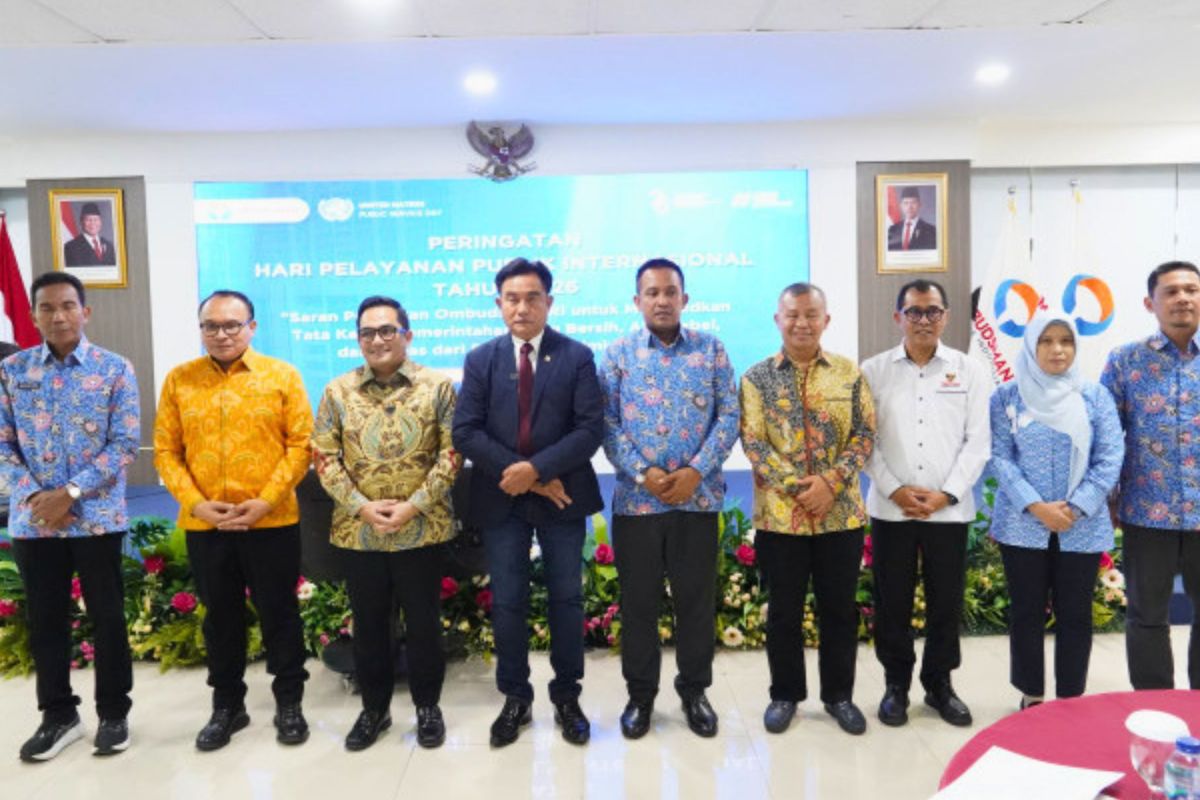
The Ombudsman of the Republic of Indonesia has presented 203 studies and improvement suggestions to public service providers throughout the 2021-2025 period to prevent systemic maladministration.
Speaking in Jakarta on Wednesday, Nuzran Joher, a member of the Indonesian Ombudsman, stated that these studies and recommendations were compiled by the central office and 34 regional representative offices across all provinces.
“These improvement suggestions are part of the Indonesian Ombudsman’s efforts to conduct early detection, identify causes, and influence public service providers to implement reforms so that maladministration does not occur or recur,” said Nuzran.
This was announced during the commemoration of International Public Service Day 2026 in Jakarta on Tuesday (23/6).
He noted that the Ombudsman’s central office has submitted 34 studies and improvement suggestions to ministries, agencies, and public service providers. Meanwhile, the 34 regional representative offices have submitted 169 studies and suggestions to local public service providers.
Several strategic studies submitted by the Ombudsman over the last five years include the monitoring of person crossings into Indonesian territory during the pandemic, submitted to the Ministry of Law and Human Rights in 202<0xA0>21.
In 2022, the Ombudsman submitted a study on preventing maladministration in Bank Tabungan Negara’s home ownership credit services, which impacted the delivery of consumer certificates, to the Ministry of Public Works and Housing and PT Bank Tabungan Negara (Persero) Tbk.
Other submitted studies include the monitoring of domestic Hajj pilgrimage services to the Ministry of Religious Affairs in 2023, and the prevention of human trafficking crimes to the Coordinating Ministry for Political, Legal, and Security Affairs in 2024.
The Vice Chairman of the Indonesian Ombudsman, Rahmadi Indra Tektona, stated that the institution’s authority extends beyond handling public complaints; it also involves preventing maladministration by providing improvement suggestions to the President, the House of Representatives (DPR RI), and other state organisers.
“We believe that improving public services cannot be achieved by a single institution alone,” said Rahmadi.
According to him, budget constraints remain a challenge for the Indonesian Ombudsman in performing its supervisory functions optimally.
The Coordinating Minister for Law, Human Rights, Immigration, and Correctional Affairs, Yusril Ihza Mahendra, stated that findings of maladministration must serve as evaluation material to improve service systems and procedures to prevent recurrence.
He added that the results of the Ombudsman’s studies and suggestions should be used as a basis for policymaking, and the follow-up on recommendations must be carried out in a measurable and transparent manner.