
Ombudsman says railway accident risk mitigation needs strengthening
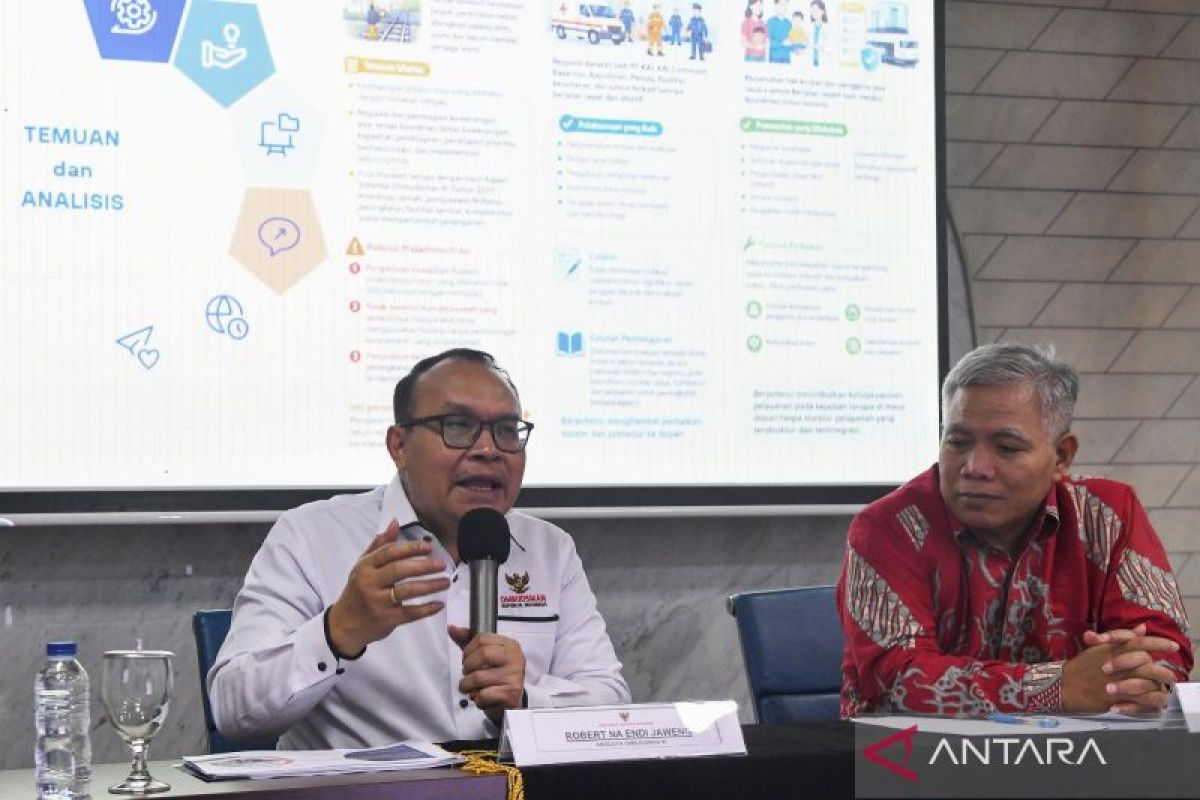
Jakarta (ANTARA) - The Ombudsman of the Republic of Indonesia (ORI) believes that risk mitigation for railway accidents needs to be strengthened, as the root cause of identified accidents lies within the pre-incident phase.
Based on facts and analysis obtained through a rapid study, Ombudsman member Robert Na Endi Jaweng stated that the accountability of public services in handling the train accident in East Bekasi, West Java, was considered good in terms of emergency response and service recovery.
“However, it is not yet adequate in terms of prevention and risk mitigation,” Robert said during a press conference in Jakarta on Wednesday.
The Ombudsman found that safety constraints are not solely caused by budget limitations. In many cases, the more fundamental issue is that safety has not been placed as a top priority within the planning and budgeting processes.
He noted that various relatively simple risk mitigation steps, such as installing barriers, providing official guards, constructing guard posts, and other safety equipment, could be implemented before the construction of grade-separated infrastructure, such as flyovers or underpasses, is realised.
Consequently, the ORI sees significant potential for maladministration during the pre-incident phase, specifically through the neglect of safety improvement obligations, failure to provide proper services, and prolonged delays in handling high-risk level crossings.
Robert revealed that the study also found the issues occurring in East Bekasi are not isolated incidents. He continued that the patterns of problems identified share similarities with the results of the Ombudsman RI’s 2017 Systemic Study regarding Railway Level Crossings on Java Island.
It was stated that various previously identified issues—such as weak cross-sector coordination, slow follow-up on high-risk locations, sub-optimal supervision, and the lack of integration between safety planning and decision-making and budgeting—were once again found in the train accident in East Bekasi.
“A number of long-standing improvement recommendations have not yet been fully and effectively implemented,” he said.
On the other asides, the Ombudsman RI understands the high level of public dependence on the Ampera Crossing as a route for daily mobility and local economic activity. However, he emphasised that the need for mobility cannot be used as an excuse to maintain crossing conditions that do not meet safety and security standards.
Meanwhile, regarding the incident and post-incident phases, the ORI assessed that the response from PT KAI, KAI Commuter, Basarnas, the Police, the TNI, healthcare workers, Jasa Raharja, local governments, and various related parties functioned relatively well.
He mentioned that the victim evacuation process was rapid, healthcare services and compensation to victims were provided, train operations were restored gradually, and mechanisms for refunds and handling lost property were implemented.
Therefore, based on the study results, the Ombudsman of RI found no significant potential for maladministration in the handling of emergencies or the fulfilment of victims’ rights after the accident occurred.
Nevertheless, Robert stated that the agency believes there is still a need to strengthen post-incident evaluation systems, protection for affected passengers, public communication during crises, and institutional learning mechanisms.
“This is so that every accident serves as a basis for continuous improvement of the safety system,” said Robert.