
Ombudsman: Disaster management must extend beyond emergency response
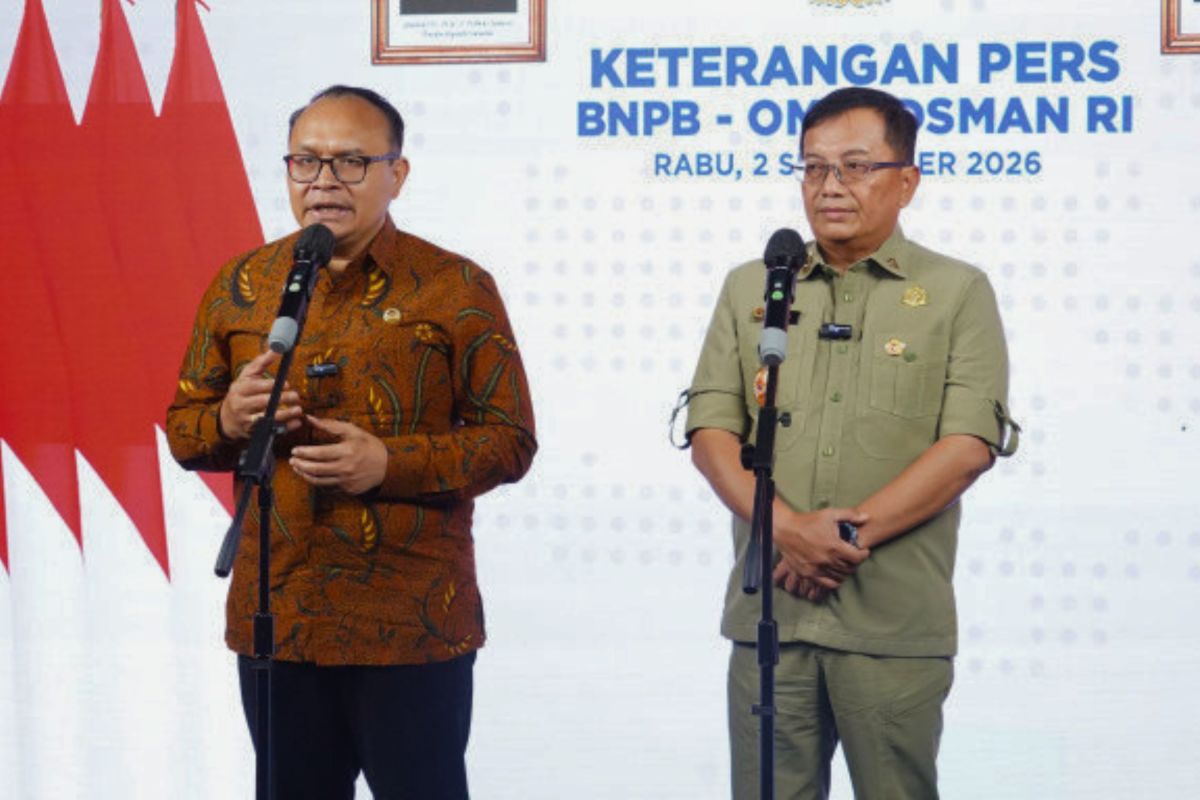
The Indonesian Ombudsman (ORI) has emphasised that disaster management does not end with emergency response, but requires continuous collaboration and supervision throughout the post-disaster recovery process.
Ombudsman RI member Robert Na Endi Jaweng stated that the speed of local government response, cross-agency coordination, and community involvement are crucial factors in ensuring that the needs and rights of affected populations are met. “In this context, the Ombudsman RI encourages strengthened collaboration between the central government, local governments, the National Disaster Management Agency (BNPB), ministries/agencies, and various elements of society in disaster handling and post-disaster recovery,” Robert said during a press conference in Jakarta on Wednesday.
He noted that disasters serve as a test case to see whether the state is present for its people. In this regard, he argued that the role of local governments, particularly at the regency, city, and village levels, must be strengthened to ensure rapid response in both rescue and recovery efforts. Therefore, Robert stated that active collaboration and the strengthening of basic readiness—in terms of human resources, budget, and inter-agency networks—are necessary to provide a swift response before support from the central government and various ministries arrives in affected areas.
In its monitoring, the Ombudsman noted that in the Sumatra region, significant work remains in the rehabilitation and reconstruction phases, particularly regarding housing, bridges and connectivity, rivers and flood control, irrigation and agriculture, dams and water infrastructure, as well as livelihood recovery. Out of 1,227 targeted bridge projects, 574 are still in progress and 653 remain unfinished. Issues were also found in the construction of permanent housing (huntap), which faces hurdles such as ‘by name by address’ (BNBA) data validation, certainty of location and land, construction progress, and housing models.
In West Sumatra, the Ombudsman recorded ongoing issues with victim data collection. One reported problem involves residents whose homes were affected by mudflows who have not yet fully received assistance. He stated that this situation highlights the need for clear criteria and standardisation in determining who is entitled to aid. “The Ombudsman has also received complaints regarding compensation or indemnity for the disruption of basic needs, including the issue of clean water not being immediately available to affected communities,” he said.
It was noted that initial data of approximately 24,000 units changed to around 17,000 units. This discrepancy requires immediate clarification through joint verification and validation mechanisms to ensure the public is not disadvantaged by differing databases between agencies. The Ombudsman also highlighted that the relocation of communities from ‘red zones’ has not been maximised. One complaint received by the North Sumatra Ombudsman representative regarding this issue has yet to reach an adequate resolution.
In Aceh, the Ombudsman found that permanent housing still faces obstacles. These hurdles are caused not only by budget and administrative issues but also by supply chain and market capacity constraints. “It is known that there has been a shortage of cement in Central Aceh and Aceh Tamiang,” Robert noted.
In East Nusa Tenggara (NTT), the Ombudsman noted that challenges faced by the community relate not only to physical needs but also to social trauma and the sustainability of public services. He continued that even more than ten days after the disaster on 14 August 2026, some residents had still not received aid. Issues regarding housing, victim data for aid recipients, and access to basic services remain major concerns. The Ombudsman noted that healthcare conditions in several affected areas remain concerning, and inter-agency coordination has not yet functioned optimally.
“This situation requires attention because disaster-affected communities still have the right to receive public services even in emergency and recovery situations,” he said. Based on these findings, the Ombudsman RI will follow up on various issues through oversight mechanisms according to its authority. Complaints indicating maladministration will be investigated, while issues requiring cross-agency resolution will be coordinated with the BNPB and relevant ministries.
The Ombudsman also urged the government to ensure the availability of accurate and inclusive data, real-time regional need maps, transparent public communication, community involvement, and active complaint channels at both central and local levels. At the same time, the Secretary of the National Disaster Management Agency (BNPB), Rustian, welcomed the strengthening of this coordination. The BNPB emphasised that disaster management requires multi-stakeholder collaboration to ensure effective community recovery.
According to BNPB data as of 1 September 2026, 1,654 disasters were recorded throughout 2026, resulting in 379 deaths. The 7.7 magnitude earthquake in NTT on 15 August was recorded to have caused 127 deaths, 1,668 injuries, 181,354 displacements, and damage to 97,215 houses and 3,266 public facilities.