
Ombudsman Assesses Flyover as Solution to Prevent Vehicles Obstructing Trains
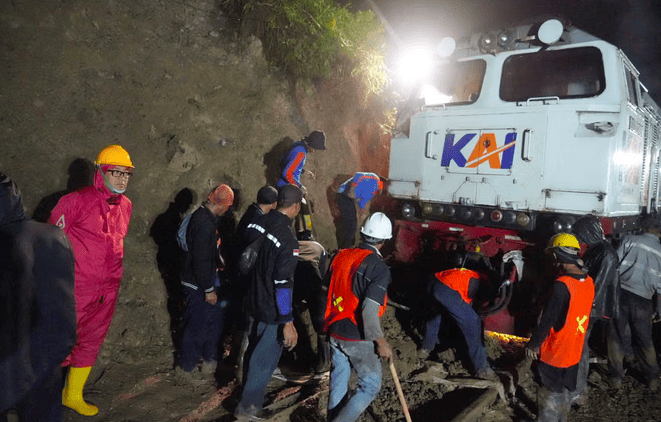
The Indonesian Ombudsman (ORI) considers the construction of grade-separated crossings, such as flyovers and underpasses, to be the most ideal option for preventing train accidents.
“The core issue is that there should no longer be any roads that directly cross railway tracks; they must be built either above or below,” said Robert Na Endi Jaweng, a member of the Indonesian Ombudsman, when met in Jakarta on Wednesday.
He noted that many of the current level crossings in Indonesia are unofficial. Out of approximately 3,700 level crossings in Indonesia, 50 per cent are unofficial crossings that lack barriers or guards. He added that even official level crossings are not necessarily safe.
However, he acknowledged that constructing grade-separated crossings is highly complex in terms of both technical requirements and funding. To avoid future train accidents, he suggested that one of the most realistic approaches is to formalise unofficial level crossings.
In this regard, he supports PT Kereta Api Indonesia (KAI), which has allocated Rp190 billion to build guard posts at level crossings across Indonesia in response to the train accident in East Bekasi. In addition to physical guard posts, these funds will also be used to provide barriers and personnel.
Currently, KAI is recruiting personnel to man these crossing posts, with 12,000 applicants undergoing selection. “So, level crossings are acceptable, provided they have official barriers, are officially guarded, and are supported by strengthened information technology,” Robert stated.
Nevertheless, he reminded that preventing train accidents is not solely the responsibility of KAI, but also involves the Ministry of Transportation and local governments. The Ombudsman found potential maladministration in the pre-accident phase of the East Bekasi incident due to weak mitigation and risk prevention.
He emphasised that all supervisory authorities, including the Ombudsman, can exercise their powers to ensure programmes run according to regulations. The Ombudsman has proposed more flexible regulations regarding land area requirements, suggesting they could be reduced and replaced with multi-storey structures.
Former KAI Commissioner Riza Primadi assessed that the accident at East Bekasi Station was not merely a matter of human error, but rather an issue involving infrastructure and operational systems.