
Olele community weaves economic value from palm fibre
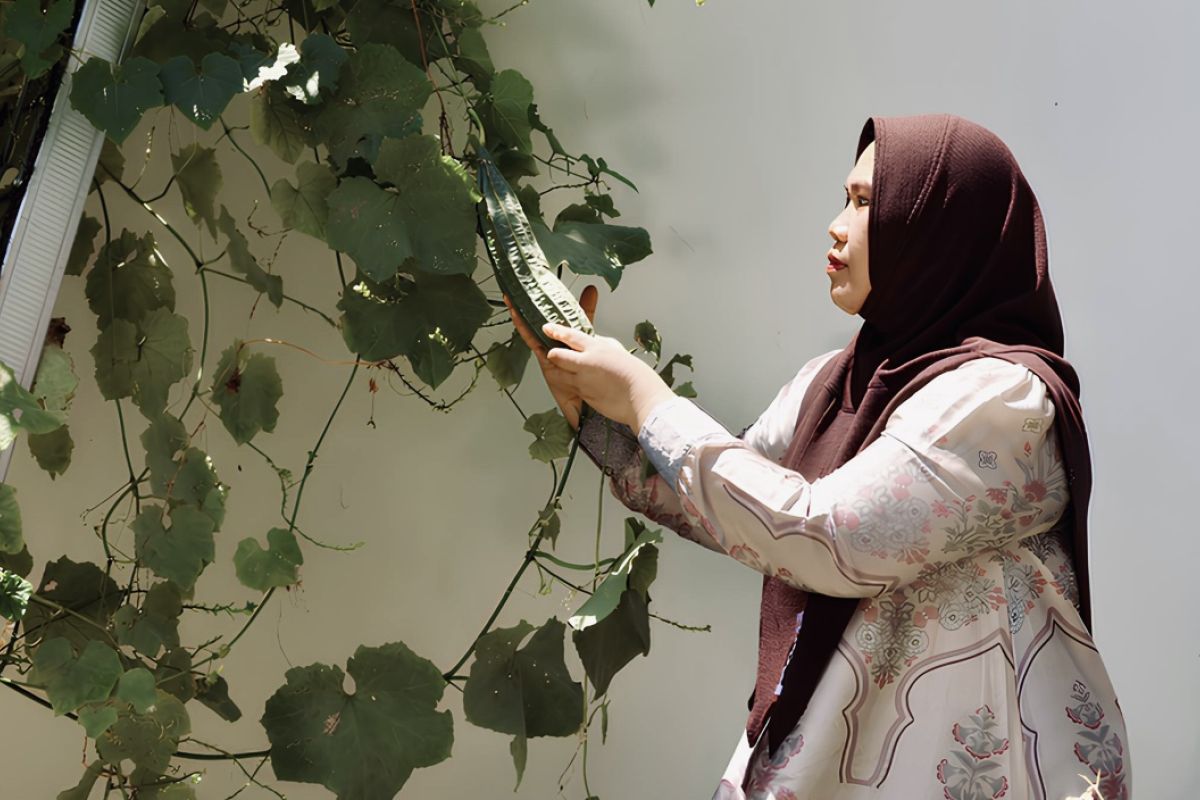
Ridge gourd tendrils creep among the blackish-brown netting. Its leaves are beginning to spread, covering part after part of the net on which the plant climbs, installed in a corner of the Olele area, Kabila Bone District, Gorontalo.
At a glance, there is nothing special about the net unless one pays attention to the details.
The net is not made of plastic or wire as is common. The base material is ijuk, the fibre of the sugar palm tree, which has so far been used mostly by communities to make brooms, doormats, or rope.
In Olele village, the simple fibre is being given a new life.
Ijuk is spun into rope, then assembled into netting. Once installed, the net becomes a place for climbing plants and is known as a green curtain.
From a material that previously had little value, the community is beginning to see new economic opportunities.
Until now, a single sheet of ijuk was valued at only around Rp6,000 and there was no guarantee of a buyer. Yet sugar palm trees, the source of the raw material, are still abundant in Gorontalo.
This was the situation found by the Universitas Negeri Gorontalo team while carrying out community assistance in Olele.
The head of the Olele 2026 Area-Based Empowerment Programme (PBW) team, Yayu Indriati Arifin, said the problem is not that the raw material is hard to find, but that its utilisation has not developed.
“So it is almost unutilised. Even though the source of sugar palm trees is still there,” said Yayu.
Yayu saw this opportunity alongside the economic condition of the Olele community, which has so far been heavily dependent on marine tourism.
Snorkelling and diving are the best-known activities of the coastal village. The sea with its clear water and rich coral reefs is the reason tourists come.
However, according to Yayu, the story of Olele does not stop at the sea.
Land-based potential, including geological wealth, plants, and community life, can become another part of the tourism experience while opening new economic space.
“On average, the community there only relies on snorkelling and diving. Even though the geodiversity and cultural diversity potential has not been maximised,” said Yayu.
It was from this thinking that the green curtain began to be introduced to the community.