
OJK's Firm Response to MSCI Announcement with These Measures
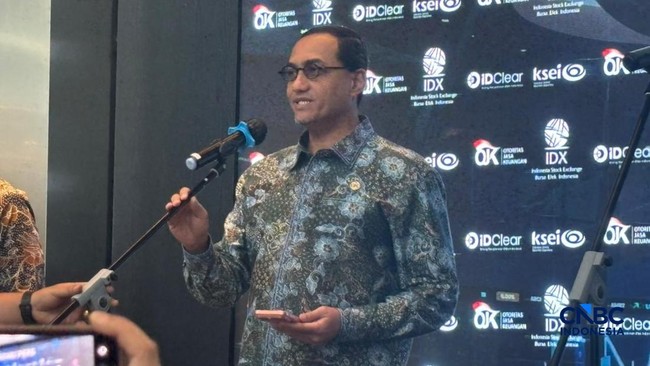
Jakarta, CNBC Indonesia - The Financial Services Authority (OJK) has responded to the MSCI rebalancing announcement. The Executive Head of Capital Market, Derivatives, and Carbon Exchange Supervision at OJK, Hasan Fawzi, emphasised that the regulator has prepared four main steps from the outset to improve transparency in share ownership structures on the Indonesia Stock Exchange (BEI). These steps are expected to assist global index providers in more accurately calculating the proportion of free float shares. First, Hasan stated, they are committed to promoting an increase in free float through changes and the issuance of exchange regulations that mandate raising free float share ownership to 15%, from the previous 7.5%. “We are continuing to monitor this because there is an annual implementation timeline,” Hasan said during a press conference at the Indonesia Stock Exchange (BEI) building on Wednesday (12/5/2026). Second, in March, OJK introduced transparency of share ownership above 1% to the public for all listed shares on the BEI. In addition, the regulator also provided granularity or detailed investor classification so that the type of investor and each shareholder can be seen more clearly. Then, in April, OJK issued the High Shareholding Concentration (HSC). Along with that, OJK and the self-regulatory organisation (SRO) also strengthened the enforcement of provisions and supervision of potential violations in the capital market, including by publishing supervision results, examinations, and sanctions against non-compliant parties. According to Hasan, all these enhancements in transparency and integrity have been recognised by investors as well as global index providers. “In the latest index review announcement, it is evident that there are shares which, after transparency was opened, made it easier for index providers to exclude certain portions that were previously claimed as free float but, after disclosure, turned out not to be free float,” he explained. Hasan also noted that a number of shares have experienced a downward price trend, thus no longer meeting the criteria set by global index providers. As a result, there are shares that have been removed from the index or have undergone weight adjustments and classification downgrades. Nevertheless, Hasan stressed that the reforms being undertaken are not merely to address short-term challenges but are part of long-term efforts to build a stronger and more credible capital market foundation. “We will continue these reforms until the entire action plan is complete, so that the Indonesian capital market has a level of integrity that is widely recognised, both by domestic and global investors,” he said. OJK stated that the results of this MSCI rebalancing are a short-term consequence of the market integrity reform process. Meanwhile, structural reforms can indeed cause short-term pressures, including adjustments to affected share prices. “This short-term pain must be faced. Short-term declines are a consequence, with the hope that this index adjustment will form a new baseline that brings better quality to listed shares and makes them an investment choice for investors,” Hasan remarked. Looking ahead, OJK hopes that more Indonesian shares can meet the criteria to enter global indices such as MSCI and FTSE Russell. “The long-term gain we are pursuing is an overall improvement in market quality. We continue to communicate with various investor representatives and index providers such as FTSE and MSCI. Our market is still considered good, credible, and prospective. This is proven by there being no market classification downgrade and Indonesia remaining in the emerging market category,” he added.