
OJK Unveils Sustainable Finance Roadmap for Insurance, Guarantee and Pension Sectors for 2026–2031
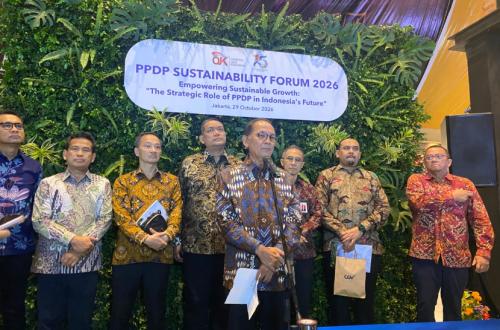
JAKARTA — Climate change and rising disaster risks threaten not only the environment but also the stability of the financial sector and the state budget. Disaster losses can spread across economic activity, business continuity and household finances, particularly when insurance protection is inadequate.
The Financial Services Authority (OJK) has responded to these challenges by launching the Sustainable Finance Development Roadmap for the Insurance, Guarantee and Pension Fund (PPDP) sectors for 2026–2031. The policy is intended to strengthen the industry’s role in managing risk while supporting the financing of the transition to a sustainable economy.
OJK Chief Executive for Insurance, Guarantee and Pension Fund Supervision Ogi Prastomiyono said climate change had become an economic and financial issue. The financial services sector therefore needed to improve its preparedness for a range of environmental risks.
“Climate change and various sustainability risks can no longer be viewed solely as environmental issues. These risks have developed into economic and financial risks that require our collective attention,” Ogi said at the launch of the PPDP Roadmap in Jakarta on Thursday (29 October 2026).
Ogi said the Global Risks Report showed that environmental risks were increasingly dominating the long-term global risk landscape. These threats include climate change and the loss of biodiversity and ecosystems.
Indonesia faces a major challenge because of its high exposure to disasters, Ogi said. Citing the World Risk Index, he noted that Indonesia ranked second for disaster risk and third for flood risk.
“What we need to recognise is that when these risks materialise, their impact does not stop at physical damage. It can extend to economic activity, business continuity, household finances and the financial services sector, and ultimately put pressure on public finances. Sustainability is therefore not only about environmental responsibility, but also economic resilience and financial stability,” he said.
Ogi said the PPDP sector had two strategic roles in addressing these risks. In addition to acting as an institutional investor managing medium- and long-term funds, the industry absorbs risk through insurance, reinsurance, guarantee services and pension programmes.
As institutional investors, PPDP firms have the potential to support development financing and the transition to a sustainable economy. Their protection function, meanwhile, helps households and businesses manage and share financial risks.
“The PPDP sector’s contribution to the economic transition is therefore not only about financing the transition, but also protecting it. This is the sector’s strategic position in the sustainability agenda: investment and protection,” he said.
Ogi highlighted the protection gap as a key challenge amid rising disaster, climate and health risks. It arises when households and businesses lack adequate financial protection to cover losses.
According to Ogi, limited protection can lead to a financing gap in recovery. If households and businesses cannot meet recovery costs, some of the burden may shift to the government, creating a fiscal gap.
“When disaster, climate, health and other emerging risks increase, the fundamental question is: who will bear the losses when they occur?” he said.
Ogi stressed that narrowing the protection gap was not simply a matter of increasing insurance penetration. It was also about enabling households and businesses to resume economic activity after suffering losses.
“Narrowing the protection gap is therefore not merely a matter of increasing industry penetration; it is an important part of the sustainability agenda in the PPDP sector. The broader the range of risks we can protect against, the greater the capacity of households and businesses to recover, and the stronger our economic resilience,” he said.
OJK reported that total PPDP sector assets stood at Rp2,989.58 trillion as of September 2026. The industry’s investments were valued at Rp2,299.37 trillion, supported by 576 business entities.
Ogi said the scale of these assets and investments should be used to expand protection and support sustainable development. The long-term funds managed by the industry are expected to make a greater contribution to economic resilience.
“More important than the size of these figures is how we use this scale to create impact: how the long-term funds we manage can become more productive for the future, how protection capacity can be broadened, and how PPDP investment can support development and the economic transition,” he said.
Ogi added that the development of sustainable finance formed part of OJK policy that had advanced through several stages. These included the first sustainable finance roadmap, the process of revising OJK Regulation No. 51 of 2017, the refinement of the second-stage roadmap, and the development of the Indonesian Sustainable Finance Taxonomy.
The 2026–2031 PPDP Roadmap continues this policy effort. OJK views the strengthening of the insurance, guarantee and pension sectors as one means of supporting the economic transition while improving resilience to environmental risks.
Source: jawawa.id (https://jawawa.id/newsitem/ojk-unveils-sustainable-finance-roadmap-for-insurance-guarantee-and-pension-sectors-for-2026-2031-1793285444)
Originally published by Republika (https://esgnow.republika.co.id/berita/tno63q416/ojk-rilis-peta-jalan-keuangan-berkelanjutan-ppdp-20262031), translated from Indonesian