
OJK to Release Revised POJK on Bank Business Plans in Q3 This Year
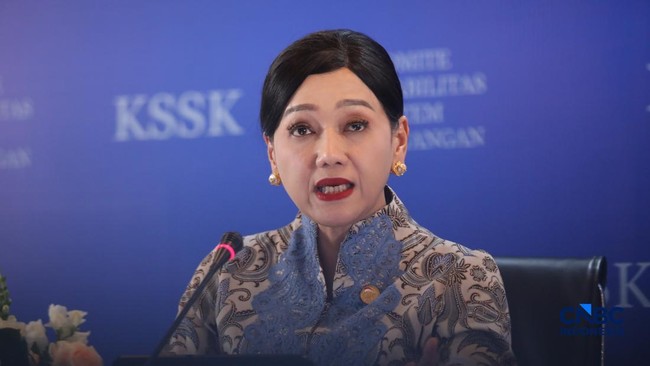
Jakarta, CNBC Indonesia — OJK Commissioner Chair Friderica Widyasari Dewi stated that the revision of the OJK Regulation (POJK) on bank business plans (RBB) will be completed in the third quarter of this year.
“The plan is to release it in the third quarter, where the RBB regulation revision is aimed at ensuring banks have directed and sustainable planning,” she said during a press conference of the Financial System Stability Committee (KSSK) on Thursday (7/5/2026).
Kiki explained that OJK views various government priority programmes as business opportunities that can be utilised by the banking sector.
She gave an example such as the 3 million houses programme. “This can be very useful for channelling credit, but it must prioritise risk management and good governance,” she said.
Kiki also assured that incorporating credit channelling plans into government programmes, as will be outlined in the revised POJK RBB, is not mandatory.
Banks are still given leeway in strategy with each company’s respective risk profile. “We emphasise that in credit decision-making, banks still have business judgement because they manage the public,” she said.
As previously reported, OJK is encouraging banks to channel credit to government priority programmes through the revision of Regulation Number 5/POJK.03/2016 on RBB.
Separately, in response to this, Bank Permata’s Chief Economist Josua Pardede assessed that the plan to issue the POJK RBB is fundamentally positive and relevant because financing support for government programmes is regulated within a more formal, measurable, and supervised bank planning framework.
According to Josua, there are several positive benefits that banks will experience if the POJK RBB is issued. First, banks will have a firmer direction because financing to priority sectors will no longer stand alone but will be included in official business documents that must be realistic and aligned with the bank’s strategy.
Second, this policy opens up growth opportunities in sectors being promoted by the government, such as SMEs, housing, food security, downstreaming, and village programmes. Third, the POJK RBB also demonstrates OJK’s support directing towards macro policies. In this regard, macroprudential liquidity incentives are directed to boost bank credit growth to the real sector and government priority sectors.
“This means, for banks that are ready in terms of capital, liquidity, and sector analysis capabilities, this policy can become a source of more directed growth, not just an additional administrative burden,” Josua said.
Nevertheless, Josua reminded that the implementation of POJK RBB also carries real risks. One of the biggest risks is if the spirit of supporting government programmes is interpreted too narrowly as an obligation to chase credit channelling targets, which then sidelines the principle of prudence.
From there, portfolio concentration risk will emerge, followed by mispricing of risk, credit channelling to immature business models, and ultimately increasing problematic loans. Credit risk in the SME segment and consumer credit also still needs to be monitored amid weak purchasing power and rising credit risk.