
OJK Targets Mineral Exchange to Begin Operating in 2027, with Commodity Prices Set Domestically
JAKARTA — Indonesia is preparing to operate the Mineral and Strategic Commodities Exchange (BMKS) from 1 January 2027, with the aim of establishing commodity reference prices based on transactions in the domestic market. The exchange is expected to improve transparency in mineral trading and reduce reliance on benchmarks currently set on overseas exchanges.
The Financial Services Authority (OJK) has prepared a regulatory and supervisory framework to support the exchange’s operations. It covers the exchange operator, clearing and custody institutions, trading mechanisms and the establishment of an Indonesian Reference Price.
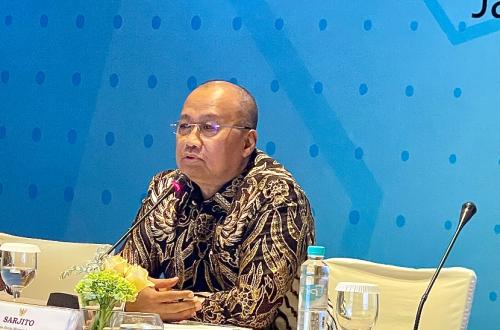
Sarjito, OJK’s Chief Executive for Supervision of the Mineral and Strategic Commodities Exchange, said Indonesia has substantial mineral wealth, but prices for several commodities are still linked to international markets. This is one reason to develop a more transparent domestic commodity trading system.
“We are a producer, but the price is decided on the London Metal Exchange,” Sarjito said at a media discussion in Jakarta recently.
Indonesia should use its position as a leading producer of several commodities to generate greater economic value, he said. Natural resource wealth does not automatically deliver maximum benefits if trade governance and price formation are not working effectively.
According to OJK presentation materials, Indonesia accounts for about 67 per cent of global nickel production. It also contributes around 21 per cent of global tin production and 9 per cent of global coal production.
This substantial mineral output gives Indonesia a basis for developing commodity trading through a domestic exchange. But a credible benchmark requires genuine transactions, reliable trading data and transparent market mechanisms.
Under OJK’s proposal, the Indonesian reference price will be formed through the interaction of supply and demand on the exchange. Each transaction will generate price and trading-volume data, which will then be used to develop the reference-price methodology.
The methodology must be submitted to OJK for approval and will be reviewed periodically. Under this system, the reference price is expected to reflect actual commodity transactions in the market.
OJK is also preparing supervision of the entire trading ecosystem, from the exchange to clearing and custody institutions. Oversight will cover risk management, transaction settlement, customer protection and market integrity.
Sarjito said supervision is needed to address commodity-trading practices that could reduce state revenue. In his presentation, he cited transfer pricing and under-invoicing, which can affect transaction values and tax liabilities.
He also highlighted the importance of checking whether the volumes and prices of traded commodities are accurate. This is a particular concern given Indonesia’s position as a major supplier of minerals to global markets.
To support the BMKS’s launch, OJK issued Regulation No. 15 of 2026 and Regulation No. 16 of 2026 on 17 September 2026. The regulations respectively cover the transfer of regulatory and supervisory authority from the Commodity Futures Trading Regulatory Agency (Bappebti), and the operation of the Mineral and Strategic Commodities Exchange.
OJK is now preparing four implementing rules in the form of Regulations of the Board of Commissioners’ Members (PADK). They will govern the exchange and its clearing and custody institutions, trading intermediaries, fit-and-proper assessments for managers, and the trading of products on the exchange.
Sarjito said the development of trading products would take account of market readiness and credibility. OJK may consider developing trading instruments as a transparent and well-governed ecosystem takes shape. “Once the market becomes more conducive, credible, and has integrity and transparency, that can be accelerated,” he said.
According to OJK’s timetable, internal preparations and stakeholder coordination will take place from September to November 2026. Licences for the exchange operator are targeted for December 2026, ahead of the first trading and the start of OJK supervision on 1 January 2027.
The preparations involve several ministries and agencies, including the Ministry of Energy and Mineral Resources, the Ministry of Trade, the Ministry of Finance, Bank Indonesia and the Mineral Industry Agency. Coordination is also under way with Danantara, mining industry players, clearing companies and other relevant parties.
The mineral exchange is being developed as the mining and quarrying sector continues to make a major contribution to the national economy. Statistics Indonesia data cited in OJK’s presentation show that the sector accounted for 8.75 per cent of Indonesia’s gross domestic product in 2025.
Meanwhile, downstreaming investment in the first half of 2026 reached Rp300.1 trillion, up 6.9 per cent year on year. This represented about 29.7 per cent of total national investment.
Through the creation of the mineral exchange, the government and OJK aim to establish a trading mechanism that can generate domestic reference prices while improving the traceability of transactions. Its success will depend on the readiness of infrastructure, industry participation and the availability of sufficient trading volumes.
Source: jawawa.id (https://jawawa.id/newsitem/ojk-targets-mineral-exchange-to-begin-operating-in-2027-with-commodity-prices-set-domestically-1791975043)
Originally published by Republika (https://ekonomi.republika.co.id/berita/tmw55m416/ojk-targetkan-bursa-mineral-beroperasi-2027-harga-komoditas-dibentuk-di-dalam-negeri), translated from Indonesian