
OJK Takes These Steps to Anticipate the Impact of Middle East Conflict on the Financial Sector
The Financial Services Authority (OJK) assesses that the escalation of the Iran-US-Israel conflict has the potential to increase transmission risks to the financial sector through three main channels. First, the financial market channel; second, rises in energy prices and the direct channel in trade; third, investment exposure.
To address this, OJK encourages financial services institutions to conduct forward-looking further assessments. Additionally, to strengthen anticipatory measures, including enhancing risk management, intensively monitoring debtor performance, and maintaining adequate liquidity and capital.
OJK Commissioner Chairman Friderica Widyasari Dewi stated that her side continues to monitor market movements and coordinates with self-regulatory organisations in taking necessary policy steps.
“We assess that several policies to maintain stock market stability remain relevant, namely share buybacks without general meetings of shareholders, delays in implementing short-selling transaction financing, trading halt policies, and auto-rejection limits. On 13 March 2026, OJK and the Indonesia Stock Exchange established the reimplementation of these policies,” said Friderica at the March 2026 Monthly Commissioners’ Meeting Press Conference on Monday (6 April).
Friderica noted that the escalation of geopolitical tensions in the Gulf region has heightened risks to global stability. This condition has driven surges in energy prices and increased volatility in global financial markets. However, the OJK Monthly Commissioners’ Meeting held on 1 April 2026 assessed that the stability of the financial services sector remains maintained.
Friderica conveyed that for domestic economic conditions, core inflation in March 2026 experienced a decline. Consumption activity also remained strong at the start of the year. This is reflected in estimated retail sales growth of 6.89% year-on-year, as well as solid motor vehicle sales performance.
“On the supply side, the Manufacturing PMI is still expansive. On the external resilience side, foreign exchange reserves in February 2026 are at an adequate level and recorded a trade balance surplus,” she emphasised.
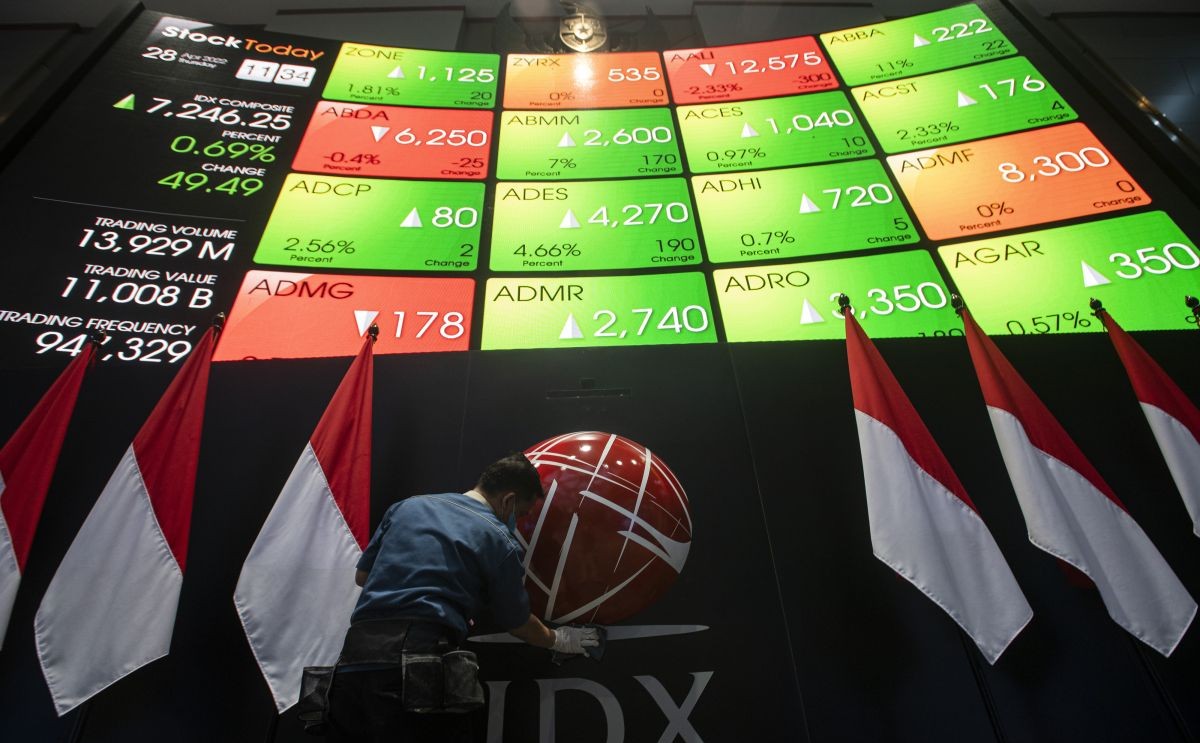
The Jakarta Composite Index of the Indonesia Stock Exchange opened weaker in Monday’s trading, in line with market participants still observing developments in the Middle East geopolitical conflict.
The movement of the Composite Stock Price Index (IHSG) at the opening of the week’s trading on Monday (6 April 2026) showed a negative trend.
The IHSG fell 0.99% to 7,026 in the week of 30 March-2 April 2026. The BEI market capitalisation shrank, with foreigners recording net sales of Rp33.83 trillion.
The IHSG closed weaker by 157.66 points or 2.19% to 7,026.78. Meanwhile, the group of 45 leading stocks or LQ45 index fell 12.21 points or 1.68% to 714.58.
Indonesia’s capital market has experienced quite dynamic movements with fairly high volatility levels due to geopolitical pressures and domestic and global conditions, according to the OJK Chief Executive.
The Indonesia Crypto Exchange (ICEx) has officially launched with support from 11 licensed asset digital providers and OJK permission, strengthening the national digital asset ecosystem on the global stage.
OJK imposed fines of Rp96.32 billion on 233 capital market participants up to March 2026, including Rp29.3 billion from share price manipulation cases.
First, she continued, share ownership transparency is already available even for 1% ownership for all listed companies on the Indonesia Stock Exchange.
Indonesia’s capital market has experienced quite dynamic movements with fairly high volatility levels due to geopolitical pressures and domestic and global conditions, according to the OJK Chief Executive.
The KPPU has decided on 97 business actors in information technology-based online lending services or fintech P2P lending, commonly known as online loans or pinjol.