
OJK strengthens rural banks through consolidation and regulatory relief
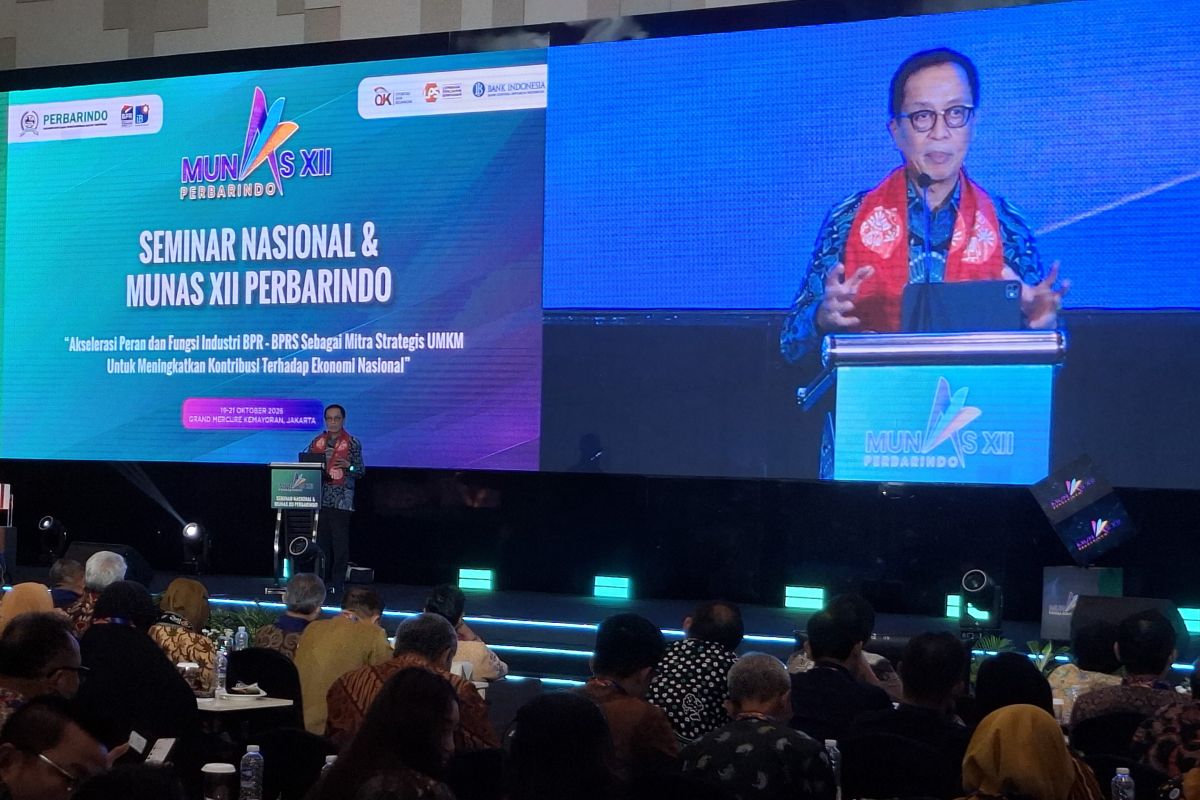
Jakarta (ANTARA) — The Financial Services Authority (OJK) is continuing to strengthen the capital of Bank Perekonomian Rakyat (BPR) and Islamic BPR (BPRS) through consolidation and regulatory relief, as 169 banks are still recorded as having core capital below Rp6 billion.
OJK Banking Supervision Chief Executive Dian Ediana Rae said the 169 institutions comprised 137 BPRs and 32 BPRS, or around 12 per cent of the total number of banks in the sector.
“This diversity is one of the important considerations for OJK in formulating policies and determining the direction of development for the BPR and BPRS industries,” Dian said at the 12th Perbarindo National Seminar and National Congress in Jakarta on Monday.
Dian said stronger capital structures and competitiveness were part of OJK’s efforts to improve BPRs’ and BPRS’s capacity to provide loans and financing to micro, small and medium-sized enterprises (MSMEs).
“OJK will consistently implement provisions on meeting minimum core-capital requirements and consolidation,” she said.
The policy also includes strengthening cooperation with regional development banks (BPDs), including by consolidating BPRs and BPRSs owned by local governments to increase financing for microbusinesses and improve regional banking governance.
Dian said OJK was offering a number of facilitations to BPRs and BPRSs undertaking mergers or consolidation. These include simplified administrative document requirements for prospective controlling parties and shareholders, as stipulated in OJK Regulation No. 7 of 2024.
Under OJK Regulation No. 7 of 2026, BPRs may meet core-capital requirements by adding paid-up capital or donated capital in the form of fixed assets, namely land and buildings, provided the specified conditions are met.
OJK is also providing relief in the implementation of Private Entity Financial Accounting Standards (SAK EP), particularly for calculating impairment loss allowances (CKPN), which requires the availability of historical data, core banking systems and technical capacity.
Another measure concerns the timeframe for foreclosed collateral (AYDA) to be treated as a deduction from core capital. Industry participants may apply for an extension by submitting an analysis of local economic conditions and a plan for resolving the collateral.
The analysis should consider, among other things, regional economic growth, trends in land and building prices and sales, steps already taken to resolve the collateral, and the effect of AYDA on the BPR’s financial performance.
Dian said the sector had substantial disparities in capital capacity. BPR core capital ranged from negative Rp18 billion to Rp1.3 trillion, while BPRS core capital ranged from negative Rp170 billion to Rp202 billion.
The variation was also reflected in total assets: BPR assets ranged from Rp424 million to Rp11.3 trillion, while BPRS assets ranged from Rp1 billion to Rp2.7 trillion.
Nevertheless, the sector’s aggregate capital adequacy ratio (CAR) stood at 28.5 per cent for BPRs and 17.31 per cent for BPRSs in August 2026. Both ratios remained above the regulator’s requirements.
OJK data showed that the assets, third-party funds and lending of the BPR-BPRS sector grew by 3.22 per cent, 3.14 per cent and 3.37 per cent year on year, respectively, in August 2026.
OJK previously reported that it had approved the merger of 117 BPRs and BPRSs into 33 banks by September 2026, while more than 200 other institutions were still undergoing the licensing process for consolidation.
Dian stressed that strengthening the sector must continue to observe prudential principles and good governance so that BPRs and BPRSs can boost their competitiveness while widening public access to financing.
“One strategic policy we will continue to promote is strengthening the structure and competitiveness of the industry, enabling BPRs and BPRSs to increase business growth, anticipate economic turbulence, face competition in the banking industry and perform their intermediary role more effectively for the public and the MSME sector,” she said.
Perbarindo chairman Tedy Alamsyah, speaking at the same event, said the sector needed comprehensive strengthening in terms of capital, governance, staff capabilities and digitalisation.
“Achieving this goal will, of course, require improvements in capital, governance, human-resource skills and the infrastructure needed to develop digitalisation,” Tedy said.
Source: jawawa.id (https://jawawa.id/newsitem/ojk-strengthens-rural-banks-through-consolidation-and-regulatory-relief-1792396387)
Originally published by Antara (Indonesian) (https://www.antaranews.com/berita/5796269/ojk-perkuat-bpr-bprs-lewat-konsolidasi-dan-kemudahan-regulasi), translated from Indonesian