
OJK: Rising Gold Demand Presents Opportunity for Domestic Production Capacity Development
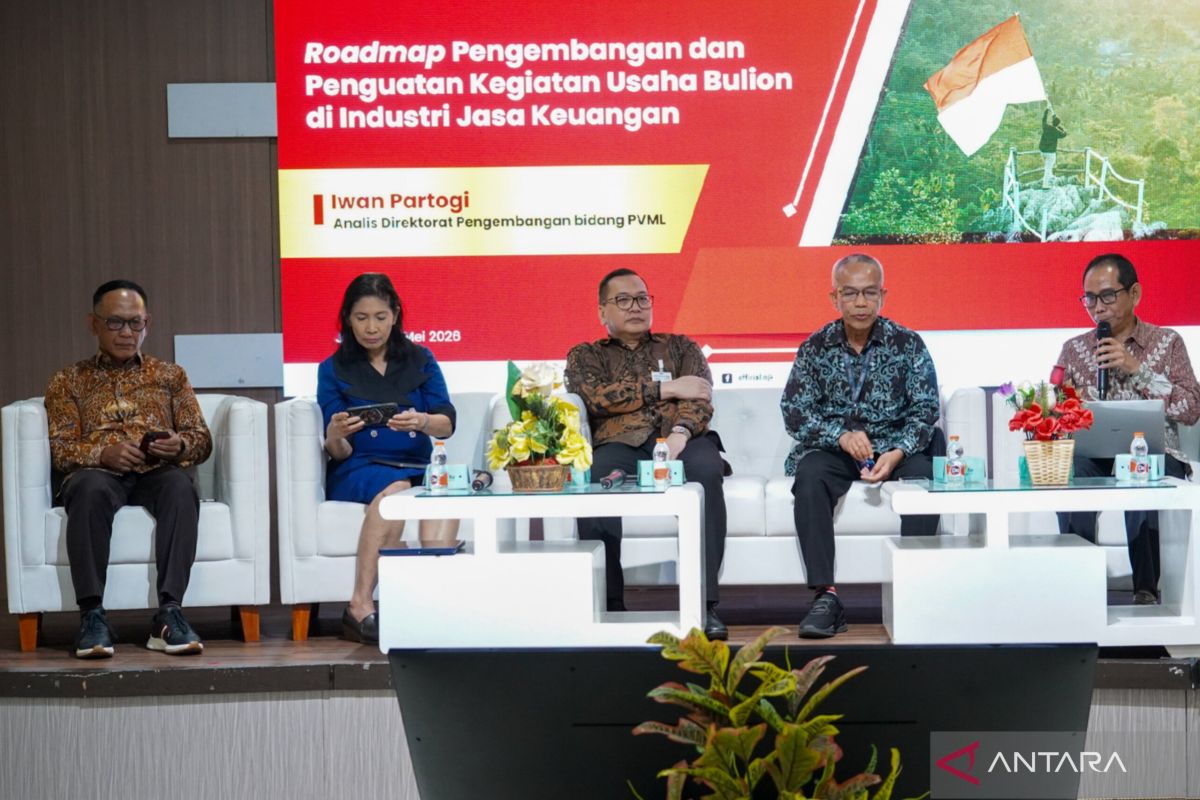
Jakarta (ANTARA) - OJK Financial Institution Development Analyst Iwan Partogi stated that the continuously increasing national demand for gold presents an opportunity for developing domestic production capacity and optimising existing gold resources in society.
Iwan revealed that Indonesia’s volume of gold bar imports has been steadily rising from 2016 to 2025, with an average annual growth rate of 29.10 per cent.
In 2025, approximately 89 per cent of Indonesia’s gold imports still originate from Australia, Hong Kong, Singapore, Japan, and Switzerland, Iwan said during a discussion event on the development of regulations, supervision, and the economic potential of gold banks organised by Universitas Kristen Indonesia (UKI), in a statement quoted in Jakarta on Sunday.
Furthermore, gold banks (bullion banks) are not separate institutions or legal entities, but rather business activities conducted by financial service institutions. The legal basis for such practices is regulated in the Law on the Development and Strengthening of the Financial Sector (P2SK), specifically articles 130 to 132.
Meanwhile, Bappebti’s Senior Trade Analyst M. Sis stated that government-supervised digital gold trading must have an underlying asset in the form of actual physical gold.
According to him, regulations for digital gold trading are established to prevent practices of trading gold without physical backing that could harm the public.
He explained that Bappebti implements a delivery versus payment (DVP) system, ensuring that physical gold is available before transactions are conducted.
Additionally, all traded gold must come from legal sources and be free from money laundering practices, terrorism financing, or other illegal sources.
On the banking industry side, BSI representative Rico Wardhana views bullion banks as a strategic government step in building a national gold ecosystem from upstream to downstream.
According to him, as one of the world’s major gold-producing countries, Indonesia must be able to leverage that potential to strengthen the national economy while expanding public investment access.
Rico stated that BSI currently manages around 23 tonnes of gold, and gold trading activities through bullion banks have seen significant increases since their launch in 2025.
“A simple aspiration from Mr Prabowo is for every individual to have gold, to have the opportunity to own gold,” Rico said.
He also revealed that more than one million people have gold accounts at BSI within about 13 months. Through bullion banks, the public can purchase gold starting from Rp50,000 and store gold digitally in a safer and more efficient manner.
Meanwhile, tax practitioner Wahyu Widodo assesses that the convergence between gold trading and the banking system in bullion banking could potentially create new taxation challenges if regulations are not designed in an integrated manner.
He recalled past experiences when sharia financing transactions were subjected to double taxation because they were considered as two separate transactions.