
OJK Reveals Why Sharia Financial Inclusion in Indonesia Remains Low
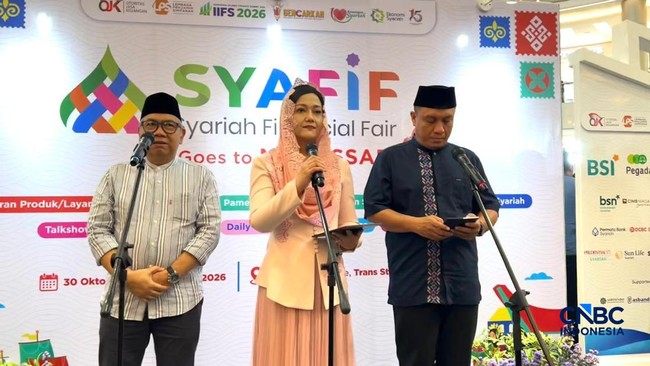
Jakarta, CNBC Indonesia — Indonesia’s sharia financial inclusion rate has reached only 13.4%, according to the Financial Services Authority (OJK)’s National Survey on Financial Literacy and Inclusion (SNLIK). The figure indicates that most Indonesians have yet to gain access to or use sharia financial products.
Indonesia nevertheless has considerable potential to develop its sharia finance industry, as the world’s largest Muslim-majority country. Sharia financial literacy among the public has in fact reached 43.07%.
OJK Board of Commissioners Chairwoman Friderica Widyasari Dewi said the high level of literacy had not been matched by adequate access to sharia financial products and services. She said limited accessibility remained one of the main obstacles to increasing sharia financial inclusion in the country.
“We continue to encourage sharia banks to improve accessibility for the public,” said Friderica, known as Kiki, at the Shariah Financial Fair (SYAFIF) in Makassar on Sunday (1 November 2026).
Another challenge is product innovation and differentiation. Sharia finance industry players need to offer products that are not only competitive but also relevant to the needs of the wider public.
Kiki cited sharia-based home financing, which is currently popular with consumers, including non-Muslims. She said the product’s appeal showed that sharia financial services could reach a broader market if they offered consumers added value.
“When a sharia product is good, it is not only Muslims who use it; people of all religions are happy to use it.”
Indonesia also has significant opportunities to strengthen its position in the global sharia economy. The country currently ranks fourth in the Global Islamic Economy Indicator Score 2025–2026.
Kiki said Indonesia’s status as the world’s largest Muslim-majority country was a strategic asset for improving its competitiveness and pursuing a top ranking. The 43.07% sharia financial literacy rate was also an initial foundation for developing the national sharia economy.
SYAFIF is an OJK programme to improve public literacy and inclusion in sharia finance. In 2026, it was held in four cities and reached thousands of people.
At the closing of SYAFIF in Makassar, the OJK and several stakeholders, including the Deposit Insurance Corporation (LPS) and the Indonesian Mosque Council (DMI), launched the Sharia Finance Reference and Preaching Guide (PELITA Syariah). The guide contains reference sermon texts that religious leaders can use to educate the public about the sharia economy and finance.
Through PELITA Syariah, the OJK hopes to raise public understanding and help people avoid risks stemming from limited financial literacy, ranging from scams to illegal investments.
Source: jawawa.id (https://jawawa.id/newsitem/ojk-reveals-why-sharia-financial-inclusion-in-indonesia-remains-low-1793541033)
Originally published by CNBC Indonesia (https://www.cnbcindonesia.com/market/20261101183248-17-781284/ojk-ungkap-alasan-sebenarnya-inklusi-keuangan-syariah-ri-masih-minim), translated from Indonesian