
OJK: Low-carbon transition an opportunity amid global challenges
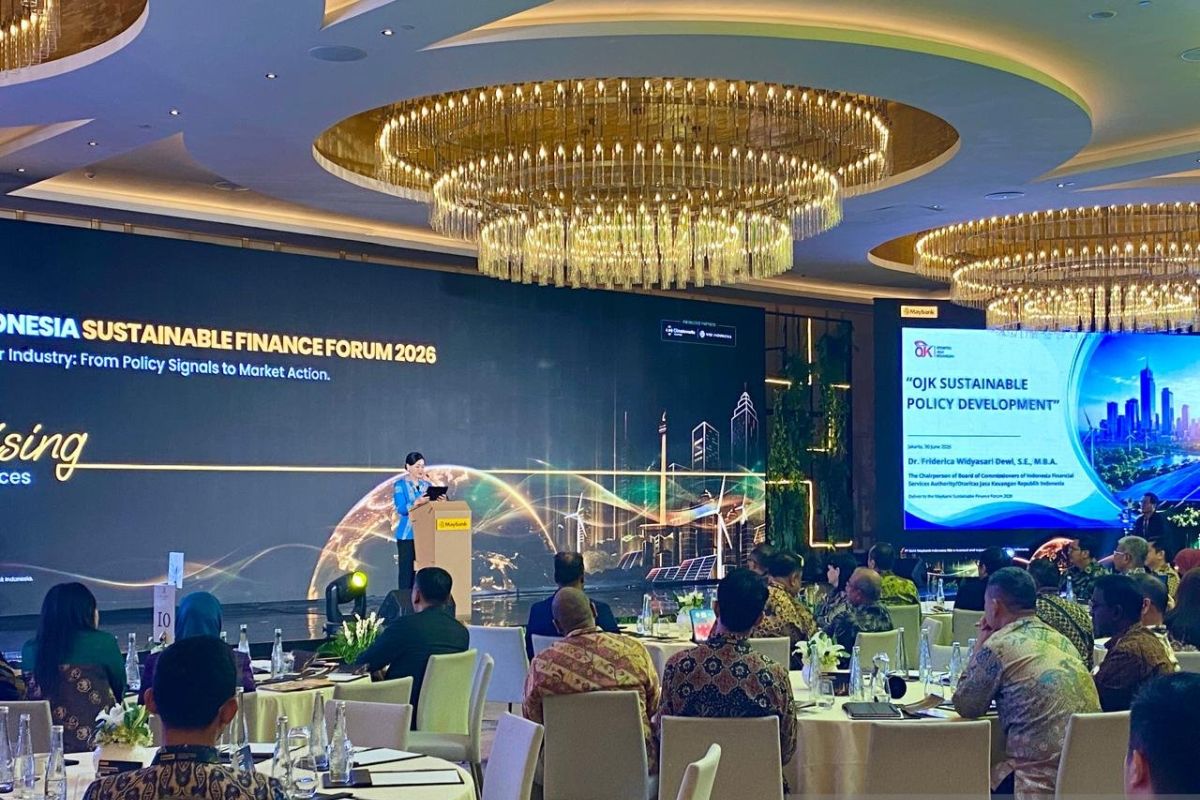
The Financial Services Authority (OJK) views the transition to a low-carbon economy not merely as an environmental necessity, but also as a significant economic opportunity, particularly amid various global challenges.
“Those who innovate and invest early will be in a better position to create long-term value and resilience,” said OJK Board of Commissioners Chair Friderica Widyasari Dewi at the Maybank Indonesia Sustainable Finance Forum 2026 in Jakarta on Tuesday.
Friderica cautioned that the global economy currently faces numerous challenges, ranging from geopolitical tensions and supply chain disruptions to climate change risks and market volatility. Additionally, climate change has become one of the most defining risks for the current generation, as it affects financial stability, investment decisions, and long-term growth prospects.
“In such a situation, building resilience is not enough with short-term responses alone. What is needed is structural transformation, and the financial services sector has a very important role in mobilising financing and accelerating the transition towards a sustainable economy,” Friderica said.
As a G20 member, Indonesia remains strongly committed to the Paris Agreement, the Sustainable Development Goals (SDGs), and achieving net zero emissions by 2060 or sooner. To realise these ambitions, Friderica believes substantial investment and close collaboration among all stakeholders are required.
“Therefore, OJK continues to strengthen a comprehensive sustainable finance ecosystem to provide policy certainty, build market confidence, and support Indonesia’s economic transformation,” she said.
To support Indonesia’s sustainable development agenda, OJK is strengthening the sustainable finance ecosystem through four strategic pillars. First, OJK continues to develop the Indonesian Sustainable Finance Taxonomy (TKBI) as a common reference framework for classifying sustainable economic activities and transition activities, aligned with national priorities and international standards.
Second, the regulator is also strengthening climate risk management through methodological improvements, policy refinements, data development, and enhanced analytical tools to bolster the resilience of the financial services sector. Third, OJK is improving the quality of sustainability disclosures through gradual alignment with internationally recognised reporting standards.
Fourth, the regulator is supporting the development of Indonesia’s carbon market ecosystem to mobilise green investment and accelerate the transition to a low-carbon economy.
“The transition to a sustainable economy cannot be achieved by regulators alone. It requires strong partnerships between the government, regulators, financial institutions, businesses, and investors. Therefore, OJK will continue to strengthen policies and create a conducive ecosystem,” Friderica said.
She added that at the same time, OJK also encourages all industry players to integrate sustainability principles into their strategies, governance, and business decision-making, not merely as an obligation, but as a driver of innovation, resilience, and growth. “Ultimately, our challenge today is how to turn policy signals into real action in the market,” Friderica concluded.