
OJK explains why Indonesia’s capital market is considered mismatched with ‘standalone’ status
The Financial Services Authority (OJK) says MSCI’s plan to reclassify Indonesia’s stock market as a standalone market has drawn the attention of financial authorities. Any change in status, it says, should take account of the country’s economic fundamentals, capital-market size and ongoing reforms.
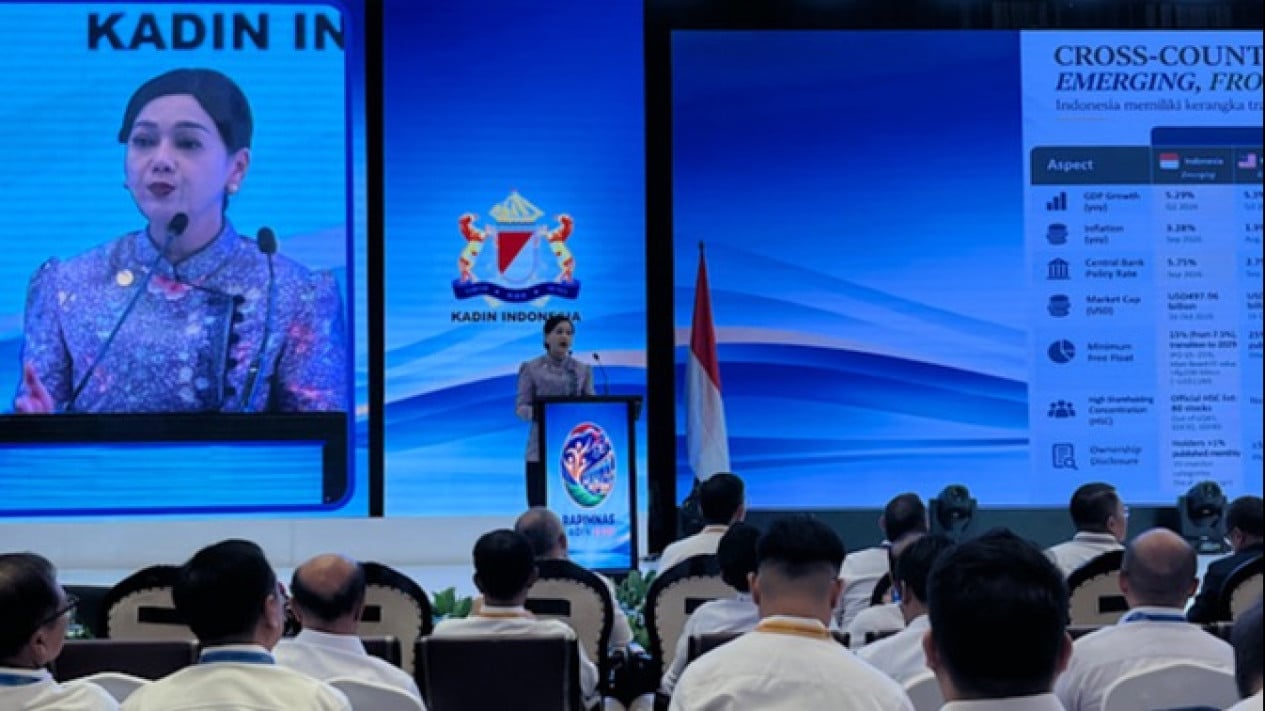
OJK Board of Commissioners Chair Friderica Widyasari Dewi said Indonesia’s capital market was not comparable with those of countries classified as standalone markets. Indonesia, she said, still had relatively strong economic and capital-market indicators.
“Is Indonesia comparable with countries such as Zimbabwe, countries such as Ukraine, which is at war, or Argentina, where inflation has reached more than 33 per cent? This is something we need to reflect on,” Friderica said at the Indonesian Chamber of Commerce and Industry’s (Kadin) national leadership meeting in Jakarta on Thursday (29 October 2026).
Friderica said Indonesia is currently in the emerging-market group alongside countries including Malaysia, South Korea, Türkiye and the Philippines. Indonesia remains competitive in terms of economic growth, inflation and market capitalisation, she said.
She also cited MSCI’s June 2026 market accessibility review, which found that Indonesia met 16 of the 18 assessment indicators. The result indicates that the country has fulfilled most of the parameters considered by global index providers.
Nevertheless, on 15 October 2026, MSCI announced a consultation on a proposal to reclassify Indonesia’s stock market from emerging-market to standalone-market status. Its assessment highlighted several issues, including transparency over share ownership structures, suspected coordinated trading and the need for evidence that rules are being implemented and enforced consistently.
OJK said it had introduced a number of reforms in response. These include improving share-ownership transparency by lowering the reporting threshold from 5 per cent to 1 per cent, strengthening free-float requirements and introducing a list identifying high shareholding concentration.
Friderica acknowledged, however, that enforcement remained one of the aspects under scrutiny in the assessment of Indonesia’s capital market. OJK would therefore continue to strengthen supervision and enforcement to improve market integrity and maintain investor confidence.
Source: jawawa.id (https://jawawa.id/newsitem/ojk-explains-why-indonesias-capital-market-is-considered-mismatched-with-standalone-status-1793285433)
Originally published by VIVA.co.id (https://www.viva.co.id/bisnis/1939650-ojk-ungkap-alasan-pasar-modal-ri-dinilai-tak-sepadan-dengan-kategori-standalone), translated from Indonesian