
OJK Chief Candidate Sarjito Outlines 3 Challenges for Indonesia's Mineral Exchange
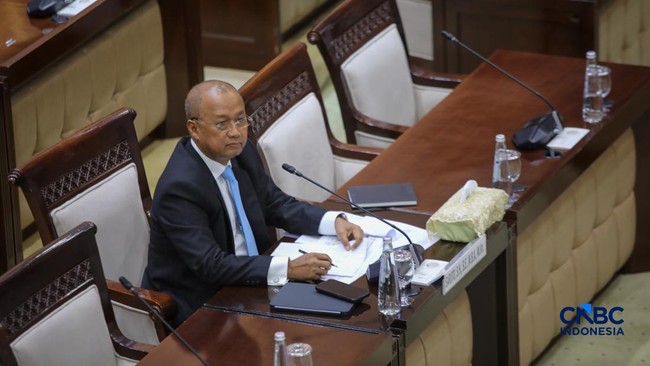
Jakarta - Candidate for Chief Executive of Mineral and Strategic Commodity Exchange Supervision (BMKS) at the Financial Services Authority (OJK), Sarjito, has outlined a number of challenges facing the development of Indonesia’s Mineral and Strategic Commodity Exchange.
Sarjito stated that Indonesia possesses abundant mineral and commodity wealth and plays an important role in the national economy and global supply chains. In 2025, the contribution of the mining and quarrying sector to Indonesia’s gross domestic product (GDP) reached 8.75%.
In terms of global production, Indonesia also dominates several strategic commodities, including nickel, with a production share of 67%, making Indonesia the world’s largest producer. This figure far exceeds the Philippines at 7% and Russia at 5%.
Similar dominance is seen in palm oil, where Indonesia’s production contribution reaches 57% of global output. Malaysia contributes around 25%, while Thailand accounts for 5%.
Despite holding a dominant position in the production of several commodities, Sarjito believes Indonesia does not yet have comparable influence in determining commodity prices. Prices for several Indonesian minerals still refer to international markets and exchanges.
“How can Indonesia be the world’s largest nickel producer but not determine its price? Other countries have the London Metal Exchange, Shanghai Futures Exchange, and others,” Sarjito said during a fit and proper test before Commission XI of the Indonesian House of Representatives on Monday (24/8/2026).
Therefore, the establishment of a Mineral and Strategic Commodity Exchange is expected to strengthen Indonesia’s role in price discovery while developing an Indonesia Reference Price. This reference price is expected to be formed based on credible transactions, clear quality standards, and adequate market liquidity.
Beyond pricing, there are issues within the national commodity trading ecosystem. These include the risk of under-invoicing, transfer pricing practices, and potential foreign exchange flight, which need to be addressed through stronger supervision and trade governance.
Sarjito also highlighted that data related to minerals and commodities is currently scattered across various institutions and not yet optimally integrated. The availability of accurate, transparent, and interconnected data is a crucial foundation for building a credible market.
The next challenge comes from a still-fragmented trading ecosystem and the need to broaden market participation. The exchange must also encourage product diversification, enhance the capacity and understanding of market participants, and address unlicensed trading and brokerage practices.
According to Sarjito, Indonesia’s main problem is not the availability of mineral and commodity resources. The greatest challenge is the suboptimal architecture and market ecosystem capable of supporting price formation, maintaining trading integrity, deepening the market, and integrating data across institutions.
To address these challenges, Sarjito previously presented eight strategic policies for developing the mineral and strategic commodity exchange ecosystem. The eight pillars consist of Trusted Infrastructure, Trusted Market, Trusted Player, Trusted Product, Trusted Data, Trusted Regulator, Trusted Ecosystem, and Trusted Price.