
OJK Awaits Presidential Regulation on Strategic Mineral and Commodity Exchange
Jakarta, CNBC Indonesia - President Prabowo Subianto today announced plans to establish a Mineral and Strategic Commodities Exchange (BMKS).
Under the supervision of the Financial Services Authority (OJK), the Mineral and Strategic Commodities Exchange is targeted to begin operations on 1 January 2027.
So, what will the implementation of this Mineral Exchange look like?
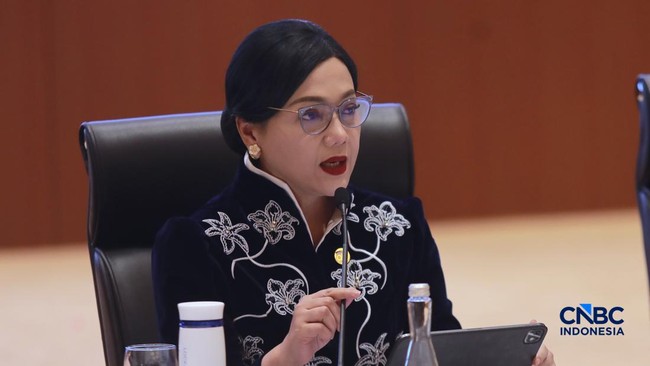
Chair of the OJK Board of Commissioners Friderica Widyasari Dewi said the implementation details for the Mineral and Strategic Commodities Exchange will be regulated through a Presidential Regulation (Perpres).
This Perpres will later govern the types of commodities involved and other details.
From the OJK’s side, she said the authority is also preparing OJK Regulations (POJK) covering the arrangements, the transition phases, and human resources.
“We have indeed held very intensive discussions, with the OJK, then with BIM (Mineral Industry Agency) and also with Danantara regarding the preparation stages for the BMKS,” she said during a press conference on the 2027 State Budget Draft and Financial Note at the Directorate General of Taxes building in Jakarta on Friday (14/8/2026).
“From the exchange side itself, we are focusing on preparing the OJK Regulations, of which there will be two. The first POJK will cover the transition phases to the BMKS for trading in minerals and strategic commodities. The second is a POJK on the arrangements. We are preparing those. Then preparations for the organisational structure, human resources, and budget are also being prepared,” she explained.
“Meanwhile, the types of strategic minerals and strategic commodities will be stipulated in the Perpres. So we will just wait for what the Perpres says and we will convey information to the media in stages once it is ready to be shared,” she said.
“But within the team we have already discussed the types of strategic minerals and commodities, though they will be in the form of a Perpres. We will just wait. That is all,” she concluded.
Meanwhile, Minister of Investment and Downstreaming/Head of BKPM and CEO of Danantara Rosan Roeslani explained that buy and sell transactions for strategic minerals are expected to be conducted through the Mineral and Strategic Commodities Exchange.
“With the Mineral Exchange, it is indeed hoped that transactions can be carried out through the exchange. But the nature of this Mineral Exchange is more of a spot market,” Rosan said on the same occasion.
“Later, for the development of this Mineral Exchange, we will see what form it takes, and of course the deepening of the exchange’s features is directed to accommodate this trade, so that what we hope for is transparency in transactions,” he explained.
“Of course, it is hoped that with this Mineral Exchange, transaction transparency will improve, so that accountability, transparency and governance will be better,” he said.
“Therefore, we fundamentally support the establishment of this Mineral Exchange, so that price formation is something that can be seen openly by all parties. And so, returning to the objective, the DSI and this Mineral Exchange are highly complementary to one another,” he explained.
President’s announcement
President Prabowo Subianto announced the next stage of Indonesia’s single-door export policy. He said Indonesia will soon have a Mineral and Strategic Commodities Exchange.
“Today I announce the next stage of our single-door export policy. We have discussed with the OJK that we want to immediately establish a Mineral and Strategic Commodities Exchange,” President Prabowo said during his speech at the DPR RI Plenary Session on the 2027 State Budget Bill and Financial Note at the Nusantara Building, DPR RI, Jakarta, on Friday (14/8/2026).
Prabowo said that for decades, Indonesia has been one of the world’s largest producers of palm oil, nickel, tin, coal, gold, coffee, rubber and various other commodities.
But, he continued, too often the prices of the wealth extracted from the earth and the sweat of the Indonesian people are determined abroad, on foreign commodity exchanges, using benchmarks that we did not create ourselves.
“Those who do not even have the commodities are the ones determining the price. This is unreasonable. I do not understand where such economics is taught. We own the goods, yet others determine the price. I ask the People’s Representatives, shall we continue this situation?” he said.
“Mothers work hard making batik, yet others determine the price. We must have the courage to change this situation. I ask for the support of the House of Representatives to change this,” he asserted, drawing thunderous applause and even a standing ovation from DPR RI members.
“And I say here, I am confident you all support me. If they do not want to pay the price we set, then they do not need to buy. Better that the commodity, the nickel, the tin, the gold, all of it stays in the ground for our children and grandchildren. Our coal, our oil, our gas, let them stay in the ground,” he continued.
“But of course we also understand market mechanisms. If the price is too high, that is unreasonable, but the important thing is that the exchange is on Indonesian soil,” he said.
“We will soon operationalise the Mineral and Strategic Commodities Exchange under OJK supervision. Our plan, if the OJK works well and I am confident the OJK works well, these are the mothers who now control our economy. Our plan, with the support of the DPR, is that on 1 January 2027 we will have our own Commodity Exchange,” he said.
“We are targeting the provisions for the operation of the Mineral and Strategic Commodities Exchange to be discussed immediately by the DPR RI and request that they be issued in the shortest possible time,” he concluded.