
OJK and PASTI Task Force Halt 278 Illegal Pawn Entities Since 2019
Jakarta (ANTARA) - The Financial Services Authority (OJK), together with the Task Force for the Eradication of Illegal Financial Activities (Satgas PASTI), has identified and halted the operations of 278 illegal pawn entities throughout the period from 2019 to June 2026.
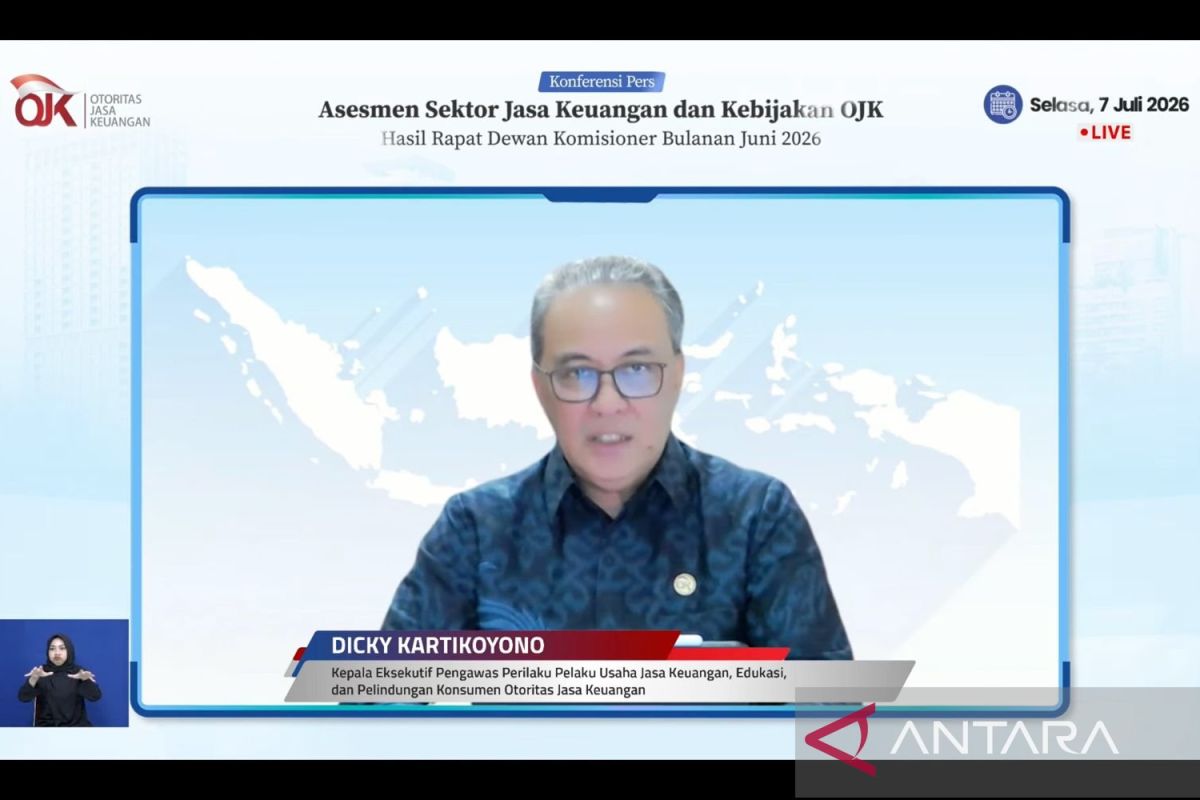
Dicky Kartikoyono, Chief Executive of Supervision of Financial Service Business Actors Behaviour, Education, and Consumer Protection at OJK, emphasised that the eradication of illegal pawnbrokers will continue through cooperation with the police, OJK offices across Indonesia, and other law enforcement officials.
“As soon as an entity is identified as illegal or we receive a complaint from the public, we immediately take action and stop its operations,” Dicky said during a press conference on the results of the RDKB in Jakarta, Tuesday.
Dicky stated that the existence of illegal pawnshops remains a concern for the authority as they continue to emerge. Therefore, the OJK, together with supervisory authorities and law enforcement officials, is continuously strengthening coordination to protect the public from illegal financial service practices.
He acknowledged that it is difficult to ascertain the exact number of illegal pawnshops because many operators move around and camouflage themselves, especially those in regional areas. This condition makes the identification process more challenging.
Nevertheless, the OJK adopts a proactive approach by immediately coordinating with law enforcement officials to stop the operations of any entity identified as an illegal pawnshop.
Based on monitoring results, Dicky explained that the public often falls victim to illegal pawnshops because pawn services are fundamentally easy to access and have a simple process. Customers simply hand over goods as collateral, which are then assessed to determine the loan amount.
This ease is exploited by illegal pawnbrokers to offer similar services without a licence. In fact, Dicky clarified, illegal pawn practices have the potential to harm the public, among other things, through the imposition of high fees and interest rates as well as other risks.
“Therefore, from a consumer protection perspective, we are very concerned about continuing to strive for the cessation of operations and eradication of illegal financial services, both illegal pawnshops and other illegal financial services that harm the public,” said Dicky.
Since 1 January 2026 until 12 June 2026, the OJK has received 312,326 service requests through the Consumer Protection Portal Application (APPK), including 45,989 complaints. Of these complaints, 14,989 came from the banking sector, 20,140 from the financial technology industry, 9,151 from finance companies, 878 from insurance companies, and the remainder related to the capital market sector and other non-bank financial industries.
In efforts to eradicate illegal financial activities and handle fraud, from 1 January 2026 to 30 June 2026, the OJK received 22,206 complaints regarding illegal entities. Of this total, 19,169 complaints concerned illegal online loans, 2,878 complaints related to illegal investments, and 159 complaints were about illegal pawnshops.
Through the Indonesia Anti-Scam Centre (IASC), the OJK together with Satgas PASTI has received 608,117 reports from the public. The number of reported accounts was 1,085,607, and the number of blocked accounts reached 557,751. To date, the total amount of victims’ funds that have been blocked is Rp674.1 billion. The IASC has also identified 132,117 telephone numbers reported by fraud victims.
The OJK stated that the IASC will continue to enhance its capacity to accelerate the handling of fraud cases in the financial sector. In line with these efforts, victims’ funds that have been returned amount to Rp196.93 billion, originating from accounts at 19 banks used by fraud perpetrators.