
OJK Accelerates Regional Economic Growth Through Cross-Sector Synergy
Jakarta — The Financial Services Authority (OJK) is strengthening the role of the financial services sector as an accelerator for regional economic growth through more inclusive, productive, and targeted financing, particularly in locally potential-based key sectors.
Inter-institutional synergy involving OJK, Bank Indonesia, the Ministry of Finance, local governments, the financial services industry, and other relevant technical ministries is essential to support various Regional Economic Development Acceleration programmes.
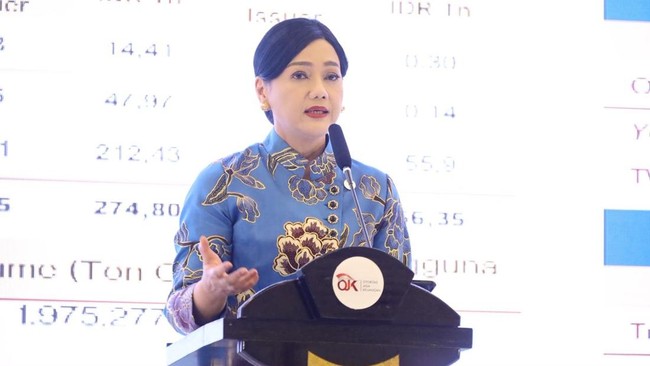
This was stated by OJK Commissioner Chairperson Friderica Widyasari Dewi during her speech at the 2026 National Conference on Regional Economic Development (KNPED), themed ‘Accelerating Regional Economic Growth Through Cross-Sector Policy Synergy’, held at Balai Kartini on Monday.
“Current global dynamic challenges must not diminish Indonesia’s optimism. This is precisely the time to prove that Indonesia’s strength lies in its regional economies. Let us love Indonesia by working together, synergising, and collaborating to support regional economic growth, which we hope will underpin national economic growth, making Indonesia more advanced and prosperous in the future,” Friderica said, quoted on Tuesday (26 May 2026).
Attendees at KNPED 2026 included Coordinating Minister for Economic Affairs Airlangga Hartarto, Commission XI Chairman of the House of Representatives Mokhamad Misbakhun, Trade Minister Budi Santoso, Micro, Small, and Medium Enterprises (UMKM) Minister Maman Abdurrahman, Deputy Finance Minister Juda Agung, Deputy Agriculture Minister Sudaryono, Deputy Interior Minister Bima Arya Sugiarto, and Senior Deputy Governor of Bank Indonesia Destri Damayanti. Additionally, regional leaders such as Central Java Governor Ahmad Luthfi, South Sumatra Governor Herman Deru, Jambi Governor Al Haris, and West Sumatra Governor Mahyeldi Ansharullah were present.
KNPED 2026 was also attended by East Java Deputy Governor Emil Elestianto Dardak and North Sulawesi Deputy Governor Victor Mailangkay.
According to Friderica, since 2024, OJK has developed the Regional Economic Development Programme (PED), focusing on optimising regional economic potentials through collaboration with relevant ministries and agencies to build ecosystems supporting economic development.
To date, PED has been implemented in 40 regencies and cities, focusing on agriculture and the creative economy, including in South Sumatra, East Java, Central Java, and Jakarta.
OJK Deputy Commissioner Hernawan Bekti Sasongko said the PED programme is expected to significantly benefit regional economies and local communities.
“We continue to expand PED to deliver tangible regional contributions through collaborations that build priority programme ecosystems,” Hernawan said.
Economic Affairs Coordinating Minister Airlangga Hartarto stated that national economic growth is inseparable from regional growth, hence the central government consistently strives to boost regional economies.
“Rural Credit (KUR) disbursement is being accelerated to support regional economies. The government is also promoting digitalisation across economic activities. Furthermore, it is advancing semiconductor industries, downstreaming processes, and preparing skilled human resources,” Airlangga said.
Misbakhun noted that financial services are a high-contributing sector to Indonesia’s economic growth, and targeted financing regulations would empower micro, small, and medium enterprises (MSMEs) and boost consumer purchasing power, impacting GDP.
“I highly appreciate OJK’s efforts to consolidate financial services sector tasks with local governments and accelerate the Regional Financial Access Acceleration Team (TPAKD). This is our collective responsibility to ensure development benefits reach all Indonesians,” Misbakhun said.
Deputy Finance Minister Juda Agung explained that collaboration and synergy are crucial for empowering regional economic growth to support the national economy.
“We must move together to achieve a strong economy. A strong regional economy is not just about large budgets but transforming budgets into services, services into productivity, and productivity into prosperity. Growth does not start from numbers but when central and local policies work together, with benefits felt at household level,” Juda said.
PED Direction
OJK’s PED implementation stages include mapping regional economic potentials through TPAKD, preparing integrated multi-stakeholder collaboration, enhancing financial services and real sector financing capacity, and leveraging financial products to add value to regional strengths.
In South Sumatra, PED focuses on developing the coffee ecosystem from upstream to downstream. By 2025, Indonesia’s coffee production is projected to reach 832,700 tonnes, potentially rising to 1.2 million tonnes annually through land productivity optimisation supported by coffee processing industry valued at Rp129 trillion.
In East Java, PED develops a dairy cattle ecosystem to support the national food value chain. With an economic value of Rp49.5 trillion, strengthening efforts include productivity enhancement, technology adoption, and expanded financial access, which could be applied to other dairy regions.
In Central Java, PED supports food security through commodity development…