
Oil Shock, Fuel Hike Drag JCI Lower Amid US–Iran Uncertainty
Oil Shock, Fuel Hike Drag JCI Lower Amid US–Iran Uncertainty
Jakarta. Indonesia’s benchmark index ended lower on Monday as escalating US–Iran tensions disrupting oil flows through the Strait of Hormuz and domestic fuel price hikes weighed on sentiment, keeping investors cautious despite supportive global cues.
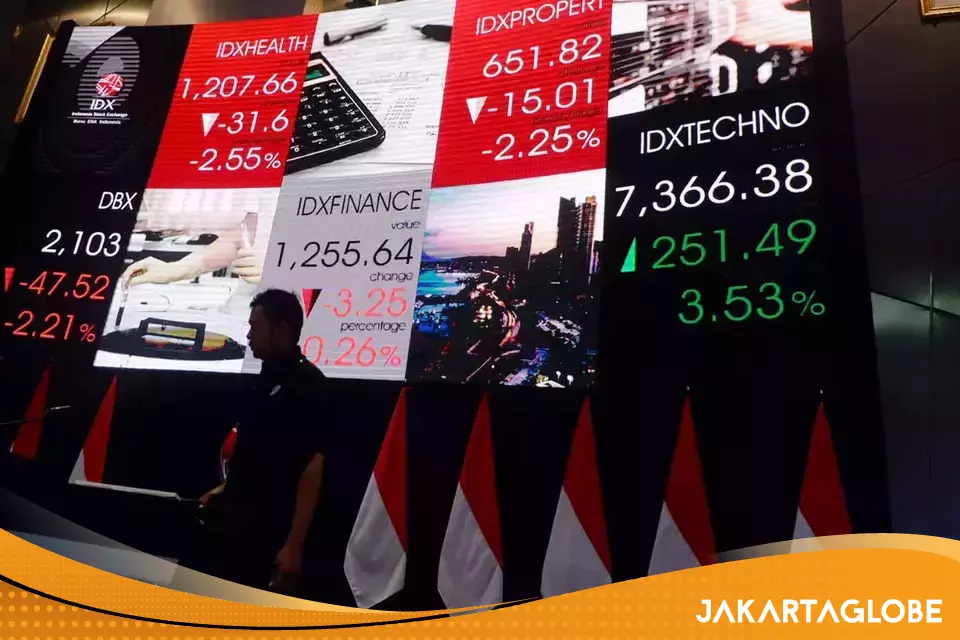
Jakarta Composite Index (JCI) opened at 7,594 and briefly slid as much as 39 points, or 0.52%, moving within a range of 7,570–7,692. By the close, the index trimmed losses to end down 12 points, or 0.16%, at 7,621, reflecting choppy trading as investors adopted a cautious stance.
Data from RTI showed trading volume reached 40.5 billion shares, with turnover of Rp 16.64 trillion ($970 million) across 2.4 million transactions. Decliners outnumbered gainers, with 424 stocks falling, 247 advancing, and 148 unchanged.
Top gainers included Danasupra Erapacific (DEFI), which surged 34.97%, LCK Global Kedaton (LCKM) up 34.88%, Intermedia Capital (MDIA) rising 34.83%, and Kedaung Indah Can (KICI) gaining 34.38%.
On the losing side, Multipolar Technology (MLPT) dropped 15%, Jaya Sukses Makmur Sentosa (RISE) fell 13.03%, City Retail Developments (NIRO) declined 12.50%, and Charlie Hospital (RSCH) slid 12.50%.
According to Pilarmas Investindo Sekuritas, external pressures were dominated by escalating tensions between the US and Iran. The situation intensified after US President Donald Trump said the US Navy had seized an Iranian-flagged cargo ship in the Gulf of Oman for allegedly violating sanctions.
Iran, meanwhile, signaled it would halt further negotiations and tightened control over the Strait of Hormuz, raising concerns about disruptions to global oil supply and heightening market uncertainty.
“Markets are still closely monitoring the dynamics of the Middle East conflict, which could disrupt global energy supply chains,” Pilarmas wrote in a Monday research note.
Despite geopolitical risks, sentiment found limited support from China’s monetary policy. The People’s Bank of China (PBoC) kept its benchmark lending rates unchanged, with the one-year loan prime rate (LPR) at 3.0% and the five-year tenor at 3.5%, signaling efforts to maintain stability as the economy grew 5% in the first quarter of 2026.
Domestically, Pilarmas noted that the government’s move to raise non-subsidized fuel prices added to market pressure, with potential inflationary effects, particularly on transportation and logistics costs.
“Although the impact is expected to be limited as subsidized fuel prices remain unchanged, markets are still watching for pressure on purchasing power and corporate margins, especially in energy-intensive sectors,” the firm added.
Read More:
Indonesia Credit Grows 10.42% in Q1 as Corporate, Consumer Lending Offset MSME ContractionOn a more positive note, S&P’s maintained Indonesia’s investment-grade rating with a stable outlook.
“This reflects solid economic fundamentals, supported by fiscal discipline and tax reforms,” Pilarmas said.
Globally, oil prices jumped more than 5% amid renewed tensions, with US crude rising 5.3% to $87.88 per barrel and Brent crude gaining 5.3% to $95.62.
Asian markets were mixed but broadly resilient. Japan’s Nikkei 225 rose 0.6% to 58,824, while South Korea’s Kospi added 0.4% to 6,219. Hong Kong’s Hang Seng Index climbed 0.8% to 26,361.07, and China’s Shanghai Composite Index advanced 0.8% to 4,082.
On Wall Street, the rally extended last week. The S&P 500 jumped 1.2% to a record 7,126, the Dow Jones Industrial Average surged 1.8% to 49,447, and the Nasdaq Composite climbed 1.5% to 24,468.
Tags: Keywords: