
Oil Prices Swing Wildly as Surge Turns to Sudden Drop
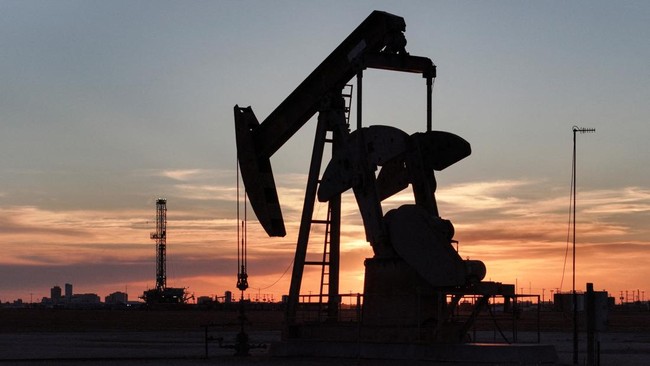
JAKARTA, CNBC Indonesia – Oil prices have swung violently amid uncertainty over a US-Iran trade deal. According to Refinitiv, Brent crude was trading at $98.63 per barrel on Wednesday (27/5/206) at 08:19 WIB, down 0.95%, while WTI fell 1.22%. The volatility is evident as on Tuesday (26/5/2026), Brent had surged 3.6% to $99.58 per barrel, while WTI dropped 1.22% to $92.74.
Oil prices weakened in early Asian trade as markets weighed the prospects of a US-Iran deal to reopen the Strait of Hormuz. Tehran signaled that recent attacks would not derail ongoing negotiations, while US Secretary of State Marco Rubio stated potential obstacles could be resolved within days. The combination of ongoing military tensions and open diplomatic channels has left markets highly sensitive to new developments.
Oil options market data analysed by Capital Economics shows investors expect prices to stabilise in the coming three months as shipping through the Strait of Hormuz normalises. However, market confidence in this scenario is considered low compared to historical patterns. Capital Economics analyst Kieran Tompkins said investors are heavily hedging against alternative risks, including failed deals or prolonged, disrupted reopening of the strait. This is reflected in options markets implying a 37% probability of prices breaching $100 per barrel within three months – a figure too significant for energy market participants to ignore, despite spot prices softening.
Uncertainty remains the dominant market factor. Rubio’s comment on a potential deal within days is now a critical point for investors. If the deadline passes without a clear agreement, the current oil price decline could reverse sharply. Markets view the combination of diplomatic progress and military attacks as a condition keeping oil volatility high despite falling prices.
US officials have repeatedly stated they are close to a deal with Iran to end the conflict, but no final agreement has been reached beyond a temporary ceasefire that has drastically reduced attacks. On Tuesday, Iran accused the US of violating the ceasefire after a defensive strike in southern Iran. Meanwhile, US Secretary of State Marco Rubio said negotiations to halt the conflict may still take ‘a few more days’.
Iran’s Foreign Ministry labelled the US attack in Hormozgan province, where local media reported explosions early Tuesday, as a ‘serious breach’ of the fragile ceasefire that has lasted nearly seven weeks. Previously, both sides were said to have drafted a memorandum of understanding to end the war and reopen blocked shipping routes, while giving 60 days for more complex negotiations, including Iran’s nuclear programme.
Tankers Begin Navigating Strait of Hormuz
Iran effectively halted nearly all non-Iranian shipping through the Strait of Hormuz after the war began in late February, disrupting about a fifth of global oil and liquefied natural gas (LNG) flows. However, vessel tracking data shows three LNG tankers have passed through the strait in recent days bound for Pakistan, China, and India. Additionally, a supertanker carrying Iraqi crude to China finally navigated the strait after being held up for nearly three months.
However, UK Maritime Trade Operations reported a tanker suffered an external explosion on its port side near the waterline, about 60 nautical miles from Muscat, Oman’s capital. Pakistan also plans to increase crude oil and refined products storage capacity to bolster energy resilience, according to government documents shared with oil producers and global trading firms.
Meanwhile, US consumer confidence dropped in May amid rising inflation fears from the conflict and persistent household pessimism about the labour market. Rising inflation has pushed up consumer prices, prompting central banks like the Federal Reserve to worry about tightening monetary policy – a move that could increase borrowing costs and dampen economic growth.