
Oil Prices Surge as Tankers Emerge from Hiding After US-Iran Talks Collapse
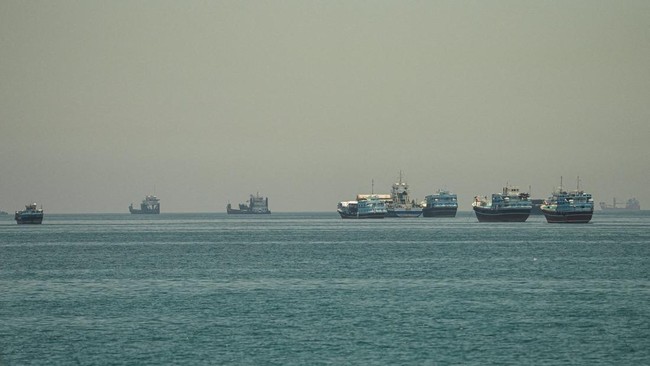
Global oil prices rose again after United States (US)-Iran negotiations in Switzerland were cancelled. The cancellation triggered concerns that the path towards a permanent peace remains fraught with uncertainty. According to Refinitiv, Brent crude oil prices closed at US$80.57 per barrel on Friday (19/6/2026), strengthening by 0.90%. This gain extended its positive trend, rising 2.03% over three consecutive days. Over the week, however, Brent crude prices fell 7.96%, marking a two-week slump. Meanwhile, WTI crude oil prices closed up 1.27% at US$77.54 per barrel on Friday, but fell 8.64% over the week. Oil prices rose despite Iran and the US maintaining a temporary ceasefire, including the reopening of shipping lanes in the Strait of Hormuz. US Vice President JD Vance stated that Iran has so far adhered to its commitment by not attacking ships transiting Hormuz. However, the cancellation of further talks in Switzerland kept market participants on edge. Separately, OPEC Secretary General Haitham Al Ghais asserted that global oil demand will not peak in the near future. Analysts at Kpler noted in a client report on Friday that Iranian supertankers have begun reactivating their transponders after switching them off during the conflict. The vessels started broadcasting their positions again while transiting the Strait of Hormuz after weeks of concealing their movements. AXS Marine data showed 25 commercial voyages through Hormuz on Thursday (18/6/2026), the highest number since 18 April and more than five times the daily average during the first ten days of June. However, this figure remains far below the pre-conflict normal level of around 120 voyages per day. Gulf oil producers are also actively offering supplies. Kuwait Petroleum Corp offered July-delivery crude oil via tender after lifting its force majeure status and announcing plans to increase production. Meanwhile, Abu Dhabi National Oil Company (ADNOC) issued its fourth tender this month. The United States officially lifted its blockade of Iranian ports on Thursday. The US Navy-led Joint Maritime Information Center (JMIC) warned mariners to remain vigilant for sea mines and military activity during clearance operations. JMIC also advised ships to avoid the Traffic Separation Scheme (TSS) route due to mine risks. The TSS route, adopted by the UN shipping agency in 1968, regulates shipping lanes through Iranian and Omani waters in the Strait of Hormuz. Shipbroker Braemar wrote in a note to Reuters, “The risks range from the threat of mines to the possibility of ships becoming trapped in the Middle East Gulf if tensions escalate again and Iran re-closes Hormuz. This deal also opens the possibility of Iran charging fees for managing Hormuz transit after 60 days.” Switzerland stated that further US-Iran negotiations regarding a broader peace agreement would not take place on Friday. US Vice President JD Vance also cancelled his visit, underscoring the high uncertainty surrounding long-term peace. Iran signalled it would tighten control over shipping traffic. Iranian state television reported that ships transiting Hormuz must coordinate with the Islamic Revolutionary Guard Corps Navy. British maritime security firm Ambrey reported that Iranian forces ordered a Hong Kong-flagged tanker and a Saint Kitts and Nevis-flagged cargo ship to turn back on Thursday. In a circular sent to the shipping industry and obtained by Reuters, the Persian Gulf Strait Authority (PGSA) of Iran stated that no vessel is permitted to transit the Strait of Hormuz without a valid navigation permit from the agency. The PGSA, claiming to be the sole permit-issuing authority, also asserted the right to charge insurance fees and require ship owners to obtain and renew insurance protection. The shipping industry rejects any form of fee or tariff imposed on what they consider international waters. Meanwhile, a fleet of ten Iranian-flagged supertankers carrying nearly 20 million barrels of oil reportedly sailed from the Chabahar anchorage area in the Gulf of Oman towards Asia, likely to supply independent refineries in China. Charlie Brown, senior advisor to the Iranian tanker monitoring organisation United Against Nuclear Iran (UANI), said, “The polemic regarding unilateral US sanctions no longer appears to be the main issue.” Five fully loaded Iranian supertankers were also observed leaving the area on Friday. Kpler analysts wrote, “The two-way shipping flow indicates that Iranian crude oil trade is gradually beginning to return to near-normal operating patterns.” Eighteen ships transiting Hormuz on Thursday used the shipping lane designated by Iran. Only one vessel used the official route established by the International Maritime Organization (IMO), while the routes of six other ships could not be confirmed. The US-Iran deal also raised questions about the future governance of the Strait of Hormuz. After the 60-day fee-free period ends, Iran will hold talks with Oman and Gulf states to discuss the strait’s management mechanism. This provision opens the door for Iran to impose transit fees or tariffs on ships passing through the Strait.