
Oil Prices Rebound as OPEC Faces Growing Rift and Power Struggle
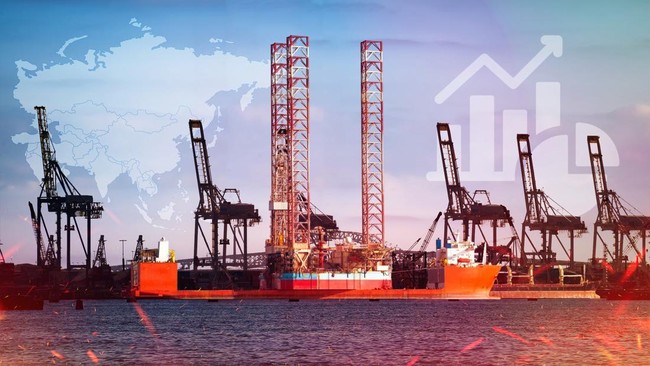
Global crude prices ended the week lower, but still managed to post a weekly gain.
Concerns over disruptions to global supplies have resurfaced after a series of attacks targeted oil tankers and refineries in the Middle East.
Although prices fell in the day’s trading, Brent crude strengthened over the week as geopolitical risks increased in one of the world’s main oil-producing regions.
According to Refinitiv, January Brent crude futures fell 1.3% to US$95.27 a barrel.
The decline ended a three-day run of gains.
US West Texas Intermediate (WTI) crude fell 0.7% to US$83.08 a barrel.
For the week, Brent rose 3.1%, ending a three-week losing streak. WTI, meanwhile, fell 1.1%, extending its decline to four consecutive weeks.
Mark Schaefer, a director at brokerage firm Liquidity Energy, said attacks on energy facilities and tankers in the Middle East had again raised the risk of disruptions to global oil supplies.
“Attacks on energy facilities and tankers in the Middle East are once again increasing the risk of supply disruptions,” he said, as quoted by Reuters.
Saudi refinery attack and turmoil in the Strait of Hormuz
Market concerns are not without cause. Part of Saudi Aramco’s Jazan refinery was reported to have temporarily halted operations after being struck by a projectile on Thursday.
The incident killed a Nepalese worker.
The attack came a day after Yemen’s Houthi rebel group claimed responsibility for an attack on Ras Tanura, Saudi Arabia’s largest refinery and one of the country’s main crude oil export hubs.
Iran has also continued to attack vessels transiting the Strait of Hormuz, disrupting oil exports through the strategic shipping route.
The Houthis have continued their attacks on Saudi energy infrastructure.
The attacks reversed market sentiment, which had improved after US President Donald Trump refrained from escalating military action against Iran following the US midterm elections.
Markets await OPEC+ decision
Alongside the Middle East conflict, investors are focused on Sunday’s OPEC+ meeting.
Three sources familiar with the discussions told Reuters that OPEC+ had reached an initial agreement to keep its oil production targets unchanged at least through the first quarter of 2027.
Markets are nevertheless watching for the alliance’s formal decision, particularly on production policy for that period. OPEC+ includes oil-producing countries such as Saudi Arabia and Russia.
Capital Economics senior economist Hamad Hussain warned of the potential for internal divisions within the producer group.
He said an increasingly fragmented and less cohesive OPEC+ could increase oil price volatility and heighten the risk of downward pressure on prices in the longer term.
Iraq has begun urging the Organisation of the Petroleum Exporting Countries (OPEC) to raise its production ceiling. The group’s second-largest oil producer wants to expand its energy sector capacity and increase crude output.
The request comes ahead of Sunday’s OPEC+ meeting, which will discuss production policy for the coming period.
Iraqi Oil Minister Basim Mohammed Khudair said the government was negotiating with OPEC for a larger production quota. He did not say when it expected an increase to take effect.
“We have told OPEC member states that Iraq needs to develop its infrastructure. Therefore, Iraq’s production ceiling within OPEC should be raised, taking into account our country’s specific circumstances,” he said on Friday, as quoted by Reuters.
The quota issue is linked to OPEC+’s first-ever assessment of its members’ production capacity. The results are intended to help determine oil production targets for 2027.
The process has encountered obstacles because of conflicting interests among member states.
A source familiar with the matter said Iraq was dissatisfied with an initial assessment that put its production capacity at 4.9 million barrels per day (bpd). Kazakhstan, another OPEC+ member, has also sought a higher capacity assessment.
Russian Deputy Prime Minister Alexander Novak previously said the capacity assessment was expected to be completed by the end of this year. Energy ministers meeting on Sunday will receive an update on the process.
OPEC+ faces threat of a supply glut
As members call for higher quotas, OPEC+ is also facing the prospect of a global oil surplus that could put downward pressure on prices.
Three sources familiar with the discussions said OPEC+ had reached an initial agreement to keep production targets unchanged during the first quarter of 2027.
Analysts at Rapidan Energy Group also expect no change to production targets at Sunday’s meeting. Uncertainty over how long the Iran war will last and its impact on oil production and exports are key considerations.
Rystad Energy, meanwhile, forecasts that the global oil market could face a surplus of about 5 million barrels a day in 2027. That would be equivalent to around 5% of total global oil demand, even if supplies from the Gulf recover only partially.
The prospect of a surplus poses a challenge for OPEC+ as it sets its production strategy for next year. Pumping too much oil into the market could put further pressure on prices.
Member states threaten to leave OPEC
Production quotas are also a sensitive issue within OPEC. Iraq is not the only country disputing its limits.
The United Arab Emirates left OPEC and OPEC+ several months ago so it could increase oil production, after years of arguing that its quotas did not reflect the scale of its investment and production capacity.
Angola had previously left OPEC in early 2024.
Iraq has even warned that it could leave the organisation if its demand for a higher production quota is not met.
This adds to pressure on OPEC+’s cohesion. The group must balance global supply and prices, while some members want to produce more oil to maximise revenue and energy investment.
Trump reportedly pressed Iraq and Venezuela to leave OPEC
The administration of US President Donald Trump was reportedly said to have pressured Iraq and Venezuela to leave OPEC. Washington was also suspected of obstructing Venezuela’s payment of its membership fees.
The alleged aim was to clear the way for both countries to increase oil production without being bound by OPEC quotas.
Pressure on Venezuela prompted Saudi Crown Prince Mohammed bin Salman to intervene. In Iraq, the possibility of leaving OPEC was discussed but rejected by the Ministry of Oil.
The US manoeuvre has added to pressure on OPEC, which has begun to lose members. Amid global competition over oil production, the cartel’s cohesion is increasingly being tested.
Source: jawawa.id (https://jawawa.id/newsitem/oil-prices-rebound-as-opec-faces-growing-rift-and-power-struggle-1795837856)
Originally published by CNBC Indonesia (https://www.cnbcindonesia.com/research/20261128065517-128-789265/harga-minyak-bangkit-opec-pecah-rebutan-kekuasaan-makin-sengit), translated from Indonesian