
Oil Flows Through the Strait of Hormuz Plunge 77% as Türkiye’s Foreign Minister Warns Sea Lanes Could Become Battlefields
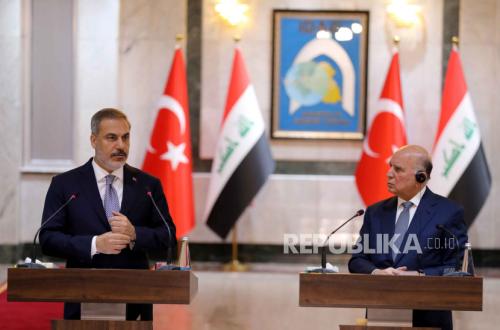
JAKARTA — Türkiye’s Foreign Minister Hakan Fidan has warned that the world’s maritime trade routes are increasingly at risk of becoming battlefields and instruments of geopolitical pressure. Tensions in the Strait of Hormuz, Bab el-Mandeb and the Black Sea could disrupt energy supplies, raise freight costs and threaten food security in countries thousands of kilometres from conflict zones.
Fidan made the remarks at the TRT World Forum 2026 in Istanbul on Saturday (7 November 2026). Speaking in a session entitled “The New Geopolitics of Connectivity: Sea Lanes, Chokepoints, and Corridors”, he said international trade’s reliance on a small number of narrow routes had created new vulnerabilities for the global economy.
Military conflicts, Fidan said, now threaten not only human lives and national territory but can also turn trade infrastructure into a means of political pressure. Shipping lanes that once connected the world’s production and consumption centres can cease to function when war or security threats impede commercial shipping.
“A shipping lane can become a battlefield. Energy pipelines can become instruments of political pressure,” Fidan said, according to Anadolu Agency on Saturday.
He stressed that disruption at a single global trade chokepoint can have repercussions for countries not directly involved in a conflict. When cargo ships cannot operate normally, supplies of raw materials, energy and essential goods are also affected. This makes the security of trade routes a strategic issue that must be addressed collectively.
Fidan’s remarks have taken on added significance amid developments in the Strait of Hormuz. Reuters reported on Sunday (8 November 2026) that the Iraqi government said it had suffered losses of about US$60 billion as a result of the war with Iran and disruption to oil exports. Iraq’s Foreign Minister Fuad Hussein said Baghdad had reached an understanding with the United States to open an oil export route through waters near Oman.
The claimed losses illustrate the scale of the economic consequences when one of the world’s most important energy routes is disrupted for an extended period. However, the US$60 billion figure is an estimate provided by the Iraqi government and should not be treated as the result of an independent audit.
The Strait of Hormuz, a global energy flashpoint
The Strait of Hormuz is one of the world’s most important energy transport routes. The narrow waterway, which connects the Persian Gulf with the Gulf of Oman, is the principal outlet for oil and gas exports from several major Middle Eastern producers, including Saudi Arabia, Iraq, Kuwait, Qatar, the United Arab Emirates and Iran.
The International Energy Agency (IEA) recorded around 20 million barrels of oil and petroleum products passing through the Strait of Hormuz each day in 2025. That was equivalent to about a quarter of global seaborne oil trade. The strait is also an important route for liquefied natural gas (LNG), particularly from Qatar.
This dependence means disruption in Hormuz has consequences well beyond the Middle Eastern market. Asian and European countries buying oil and LNG from the Gulf face the risk of delayed shipments, higher freight costs and increased ship insurance premiums amid the threat of war.
The latest data from the US Energy Information Administration (EIA) show the scale of disruption during 2026. In an August report, the EIA said the volume of crude oil and petroleum products passing through Hormuz fell from an average of 21.6 million barrels per day in the fourth quarter of 2025 to just 4.9 million barrels per day in the second quarter of 2026.
The decline of about 77% demonstrates how sharply energy trade flows changed after the war between the United States, Israel and Iran began on 28 February 2026. However, the second-quarter figure describes an earlier period, not ship traffic in November, when some exports had begun to recover.
Reuters reported on Tuesday (3 November 2026) that Gulf oil exports in October totalled about 17.1 million barrels per day, according to estimates from ship-tracking firm Vortexa. That was down from about 18.9 million barrels per day in September and remained below pre-war levels.
The data cover exports from the Gulf region using various ports and shipping routes, and therefore cannot be equated with the volume passing through the Strait of Hormuz alone. Vortexa and Kpler have also warned that tracking has become more difficult because some vessels are switching off their automatic identification systems to reduce the risk of attack.
Attacks on ships drive up shipping costs
The conflict’s impact on energy trade is reflected not only in falling export volumes. The shipping industry is also facing higher transport costs and the expense of protecting against war risks, which can push up energy prices even when physical supplies remain available.
The Financial Times reported in October 2026 that tanker captains willing to pass through the Strait of Hormuz could receive compensation equivalent to US$100,000 a month, plus bonuses of up to US$50,000 for each voyage. The increase reflects the safety risks faced by crews operating in a conflict zone.
According to the British business newspaper, at least 93 ships had been targeted since the war began in late February, as of the period covered by its report. Twenty-four seafarers were reported killed. The risks have forced shipping companies to review their routes, freight contracts and insurance cover.
The Financial Times also reported that rates for certain tankers had at one point reached US$1.3 million a day. Meanwhile, war-risk insurance for a single voyage by a very large crude carrier could cost as much as US$20 million. These figures illustrate extreme costs under particular market conditions and are not rates that apply to all vessels.
Higher shipping costs are then passed on to energy buyers and oil processors. As a result, disruption in Middle Eastern waters can affect fuel and consumer-goods prices in countries far from the battlefield.
Reuters reported on Friday (6 November 2026) that the surge in tanker rates was giving some US refineries a competitive advantage. Refineries on the US Gulf Coast have relatively close access to supplies of heavy crude from Canada and Venezuela, and are therefore not wholly reliant on the more expensive shipping routes from the Middle East.
The developments show that the conflict does not affect every country in the same way. Some companies benefit from shifts in oil-price differentials and transport costs, while importers dependent on long-distance shipments face greater pressure.
Source: jawawa.id (https://jawawa.id/newsitem/oil-flows-through-the-strait-of-hormuz-plunge-77-as-turkiyes-foreign-minister-warns-sea-lanes-could-become-1794207052)
Originally published by Republika (https://news.republika.co.id/berita/to7ngi451/minyak-di-selat-hormuz-anjlok-77-persen-menlu-turki-jalur-laut-bisa-jadi-medan-perang), translated from Indonesian