
Oil 'Doomsday' Alert in Asia: Red Sea Blockade Claims First Victims
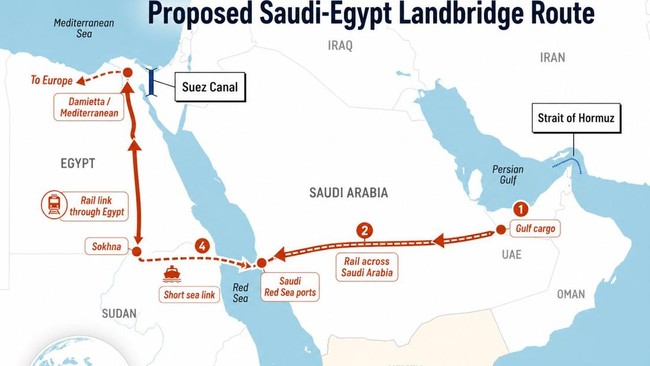
Jakarta, CNBC Indonesia – The Red Sea blockade, a consequence of tensions between Saudi Arabia and Yemen’s Houthis, has already claimed victims. Asian oil refining companies have begun seeking alternative routes to transport crude oil from Saudi Red Sea ports through the Suez Canal, or even around the African continent.
This extreme step was taken as a precaution after the Houthi group in Yemen, allied with Iran, announced a maritime blockade against Saudi Arabia. The rerouting has become the latest dynamic in global oil trade flows, amid the ongoing war between the United States and Iran in the Gulf.
“The situation has pushed refiners to look for alternative supply sources and to use different shipping routes,” Reuters reported, quoted on Wednesday (22/7/2026).
“Two tankers carrying Saudi crude oil bound for Asia were reported to have turned around in the Red Sea on Tuesday after threats from the Houthis emerged. At the same time, the number of ships passing through the Strait of Hormuz also declined again at the start of this week,” the outlet added.
In fact, analysts and industry observers have warned that westbound shipments to Egypt from Saudi Arabia’s Yanbu port on the Red Sea must now pass through the Suez Canal and then round the Cape of Good Hope in Africa. This could add up to four weeks of additional travel time.
This detour is certain to multiply freight costs as well as ship fuel consumption. Under normal circumstances, ships from Yanbu head directly east towards the Arabian Sea.
One such vessel is the Liberia-flagged Rodos, which loaded crude oil at Yanbu for delivery to India’s west coast. According to LSEG and Kpler data on Tuesday, the ship was observed turning westward and signalling a destination towards the Suez Canal.
Meanwhile, it was also reported that the South Korean refining company Hyundai Oilbank is now searching for a very large crude carrier (VLCC) to load oil at Yanbu. Hyundai is considering the use of the Suez Canal as well as the SUMED pipeline (Suez-Mediterranean Pipeline), which connects the Red Sea with the Mediterranean Sea in Egypt, to bring the oil to the Land of the Morning Calm.
In fact, a fully laden VLCC cannot pass through the Suez Canal due to the waterway’s depth limitations. For this reason, ship operators usually transfer part of the oil cargo to the SUMED pipeline on the Egyptian Red Sea side before entering the canal. After the ship passes through the Suez Canal with a lighter load, the oil is reloaded on the Mediterranean side.
According to shipping sources, charterers can choose to use a combination of the SUMED pipeline and the Suez Canal depending on their needs, particularly if the Bab el-Mandeb Strait, the southern entrance to the Red Sea, is truly blockaded. The calculation of additional costs resulting from the route change will be carried out later. The Suez Canal and the SUMED pipeline have long been the main routes for oil shipments from the Red Sea to Europe.
“The change in behaviour by tankers tells us that they are taking the threat seriously,” said Matt Smith, Director of Commodity Research at Kpler.
“This Houthi disruption comes at a very crucial time for Saudi Arabia. Saudi crude oil and refined product volumes passing through the Bab el-Mandeb Strait had just reached a record high last month, exceeding 4 million barrels per day,” he added.