
OECD Identifies Five Barriers to Indonesia’s Entry into the Global Chip Supply Chain
Jakarta, CNBC Indonesia — The Organisation for Economic Co-operation and Development (OECD) has identified a number of issues Indonesia needs to address to expand its role in the global semiconductor supply chain. Regulatory certainty, easier imports, workforce readiness, infrastructure and innovation incentives will all shape the country’s attractiveness to investment in the chip industry.
The findings are set out in a special OECD report, Promoting the Development of the Semiconductor Ecosystem in Indonesia. The report was presented to Coordinating Minister for Economic Affairs Airlangga Hartarto on Wednesday, 25 November 2026.
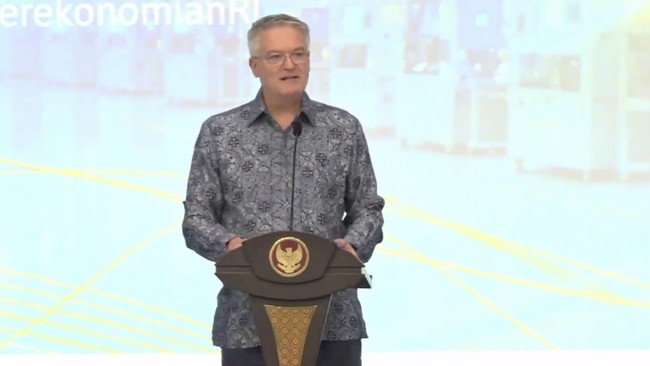
OECD Secretary-General Mathias Cormann said Indonesia had several advantages for developing a semiconductor industry, including a young workforce, renewable energy potential and a location close to Asia’s electronics and chip-industry centres.
But realising that potential will require policy reforms and infrastructure development so Indonesia can seize opportunities from rising global demand.
“Our report sets out how to sustain this momentum and move ahead faster,” Cormann said in a speech on Wednesday, 25 November 2026.
He said the first step was to organise regulations so the industry had a clear strategy and secure access to raw materials and markets. At the same time, Indonesia needs to build the foundations required by factories, including skilled workers, reliable infrastructure and facilities that support innovation.
1. Industrial strategy is not yet concrete enough
Cormann said semiconductor investment involves large capital requirements and long timeframes. Investors therefore need a clear policy direction before committing funds.
Indonesia needs an industrial strategy that goes beyond aspirational targets and sets out specific, predictable policy commitments.
“Investors need to know where policy is heading before they commit [capital],” Cormann said.
The OECD also highlighted the need to strengthen coordination within the Semiconductor Task Force, established in 2024, including by widening the involvement of ministries and agencies responsible for labour, education and transport.
Indonesia should also decide which parts of the industry to prioritise. The OECD recommends starting with assembly, testing and packaging (ATP), where a base of companies, infrastructure and training is already in place.
The sector is also relatively labour-intensive and could therefore have a greater impact on job creation.
2. Import rules could still obstruct access to raw materials
Trade and import licensing are another obstacle. The semiconductor industry depends heavily on imported raw materials and timely shipments to meet production needs.
Cormann said more than a third of the value of Indonesia’s electronics exports in 2022 came from foreign inputs, including semiconductors. That share was almost twice the proportion of imported inputs in manufacturing as a whole.
Although Indonesia’s customs procedures are considered relatively efficient, import permits remain a source of delays and costs.
Cormann referred to the expansion of import controls through the commodity balance system in late 2023, which covered more than 3,800 products. Disruptions in 2024 contributed to delays affecting around 26,000 containers at Indonesia’s main ports.
“The disruption in 2024, when the expanded system also caused delays to around 26,000 containers at Indonesia’s main ports, showed the scale of the costs for internationally integrated companies,” Cormann said.
The OECD recommends simplifying and stabilising the commodity balance system, considering a more market-based approach, and regularly reviewing local-content requirements.
3. Need for skilled workers
Indonesia also needs to ensure that workers have the skills required by the semiconductor industry.
Cormann said Indonesia’s electronics workforce was relatively young. In Batam, around 250,000 people work in manufacturing, with more than 40% of the working-age population employed in the sector. More than 210,000 workers have a combination of manufacturing experience and formal education.
The OECD sees this group as a potential source of workers for the semiconductor industry, particularly the technicians needed at assembly and packaging facilities.
“Their skills can generally be developed in less than a year, making the upskilling of workers from existing Indonesian industries a realistic and rapid way to increase capacity,” Cormann said.
He cited cooperation between Batam State Polytechnic and Infineon, which has trained 60 technicians for the company’s operations in Batam. A partnership with Arm Holdings is expected to support training for 15,000 chip-design engineers.
However, the OECD said stronger foundational education, especially in mathematics and science, remained essential to developing semiconductor talent over the longer term.
4. Electricity and water infrastructure are inadequate
Infrastructure is also an obstacle, particularly in industrial centres such as Batam.
Cormann said Indonesia had made progress on ports and major transport corridors. Nationally, companies’ access to electricity and the reliability of supply were also considered relatively good.
Batam, however, continues to face recurring electricity shortages due to rising industrial demand, ageing infrastructure and generation disruptions.
Semiconductor manufacturers increasingly need reliable renewable energy. The OECD is calling for greater investment in electricity transmission, including the Batam-Bintan-Sumatra interconnection, to improve supply reliability and open access to Sumatra’s renewable energy potential.
Water supply is another concern. Batam has no major rivers, limited groundwater and relies on six rain-fed reservoirs.
Cormann warned that the development of more advanced industrial technologies would increase pressure on water availability.
“A single modern chip fabrication plant could use up to 16% of the island’s current water supply, competing with residents’ needs and the growing data-centre sector,” he said.
The OECD said investment in water storage and treatment, as well as demand management, would be important to secure supplies for both industry and the public.
5. Innovation incentives are not being used effectively
The final obstacle identified by the OECD is innovation. Indonesia has considerable scope to improve manufacturing firms’ ability to introduce new technologies and processes.
Cormann said fewer than 3% of Indonesian manufacturing firms surveyed in 2023 had introduced process innovations in the previous three years.
Indonesia already offers tax deductions of up to 300% for eligible research and development (R&D) costs. But in 2024, the incentive generated estimated tax savings of only around Rp3 billion nationwide.
That figure was far below the approximately Rp6.3 trillion in tax savings provided through tax holidays for priority industries.
“Making this support easier to access and raising awareness among eligible companies would help them invest in innovation,” Cormann said.
The OECD recommends directing incentives more towards technology and productive investment, while reducing reliance on tax holidays.
Cormann stressed that addressing these barriers would benefit not only the semiconductor industry, but also medium- and high-technology manufacturing more broadly.
Deeper integration into global value chains, fewer trade and investment barriers, and lower logistics costs could support Indonesia’s ambition to become a high-income country by 2045.
Source: jawawa.id (https://jawawa.id/newsitem/oecd-identifies-five-barriers-to-indonesias-entry-into-the-global-chip-supply-chain-1795593098)
Originally published by CNBC Indonesia (https://www.cnbcindonesia.com/tech/20261125134755-37-788344/oecd-bongkar-5-hambatan-ri-masuk-rantai-pasok-chip-dunia), translated from Indonesian