
October 2026 Was Brutal for the IDX Composite
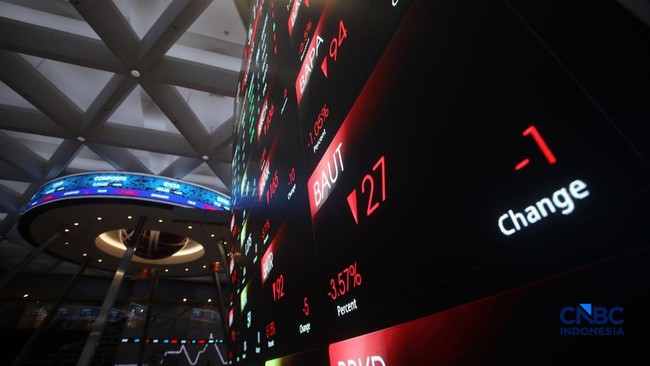
Jakarta, CNBC Indonesia — The Indonesia Stock Exchange Composite Index (IDX Composite) came under heavy pressure throughout October 2026, posting its worst performance of the year.
According to Stockbit data cited on Monday (2 November 2026), the IDX Composite plunged 16.70% in the year’s tenth month compared with September. This was its sharpest decline of 2026.
The index fell 3.67% in January 2026, then dropped 1.13% in February and slumped 14.42% in March. The weakness continued over the next three months, with declines of 1.30% in April, 11.92% in May and 7.90% in June.
The IDX Composite rebounded in July 2026, gaining 10.51%, and rose a further 4.64% in August. It returned to negative territory in September, contracting by 6.96%, before recording its steepest fall of the year last month, at 16.70%.
October’s performance was also the index’s worst for that month in the past decade. Even during the Covid-19 pandemic in 2020, the IDX Composite recorded its strongest October gain of the decade, rising 5.30%.
Over the past decade, the index posted October losses in 2018, when it fell 2.42%; in 2023, when it dropped 2.70%; and this year, when it plunged 16.70%. It rose in October in all the other years.
The IDX Composite’s severe October pressure was influenced by Morgan Stanley Capital International (MSCI), which on 16 October 2026 opened a public consultation on a plan to reclassify Indonesia’s capital market from emerging-market to standalone-market status.
The proposal remains under consultation with market participants, and a final decision will be announced no later than 30 June 2027.
“MSCI will announce its final decision at the end of June 2027 and may provide an interim update on market participants’ responses during the consultation period,” the announcement said, as quoted on Friday (16 October 2026).
MSCI said it was consulting on a proposal to reclassify the MSCI Indonesia Index. It may also issue an interim update on feedback from market participants during the consultation.
MSCI said Indonesia’s status as an emerging market no longer reflected current conditions in the domestic stock market. Its assessment was based on market participants’ concerns about the investability of Indonesian shares, including transparency around share ownership structures and suspected coordinated trading practices.
A standalone market is an MSCI classification that places a country outside the main groupings of developed, emerging and frontier markets.
Its defining feature is that it stands alone. Shares from countries with this status are no longer included in major global indices such as the MSCI Emerging Markets Index or the MSCI Frontier Markets Index.
MSCI may still calculate a separate index for the country, but it would no longer form part of the standard benchmark portfolios used by most global investment managers.
The status is assigned to countries considered to have serious structural problems, insufficient ownership transparency, suspected coordinated trading or a significant decline in accessibility for foreign investors.
Countries that have been or are currently classified as standalone markets include Argentina, Jamaica, Nigeria and Lebanon.
Capital market reform
In response to the announcement, the Indonesia Stock Exchange (IDX), the Financial Services Authority (OJK) and self-regulatory organisations (SROs) are continuing to strengthen transparency and the quality of Indonesian capital-market data to maintain investor confidence and support long-term market growth.
Improving market transparency and integrity is an important part of Indonesia’s capital-market reform agenda. Measures already taken include publishing data on shareholdings above 1%, providing more detailed ownership information and strengthening trade surveillance.
The IDX and the Indonesian Central Securities Depository (KSEI) have also refined the methodology for High Shareholding Concentration (HSC). They have expanded the range of shares reviewed to include those with a Price Impact Ratio and a market capitalisation above Rp5 trillion, as an additional indicator for monitoring ownership concentration and share-trading activity.
IDX Director Iding Pardi said that greater transparency and better-quality data were essential to strengthening the credibility of Indonesia’s capital market.
“We are continuing to make improvements to increase transparency, strengthen data quality and ensure investors have better access to information. These efforts are also part of our commitment to addressing MSCI’s concerns about Indonesia’s capital market,” Iding said, as quoted on Tuesday (20 October 2026).
To improve liquidity, measures have also included removing minimum share prices and gradually raising the minimum free-float requirement for listed companies to 15%. As at 30 September 2026, listed companies’ average free float stood at 22.99%, with 560 of 918 companies (61%) meeting the requirement.
Iding said the IDX was supporting the transition through outreach, transition-period reminders, one-to-one engagement and a hot-desk service for listed companies. The IDX has also established a Free Float Monitoring Task Force with KSEI and representatives of market associations.
“We are also facilitating meetings between listed companies and prospective investors through roadshows, business meetings and live public exposés, to broaden companies’ exposure while supporting compliance with the requirements in a measured way,” he added.
Market surveillance and law enforcement are also important to maintaining the integrity of the capital market. In the latest development, the OJK announced fines totalling Rp2.1 trillion against related parties.
The fines comprise Rp1.5 trillion in connection with market manipulation involving one listed company, and Rp600 billion for violations of the initial public offering (IPO) process involving two listed companies. The action is part of efforts to strengthen compliance and maintain investor confidence.
Source: jawawa.id (https://jawawa.id/newsitem/october-2026-was-brutal-for-the-idx-composite-1793591430)
Originally published by CNBC Indonesia (https://www.cnbcindonesia.com/market/20261102092501-17-781413/bulan-oktober-2026-brutal-untuk-ihsg), translated from Indonesian