
Observing the Lush Rice Crops Grown in Used Plastic Gallons in Wirobrajan, Yogyakarta
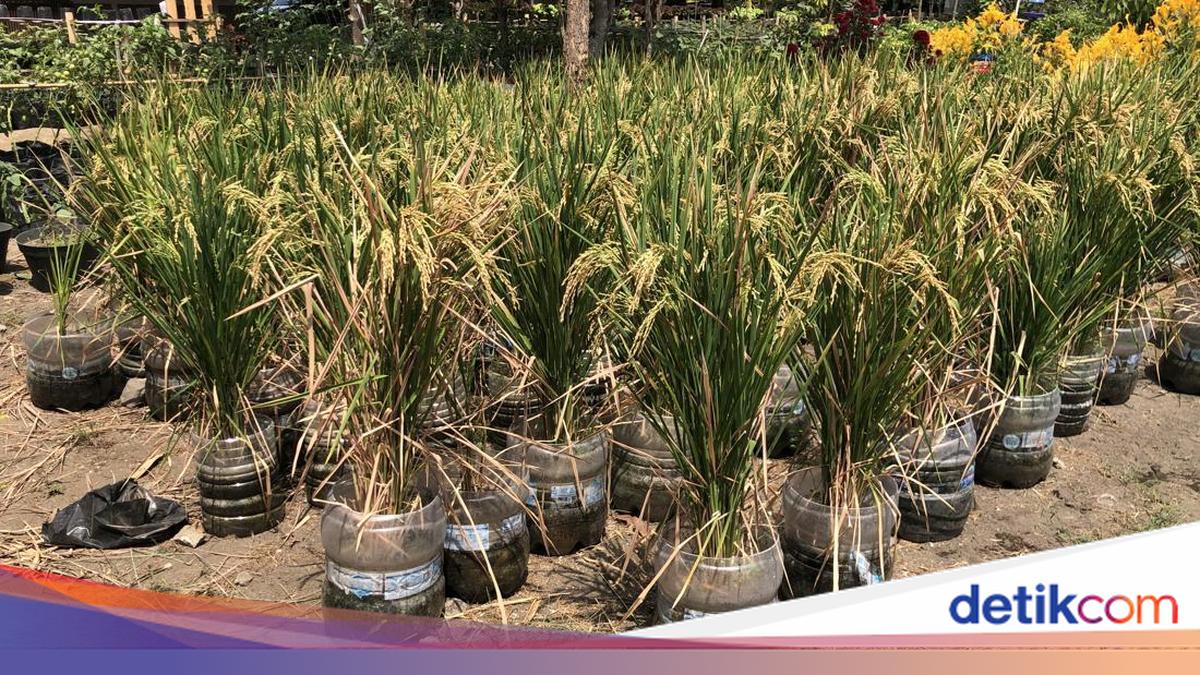
Amidst the crowded residential areas of Yogyakarta, a unique sight can be found in Wirobrajan. Rice plants are growing lushly, but not in traditional paddy fields; instead, they are arranged neatly in rows of used plastic gallons, topped with ripening grains of rice.
This ‘gallon paddy field’ belongs to the Swa Katon Asri Farmers Group in the Wirobrajan neighbourhood, which has been developing urban farming for the past two to three years. The head of Wirobrajan village, Budi Sutrisno, stated that the group initially focused only on growing vegetables.
However, a new challenge and opportunity arose through assistance from the Universitas Muhammadiyah Yogyakarta (UMY) a few months ago.
“The inspiration for planting rice actually came from UMY, to be fair. It was from Mr Agus, an agricultural lecturer. The initial suggestion from UMY was, ‘Let’s do something different, perhaps plant rice using gallons,’” said Boded at the Swa Katon Asri farming site on Friday (4/9/2026).
“UMY provided not only seeds but also funding, approximately Rp 6 million, as the requirements included irrigation hoses and pipes. This was part of UMY’s community service programme for the region,” he added.
The Swa Katon Asri Farmers Group began planting rice in used gallon media three months ago. In practice, the group is being assisted by the Yogyakarta City Agriculture and Food Office (DPP).
Sugio, a field instructor from the Yogyakarta City DPP, explained that this gallon paddy field is the first rice planting project undertaken by the Swa Katon Asri Farmers Group. His role is to provide planting techniques to the farmers.
“This is the first planting; it is currently 90 days old, so about three months. We are using the ‘tabela’ method, which is direct seeding. The media we prepare consists of soil and organic fertiliser. The seed is just a single grain, soaked for two nights before being placed in the media,” he explained.
The rice variety used is Hybrid 32, which has a harvest period of 110 days. Sugio also explained the maintenance process for rice in gallon media.
“Maintenance is very easy. Once planted, the important thing is to keep the water level shallow—just enough to keep it moist. It does not need to be deep or full of water,” Sugio explained.
“From planting until 30 to 40 days of age, the water should be kept at a low level. Since we only plant one seed per gallon, it will develop into multiple tillers. After about 40 days, we then introduce standing water,” he added.
Sugio noted that a single seed develops into dozens of stalks after 40 days. Once mature, one gallon can contain between 30 to 60 stalks. He further noted that the entire process avoids the use of chemical fertilisers or pesticides.
“We use organic fertiliser combined with catfish water—we raise the fish ourselves. We take the murky water from the catfish tanks and use it for irrigation. This way, nothing goes to waste,” he said.
“Using gallons is very practical; water and fertiliser levels can be precisely controlled. Unlike in traditional fields where fertiliser might wash away during rain or irrigation, here, the nutrients are maximised and fully absorbed by the rice,” he continued.
After 90 days of growth, Sugio admitted he has yet to find any weaknesses in the method. He noted that the resulting grains are plump, a fact validated by a visitor who compared it to his own traditional paddy field.
“I honestly haven’t seen any drawbacks yet. Even one of the visitors said, ‘Why doesn’t my field look like this?’ It turns out the rice in the gallons is not inferior to that grown in fields,” Sugio revealed.
“The gentleman even proved it, saying that although he plants the same variety on one hectare of his land, this method produces better results,” he added.
There are currently hundreds of gallons containing rice nearing harvest at the Swa Katon Asri site. However, Sugio admitted he cannot yet predict the total rice yield from this inaugural harvest.
“The harvest period is 110 days. We don’t know the exact amount of rice yet. It should be ready in about 10 days,” Sugio explained.
The Swa Katon Asri Farmers Group and Sugio are now attempting a second planting. This time, they are using the ‘mina padi’ method.
Mina padi is an integrated farming technique that combines rice cultivation with aquaculture (fish farming) in a single area.
“For this second attempt, we are trying mina padi. The system involves sowing seeds and nurturing them for 12 to 18 days before transplanting them individually,” Sugio said.
“The difference is we are using gallons with catfish at the bottom. The hope is that both the rice and the catfish will grow well. Since rice often faces pests like grasshoppers, the fish can help manage them,” he concluded.
Source: jawawa.id (https://jawawa.id/newsitem/observing-the-lush-rice-crops-grown-in-used-plastic-gallons-in-wirobrajan-yogyakarta-1788537313)
Originally published by detikJogja (https://www.detik.com/jogja/berita/d-8649151/melihat-suburnya-padi-yang-ditanam-pakai-galon-bekas-di-wirobrajan-jogja), translated from Indonesian