
Observing the Ka'bah Kiswah Replacement Tradition to Welcome 1 Muharram
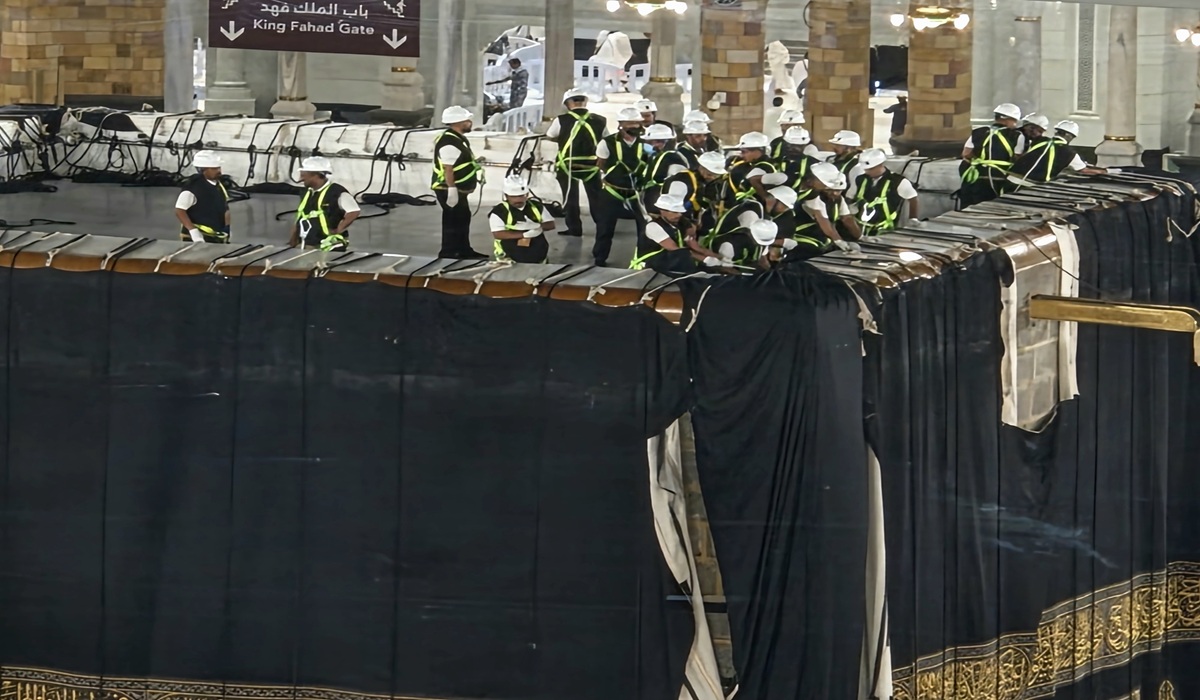
The Islamic community welcomed the Hijri New Year 1 Muharram 1448 H. In the Holy City of Mecca, Saudi Arabia, this new year’s momentum was marked symbolically through the procession of replacing the kiswah, or the covering cloth of the Ka’bah, at the Grand Mosque. The sacred procession took place on Monday (15/6), beginning at 4 p.m. Saudi Arabian time and lasting until midnight.
The kiswah is a magnificent cloth covering the Ka’bah, woven from fine black silk. Its beauty is accentuated by embroidered calligraphy of holy Quranic verses. The ornamental composition utilises pure gold and silver threads, meticulously crafted by expert artisans at a special kiswah manufacturing complex in Mecca.
Erti Herlina, Head of the Worship Guidance Section for the Mecca Working Area of the Indonesian Hajj Organising Committee (PPIH) in Saudi Arabia, stated that the replacement of the kiswah is not merely an annual ritual, but a symbol of spiritual renewal and a marker of a new spirit for Muslims.
“The moment of replacing the kiswah at the Grand Mosque on 1 Muharram is a symbol that the Islamic New Year is chosen as a marker of the birth of a new spirit and self-purification,” Erti said in Mecca, Saudi Arabia, on Monday (15/6).
Beyond its profound spiritual meaning, Erti added that this replacement is essential to maintain the sanctity, cleanliness, and aesthetics of the Ka’bah’s covering. This is especially important as the sacred cloth is touched by millions of Hajj and Umrah pilgrims performing tawaf throughout the year.
On the same occasion, Erti also discussed the historical shift in the timing of this procession. Several years ago, the tradition of replacing the Ka’bah’s covering was routinely held every 9th of Zulhijah, coinciding with the day pilgrims perform wukuf at Arafah.
“I experienced in 2018 that the kiswah replacement was on 9 Zulhijah, or the night of Arafah. King Salman decided to change it from 9 Zulhijah to 1 Muharram in 2022, or the year 1444 Hijriah,” Erti explained.
Erti reflected that this visual transformation of the Ka’bah truly serves as a mirror for humanity. Just as the kiswah is replaced with a new, clean cloth, humans are urged to leave behind past mistakes to embrace a better future.
“When those things are still stored, the bad things from the past, we will discard them and we will improve for the future with new determination, with new spirit, with new purity,” she said.