
Observers Urge Prosecutorial Reform to Strengthen Oversight and Integrity
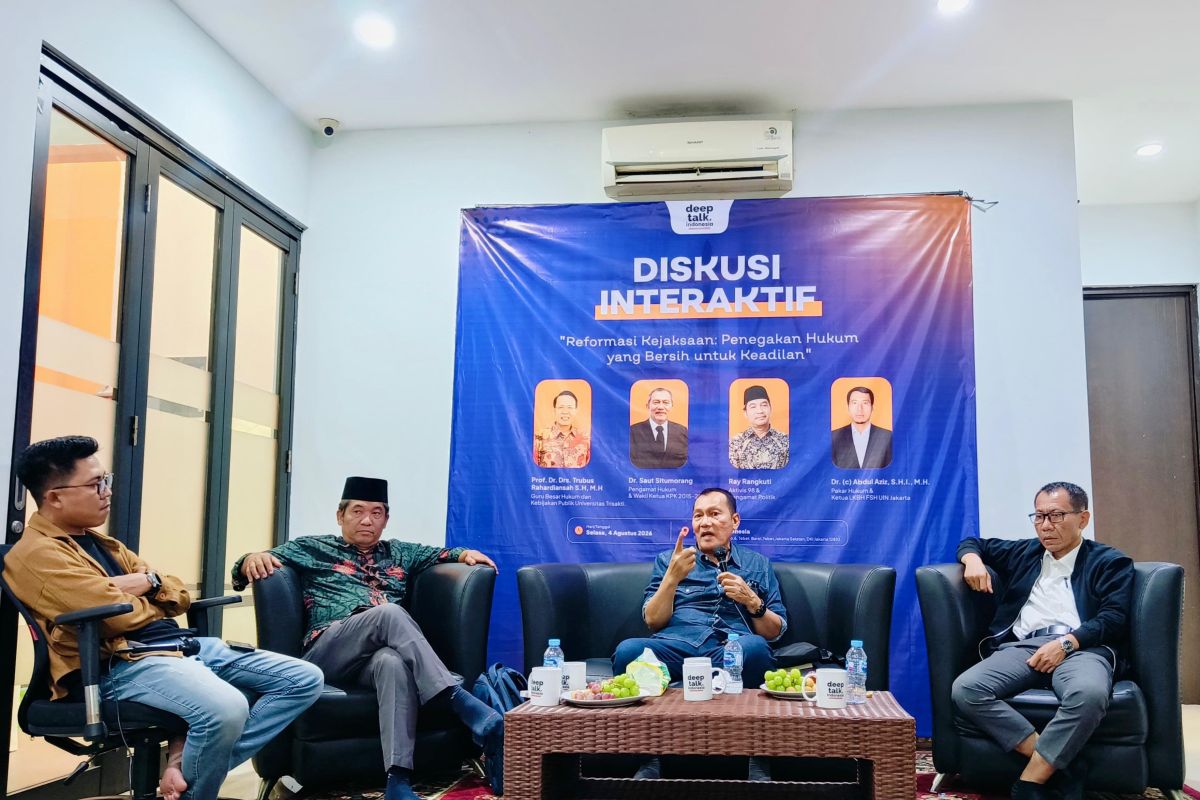
Jakarta (ANTARA) - A number of legal and political observers are urging reform of the Attorney General’s Office to strengthen oversight, enhance the integrity of its officers, and ensure professional case handling, including a thorough investigation into the case of former Junior Attorney General for Special Crimes (Jampidsus) Febrie Adriansyah.
The call was made during a discussion titled “Prosecutorial Reform: Clean Law Enforcement for the Courts,” organised by Deep Talk Indonesia in South Jakarta on Tuesday. The event brought together legal experts, a former Corruption Eradication Commission (KPK) leader, and political observers to discuss strengthening governance and supervision within the prosecution service.
Legal expert Abdul Aziz, who chairs the Consultation and Legal Aid Institute at the Faculty of Sharia and Law at UIN Jakarta, stated that the prosecutor’s vast authority as dominus litis, or controller of the case, must be balanced with an effective oversight mechanism. “When an institution holds such broad authority, from investigation to prosecution, a supervisory mechanism is needed to ensure every action remains within the legal corridor,” he said. He noted that extensive power could potentially lead to abuse without a strong supervisory system. Although the Attorney General’s Office already has internal oversight and there is an external Prosecutorial Commission, the effectiveness of this supervision still needs to be strengthened. “Reform should be directed at improving the quality and effectiveness of oversight, not just creating new institutions,” he added.
Former KPK Deputy Chairman for the 2015-2019 period, Saut Situmorang, assessed that the case involving Febrie Adriansyah should serve as a momentum to improve the management of evidence across all law enforcement agencies. He proposed a regulation that standardises evidence management procedures for the police, the Attorney General’s Office, and the KPK, ensuring a uniform reference for seizure and management mechanisms. Furthermore, Situmorang emphasised the need to strengthen the intelligence and internal oversight functions as an early warning system. “The intelligence function should not only work after a case emerges. It must be able to provide early warnings, map risks, and help resolve issues before they escalate into bigger problems,” he said. He added that the success of eradicating corruption is determined not only by institutional structures or legal authority but also by the integrity of the officers exercising that authority.
Meanwhile, political observer and 1998 activist Ray Rangkuti assessed that reforming the Attorney General’s Office and the National Police is a crucial step to strengthen the national law enforcement system. He argued that the existence of anti-corruption bodies like the KPK remains necessary as long as public trust in law enforcement officers has not been fully restored. Rangkuti noted that the effectiveness of oversight is not determined by the number of supervisory institutions, but by the independence, courage, and integrity of those performing the function. He also reminded that ethics bodies and supervisory institutions must maintain a distance from political interests and the institutions they oversee.
The panellists also urged that the investigation into the case involving former Jampidsus Febrie Adriansyah be conducted comprehensively, including tracing other potentially related parties, as part of efforts to strengthen accountability and public trust in law enforcement.