
Observer: Transfer of Coal Corruption Case Prevents Institutional Clash
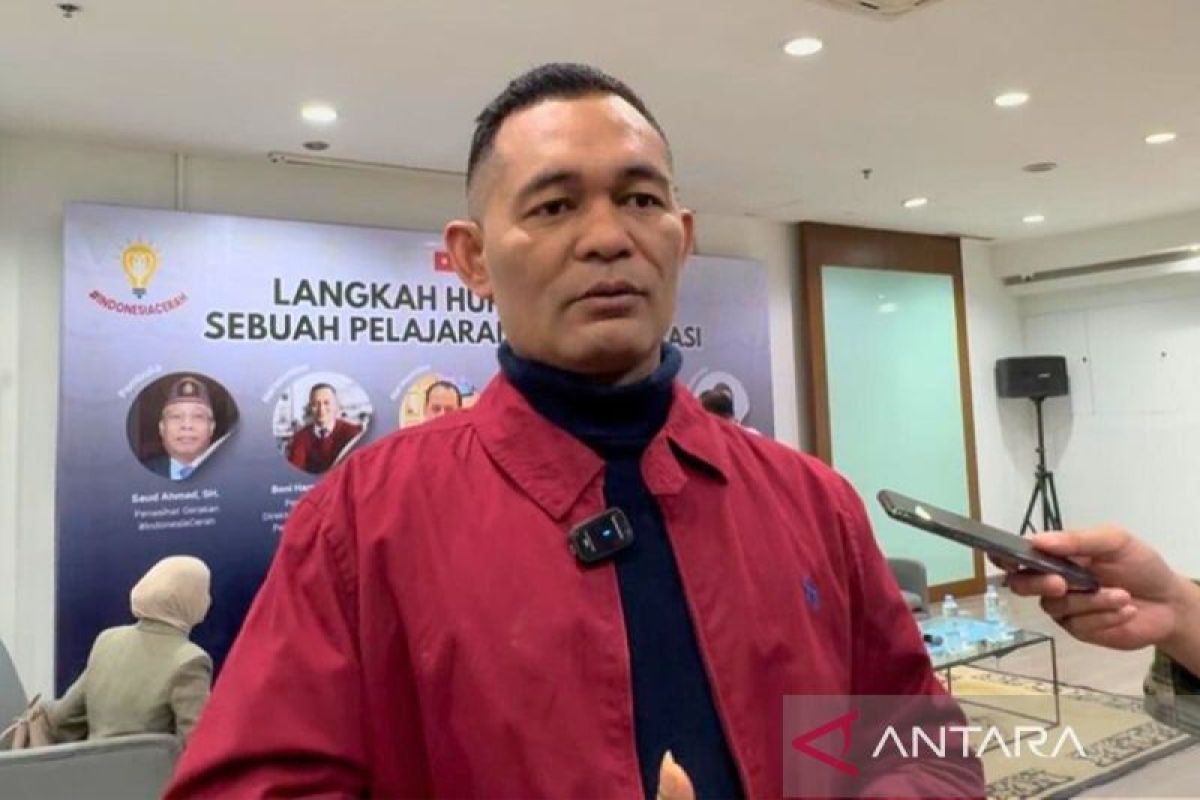
Jakarta (ANTARA) - Political and legal observer Boni Hargens believes the handover of the alleged coal corruption case from the National Police (Polri) to the Attorney General’s Office is a tactical step to prevent a clash between law enforcement institutions.
In his remarks in Jakarta on Friday, Boni said the move was a rational mechanism to avoid friction between law enforcement agencies that could disrupt the legal enforcement process.
“In this context, the interest of maintaining institutional harmony between Polri and the Attorney General’s Office is more urgent than rigid procedural compliance,” he said.
According to Boni, the difference between a delegation of case files and a handover of files for the continuation of an investigation is not merely a matter of terminology, but concerns jurisdiction, legal responsibility, and the validity of the prosecution process.
He said this difference in perspective reflects the tension between formal legality and practical effectiveness within Indonesia’s legal system.
Firstly, Article 14 of Law Number 2 of 2002 on the National Police of the Republic of Indonesia grants Polri discretionary authority to determine investigative priorities and strategies, including cross-institutional coordination for the effective handling of cases.
Secondly, Articles 38 to 40 of Law Number 16 of 2004 on the Prosecution Service of the Republic of Indonesia govern the prosecutor’s coordinating authority in the inquiry and investigation of certain criminal offences.
“Therefore, the handover of files can be construed as coordination between law enforcers within a legally valid criminal justice system,” he said.
According to him, in Indonesia’s criminal justice system, prosecutors act as the “dominus litis” or controller of cases, so the handover of files to the Prosecutor’s Office can be interpreted as involving prosecutors in the investigative process, thereby strengthening the legality of any prosecution.
Thus, Polri’s step can be viewed as a form of coordination within an integrated criminal justice system.
According to Boni, the strongest argument for Polri is to frame the handover as institutional coordination between law enforcement agencies, not as a technical delegation as regulated under the Criminal Procedure Code (KUHAP).
Under that construction, the handover of investigative administration does not have to follow the P-21 mechanism set out in the KUHAP.
Earlier, a joint team of investigators from the Police Corruption Eradication Corps (Kortastipidkor) and the Greater Jakarta Metropolitan Police arrived at the building of the Attorney General’s Office for Special Crimes (Jampidsus) in Jakarta to hand over the investigative administration of three cases of alleged corruption and money laundering.
Based on ANTARA’s observations, the joint Polri team arrived at the Jampidsus building of the Attorney General’s Office at around 1pm Western Indonesia Time (WIB).
On Saturday (11 July), Polri announced that three cases—the alleged corruption in coal governance, the alleged corruption at PT Asabri and PT Jiwasraya covering the 2020–2025 period, and the alleged money laundering in the settlement of PT CBS’s debt to PT KNI—had been transferred to the Attorney General’s Office based on an agreement between the two institutions as a form of law enforcement synergy.
In these cases, Polri has named former Attorney General’s Deputy for Special Crimes (Jampidsus) Febrie Adriansyah and Don Ritto as suspects in alleged corruption and money laundering offences.