
OANA urged to establish joint fact-checking to combat disinformation
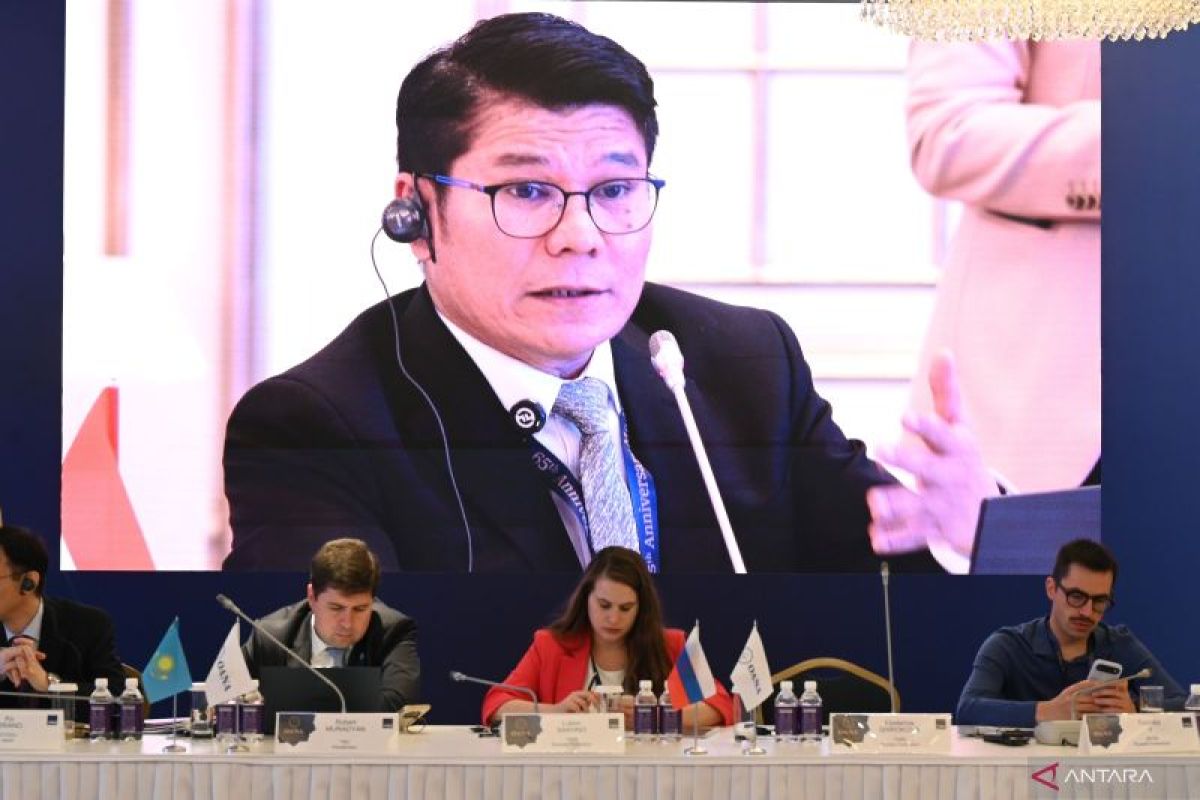
Moscow (ANTARA) - The President Director of Perum LKBN ANTARA, Benny Siga Butarbutar, has urged the Organisation of Asia-Pacific News Agencies (OANA) to establish a permanent working mechanism to strengthen cross-border news verification in the face of spreading disinformation, which is being exacerbated by artificial intelligence (AI).
“Disinformation is no longer merely a media issue, but an accelerator of various global risks. If disinformation moves without borders, then truth must move faster, together,” said Benny, speaking during the opening session of ‘Approaches to Discountering the Spread of Disinformation and Fake News’ at the 65th OANA Annual Meeting in Moscow, Russia, on Monday.
Benny presented a paper titled ‘Navigating the Information Landscape in the Age of AI: Countering Disinformation, Strengthening Verification, and Building Public Trust’ before representatives of OANA member news agencies.
In his presentation, he emphasised that AI technology has fundamentally altered the processes of creating, distributing, and receiving information. According to him, generative AI enables the large-scale creation of synthetic text, images, audio, and video, including deepfakes that are increasingly difficult to distinguish from authentic material.
Such conditions can accelerate the spread of false narratives, increase social polarisation, erode trust in media and institutions, and heighten risks during elections, disasters, conflicts, and health crises.
“AI must be treated as both a risk and a verification tool. Technology can help newsrooms accelerate detection, translation, fact-checking, and pattern analysis, but human editorial accountability remains non-negotiable,” Benny stated.
He cited Indonesia as an illustration of the significant challenges within the Asia-Pacific region. Indonesia has approximately 230 million internet users, 331 million active mobile connections, and around 180 million social media identities, meaning false narratives can spread rapidly among a population increasingly reliant on mobile devices and digital platforms.
Benny noted that the shift in news consumption towards social media and video platforms means that algorithmic recommendation systems increasingly determine the information seen, believed, and shared by the public. Therefore, he argued, news agencies must strengthen verification speed while ensuring that confirmed information remains easily accessible amidst the flow of algorithmic content.
“For the 41 OANA members, this challenge is a call to build collective information resilience: strengthening trustworthy journalism, accelerating cross-border verification, and building shared responsibility to protect public trust,” Benny said.
During the forum, ANTARA also proposed strengthening OANA’s role from a news exchange network into a regional information integrity network. This proposal includes the formation of a rapid verification network and a cross-border early warning system, the exchange of forensic metadata to detect deepfakes, the strengthening of cross-linguistic media literacy, shared ethical standards for AI, and cooperation for fair content licensing with AI companies.
Benny added that such cooperation must bridge the capacity differences between countries and the various funding models of news agencies, whether state-funded, public service-based, commercial, or hybrid. Cooperation should be based on verifiable evidence, transparent governance, sustainable funding, and guarantees that funding sources do not influence editorial conclusions.
The former Deputy I of the Indonesian Government Communications Agency also proposed the establishment of a permanent OANA task force for AI and disinformation, which would be adequately funded and operate functionally rather than merely through ceremonial meetings. The task force is expected to develop crisis response protocols, share evidence, strengthen newsroom capacity, and expand protections for information integrity in the region.
The first session of the OANA Annual Meeting also featured speakers from Mehr News Agency and the Islamic Republic News Agency (IRNA) of Iran, Bakhtar News Agency of Afghanistan, and representatives from the ANO ‘Dialog’ of the Russian Federation.
OANA is a media organisation comprising 41 news agencies from 35 countries in the Asia-Pacific region. The meeting in Moscow is also part of the celebrations for the 65th anniversary of OANA’s founding. The Asia-Pacific region accounts for approximately two-thirds of the information circulating worldwide, giving OANA significant potential to influence the global information ecosystem.