
Nvidia's Plight: Begging China to Adopt New Vera Chips After Market Share Collapses
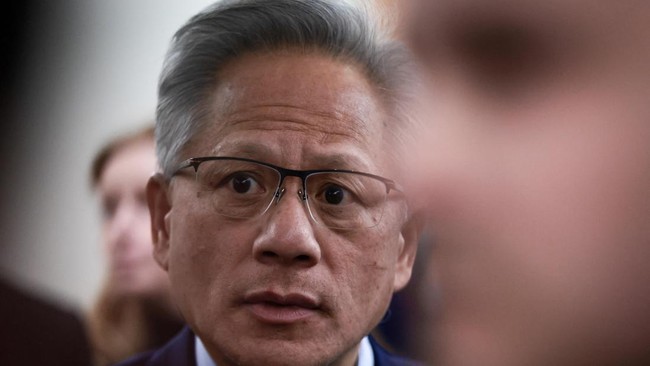
Jakarta, CNBC Indonesia - US semiconductor giant Nvidia is currently in a tight spot, becoming one of the most impacted victims of the geopolitical cold war between Washington and Beijing. Nvidia’s market share in China has reportedly collapsed to an effective zero percent, despite the country previously being one of the largest revenue sources for the company led by Jensen Huang.
Although the Donald Trump administration recently softened its stance by giving the green light for exports of the advanced H200 chip to China, Beijing appears to be playing hard to get. To date, the Chinese government has not granted formal approval for the chip to enter its domestic market. As a result, sales of the H200 chip in China have been completely stalled for months.
This critical situation has forced Nvidia to rethink its strategy. According to Reuters, in an effort to revive its slumping business, Nvidia is now reportedly ‘begging’ and courting its major clients in China to switch to its new product, the Vera chip. The Vera processor is Nvidia’s first standalone CPU designed specifically for agentic AI technology, or autonomous artificial intelligence systems. This data centre chip is claimed to deliver 1.8 times the performance of its competitors.
Nvidia has reportedly informed its clients in China that the Vera chip will be available as early as August 2026, with orders already being accepted now. This aggressive move is seen as necessary given the increasingly fierce competition, with perennial rivals like Intel and AMD also racing to secure a slice of the AI data centre market.
Some positive signals have emerged. Several Chinese tech giants are reportedly showing interest in the new chip. One major Chinese cloud company is even planning to test it by ordering more than 300 servers, each equipped with two Vera CPUs. CEO Jensen Huang had previously boasted during the chip’s launch in March that it would become a new billion-dollar revenue engine for the company. He claimed that Chinese tech behemoths like Alibaba and ByteDance are fully committed to adopting Vera technology.
However, whether this interest will translate into large-scale purchases remains a major question. Nvidia must overcome thick walls, ranging from software compatibility issues to the reluctance of Chinese firms to migrate away from the domestic AI chips they are currently developing aggressively. Moreover, the chip does not come cheap. According to data from SemiAnalysis, a single Vera processor is priced above US$20,000, or approximately Rp 356 million (assuming an exchange rate of Rp 17,838 per US dollar). A full rack containing 256 chips could cost up to US$10 million, equivalent to Rp 178 billion.
Nvidia is targeting a massive revenue haul of up to US$20 billion (Rp 356 trillion) from Vera chip sales by the end of this fiscal year in January. However, with China’s attitude remaining frosty, Jensen Huang and his colleagues will have to fight tooth and nail to achieve that target. As of the time of reporting, Nvidia declined to provide official comment. Similarly, Alibaba and ByteDance remained tight-lipped and did not respond to requests for confirmation.