
Nutritional Service Units in Underdeveloped Areas at Only 10.78%, BNPP Accelerates Free Nutritious Meal Programme
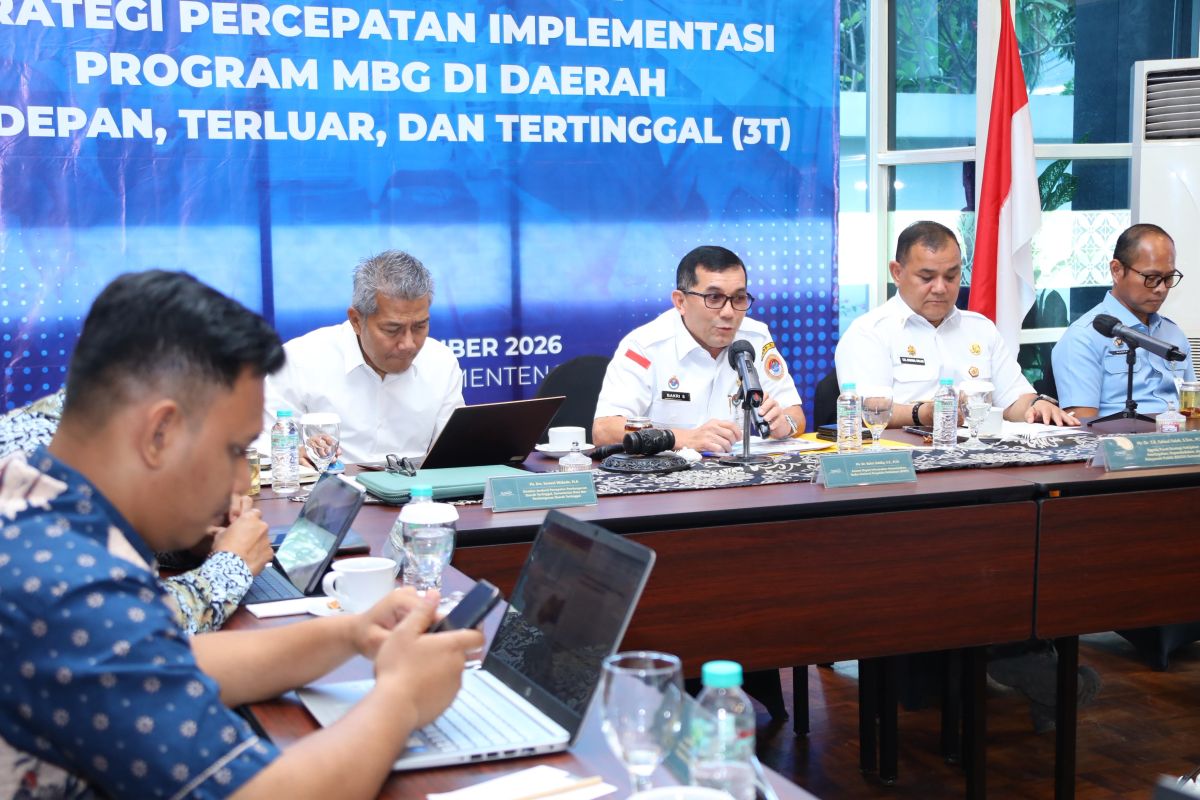
The National Border Management Agency (BNPP) of the Republic of Indonesia, together with the Agency for Domestic Policy Strategy (BSKDN), has discussed strategies to accelerate the implementation of the Free Nutritional Meal (MBG) Programme in underdeveloped, frontier, and outermost (3T) regions.
According to a BNPP press release issued in Jakarta on Friday, the discussions held on Wednesday (23/9) highlighted the readiness of Nutritional Service Units (SPPG), infrastructure conditions, and the geographical challenges affecting programme execution in border areas.
Bakri Siddiq, Assistant Deputy for Government Infrastructure at BNPP, stated that the agency plays a vital role in identifying the implementation conditions of the MBG programme in border areas, particularly across the 15 operational Integrated Border Posts (PLBN).
“We from BNPP have been given the opportunity to present acceleration and implementation strategies for the Free Nutritious Meal programme, specifically in 3T areas,” said Bakri.
He noted the need to map PLBNs that possess the necessary facilities and infrastructure to support the MBG programme, as only about 50% of the 15 operational PLBNs have received intervention from the National Nutrition Agency (BGN).
According to him, the availability of basic infrastructure, such as clean water, is a determining factor in the operational readiness of SPPGs and the scope of service to beneficiaries.
Consequently, inter-ministerial and inter-agency coordination is required so that operational obstacles can be promptly identified and addressed according to regional characteristics.
In addition to infrastructure, Bakri highlighted that the operations of several SPPGs in 3T areas are not yet optimal. This situation requires attention because the geographical and social characteristics of border regions differ from other areas.
“We must ensure there is no disparity between SPPGs in Java and Sumatra compared to Papua. Due to geographical challenges, community culture, and investor interest, the conditions there are not yet ideal,” he said.
He added that the limited number of SPPGs is also related to regional conditions, which necessitate that services be provided through the nearest available unit.
In reality, the provisions for beneficiaries have been designed to ensure service coverage remains within an ideal capacity of approximately 2,500 to a maximum of 3,000 recipients per unit.
Meanwhile, the Head of BSKDN, Yusharto Huntoyungo, stated that the MBG is one of the government’s strategic interventions to ensure access to nutritious food for the population. The programme is a national priority that must reach target groups more broadly and equitably.
Based on preliminary data compiled by the Ministry of Villages and Underdeveloped Regions, the adequacy level of SPPGs in underdeveloped areas has only reached 10.78% of the required ideal number.
“The implementation of the MBG programme in 3T areas will require a very different approach compared to non-3T areas,” said Yushante.
He explained that 3T regions face numerous challenges, ranging from supply chain vulnerabilities and limited basic infrastructure, such as clean water and electricity, to a shortage of trained nutrition personnel.
From a regulatory perspective, the government has prepared several foundations to support the MBG programme in 3T areas, including the National Nutrition Agency Head’s Decision Number 58.1 of 202<0xC2>5 regarding Technical Guidelines for the Management of the Free Nutritious Meal Programme in Frontier, Outermost, and Underdeveloped Areas.
Furthermore, there is the Ministry of Home Affairs Circular Letter Number 400.5.7/4072/SJ regarding the Formation of Task Forces for the Acceleration of the Free Nutritious Meal Programme Implementation in Regions.
BNPP also holds the BNPP Head’s Decision Number 35.04-705 of 2025 concerning the Management of National Border Areas and Border Regions for 2025–2029.
The results of this forum, along with input from stakeholders and experts, will serve as material to formulate alternative strategies and policy recommendations that can be applied according to regional characteristics. With an approach tailored to local conditions, the implementation of the MBG in border areas is expected to reach the community and beneficiaries more equitably.