
Nusantara Capital City Development and the Polycentric Approach
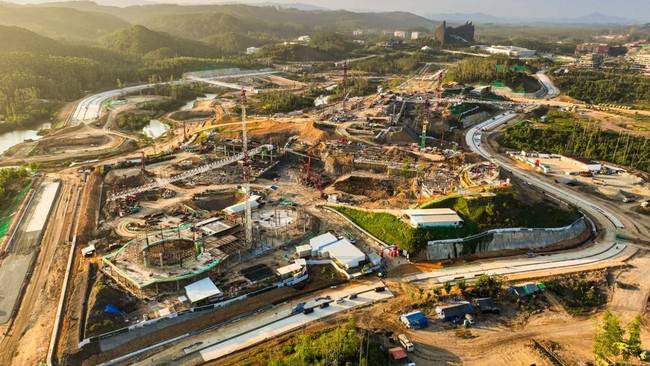
The development of Ibu Kota Nusantara (IKN) in East Kalimantan Province was projected from the outset as an instrument for equitable national development and a solution to the high concentration of density on Java Island. However, to date, IKN’s effectiveness as a new growth centre still faces various obstacles. Although infrastructure development is ongoing and investment is starting to flow, the impact on national economic equality remains relatively limited. Amid the not-yet-optimal relocation of government functions and socio-economic activities, development that focuses solely on one growth centre is prone to creating new inter-regional inequalities if not balanced by strengthening other regions. The IKN development concept emerged as a response to the high concentration of socio-economic activity on Java Island. According to data from the Central Statistics Agency (BPS), up to 2025 Java Island still contributes 56.93 percent of the Gross Domestic Product (GDP). This condition shows that the national economic structure is still highly centralised, and regional equity is one of the government’s new challenges, including IKN. In the view of regional economics, centripetal development tends to attract capital, investment, skilled labour, and public facilities to one particular area. If the resulting multiplier effect cannot reach other supporting regions, the new growth centre area will instead create a new socio-economic concentration. Various regional economic studies show that an overly centripetal development concept has the potential to cause a backwash effect, a condition where capital, labour, and economic activity are continuously drawn towards the growth centre, while other regions lose the resources needed to develop, resulting in areas outside the development centre experiencing an investment slowdown that causes a decline in regional economic competitiveness. Another risk is also apparent with the increasing economic dependence on one growth area. If socio-economic activity is too concentrated in one region and is faced with an economic shock or natural disaster, it will have a huge impact on the national economy due to its centralised nature. Research from the Bogor Agricultural Institute (IPB) notes that an Inter-Regional-Output (IRO) approach shows IKN development has the potential to increase economic output, household income, and labour absorption, but maximum utilisation can be achieved if balanced with equity and connectivity to the surrounding regions. To date, IKN development is still dominated by basic infrastructure and government area construction, so private social and economic activities, industry, and supporting sectors are not yet operational, meaning the expected economic effects cannot yet be felt. This shows that IKN’s success is not only measured by physical development but also by its ability to create a new centre of socio-economic activity. Another risk is also felt; with the concentration of state spending only focused on certain strategic projects, IKN development must be aligned with the acceleration of development in other regions. If not, the more advanced regions will become increasingly competitive while lagging regions will face infrastructure and investment limitations. If not resolved in the long term, this condition will widen the development gap between regions. Ideally, national development should prioritise a polycentric approach, building multiple growth centres interconnected through infrastructure and logistics networks. With this approach, IKN would not be the only concentration area, and other regions would also experience equitable development.