
NUS Business School integrates AI into business education
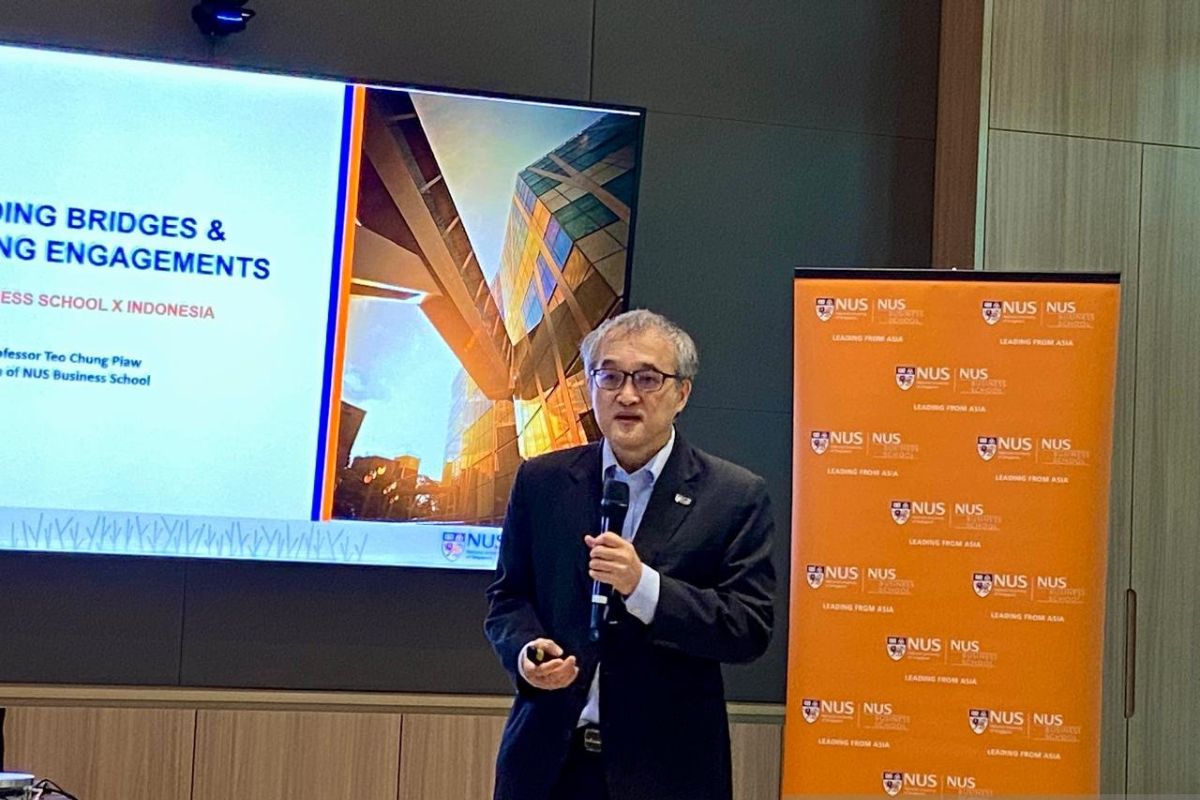
Singapore (ANTARA) — National University of Singapore (NUS) Business School Dean Prof. Teo Chung Piaw said the school is developing an AI-based, or “AI-native”, education model by integrating AI and digital literacy into teaching, research and operations.
NUS Business School aims to join the ranks of the world’s leading business schools by deepening its expertise in business in Asia and preparing human resources to build businesses that Asian countries need.
“I continue to discuss with colleagues here how to define the characteristics of an AI-native business school, including how to integrate AI and digital literacy into all our activities,” Teo said in Singapore on Thursday.
According to Teo, becoming AI-native is not simply a matter of adding AI courses to the curriculum. The concept also encompasses how people think and work with technology across different areas, including changing approaches to learning and research and embracing new methods.
He believes the value of business education can be maintained in the AI era by bringing real-world industry problems into the classroom. Business education, he said, needs to present the actual challenges companies face so students can learn from issues arising in practice.
Alongside its AI-native approach, NUS Business School is developing an “externally engaged” pillar to strengthen its involvement with industry and the public sector.
Teo said the school would step up efforts to involve students in addressing real business challenges. He is also drawing on the alumni network to bring industry problems back into the business school.
NUS Business School is also developing an “impact-driven” pillar, which prioritises research with tangible benefits for business, the economy and society.
Teo said faculty members are being encouraged to focus on impact-based research. He said the school’s academics have the capacity to push the boundaries of knowledge.
Going forward, however, they are also expected to bring research findings back to the local environment to generate tangible translational impact.
“This is how I intend to lead the school going forward. I want to align research, teaching and industry engagement so that they reinforce one another,” Teo said.
He also wants faculty to take a more outward-facing approach by understanding developments and challenges in industry, studying those challenges through research programmes, and then bringing the findings back to the classroom for students.
According to Teo, the connection between research, teaching and industry practice will create a continuous loop that reinforces each element and helps NUS Business School achieve its vision.
In relation to Indonesia, Teo said NUS Business School is committed to deepening its engagement with partners in the country, including by encouraging faculty and students to collaborate with Indonesian universities.
He also wants to expand cooperation with Indonesian businesses so faculty and students can bring their knowledge and expertise directly to the field and develop research based on real challenges facing companies.
“We want to build a network that helps corporations, executives and students operate across ASEAN, particularly in Indonesia, and work with companies to provide executive education programmes for upskilling,” Teo said.
Source: jawawa.id (https://jawawa.id/newsitem/nus-business-school-integrates-ai-into-business-education-1791467660)
Originally published by Antara (Indonesian) (https://www.antaranews.com/berita/5777454/nus-business-school-integrasikan-ai-dalam-pendidikan-bisnis), translated from Indonesian